




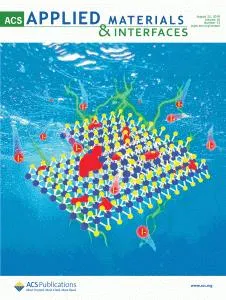
ACS Applied Materials & Interfaces
基本信息
期刊简写:
ACS Appl. Mater. Interfaces
影响因子:
8.3
ISSN:
1944-8244
研究领域:
ENGINEERING TECHNOLOGY
h-index:
169
自引率:
4.8%
年发文量:
5439
SCI收录来源:
Science Citation Index Expanded
期刊官网:
https://pubs.acs.org/journal/aamick
期刊介绍:
ACS Applied Materials & Interfaces serves the interdisciplinary community of chemists, engineers, physicists and biologists focusing on how newly-discovered materials and interfacial processes can be developed and used for specific applications. The editors are proud of the rapid growth of the journal since its inception in 2009, both in terms of the number of published articles and the impact of the research reported in those articles. ACS AMI is also truly international, with the majority of published articles now coming from outside the United States, capturing the rapid growth in applied research around the globe. Details about the journal article types and submission requirements may be found in the Author Guidelines. The following journal TOC sections provide a high-level guide to the journal scope: Biological and medical applications of materials and interfaces Energy, environmental, and catalysis applications Functional inorganic materials and devices Organic electronic devices Functional nanostructured materials (including low-d carbon) Applications of polymer, composite, and coating materials Surfaces, interfaces, and applications ACS Applied Materials & Interfaces, with its focus on applications, complements the portfolio of existing ACS publications focusing on fundamental materials science discovery, including Chemistry of Materials, Langmuir, Biomacromolecules, Macromolecules, The Journal of Physical Chemistry B and C, Journal of Physical Chemistry Letters, ACS Energy Letters, and ACS Photonics.
CiteScore
CiteScore
16
SJR
2.058
SNIP
1.283
| 学科 | 排名 | 百分位 |
|---|---|---|
Materials ScienceGeneral Materials Science |
33 / 463 | 92% |
期刊统计
Weekly
期/年
Submission to First Editorial Decision (Median Days): 6.2
Submission to First Decision with Peer Review (Median Days): 33.6
Submission to Accept (Median Days): 69.2
Accept to ASAP Publication (Median Days): 12.8
审稿周期
论文处理费
投稿信息
投稿网址:
https://acs.manuscriptcentral.com/acs收录体裁:
Articles
Reviews
Spotlights
Forum Articles
Comments
Reviews
Spotlights
Forum Articles
Comments
期刊推荐
相关文献
A RISM approach to the liquid structure and solvation properties of ionic liquids
Samantha Bruzzone, Marco Malvaldi, Cinzia Chiappe
2007-08-30
Paper
DOI: 10.1039/B708530C
Performance of spin-component-scaled Møller–Plesset theory (SCS-MP2) for potential energy curves of noncovalent interactions
Tait Takatani
2007-10-11
Paper
DOI: 10.1039/B709669K
Single-wall carbon nanotubes and peapods investigated by EPR
B. Corzilius, K.-P. Dinse, K. Hata
2007-07-24
Perspective
DOI: 10.1039/B707936M
Kinetic explosion and bistability in adsorption and reaction of acetic acid on Pd(110)
Michael Bowker, Chris Morgan, Vladimir P. Zhdanov
2007-09-13
Paper
DOI: 10.1039/B709384E
The effect of parity violation on kinetic models of enantioselective autocatalysis
Gábor Lente
2007-10-11
Paper
DOI: 10.1039/B711546F
Temperature dependence of the NO3 absorption cross-section above 298 K and determination of the equilibrium constant for NO3 + NO2 ↔ N2O5 at atmospherically relevant conditions‡
Michael J. Pilling, Steven S. Brown
2007-09-13
Paper
DOI: 10.1039/B709193A
Characterization of a shallow-bound 0g+ valence state of I2 using emission from the D 0u+(3P2) and F′ 0u+(1D2) ion-pair states populated by amplified spontaneous emission
Trevor Ridley, Kenneth P. Lawley, Robert J. Donovan, Vadim A. Alekseev
2007-09-26
Paper
DOI: 10.1039/B710924E
A near-IR emitting Bodipy-based dye fitted with ancillary light harvesting units
Anthony Harriman, Laura J. Mallon, Sébastien Goeb, Raymond Ziessel
2007-07-25
Communication
DOI: 10.1039/B709358F
Probing the evaporation of ternary ethanol–methanol–water droplets by cavity enhanced Raman scattering
Chris R. Howle, Chris J. Homer, Rebecca J. Hopkins, Jonathan P. Reid
2007-08-06
Paper
DOI: 10.1039/B706211G
您可能还喜欢
化合物问答
4-[4-三氟甲基苯基]恶唑(CAS号:1126636-40-5)通常如何合成?
4-[4-三氟甲基苯基]恶唑通常通过将4-三氟甲基苯酚与异硫氰酸苯酯在有机溶剂中进行酯化反应合成。该反应可在无水条件下,使用适当的催化剂,如四丁基氢氧化铵,以提...
1126636-40-54-(4-(Trifluoromethy...
59729-32-71-[3-(Dimethylamino)...
化合物问答
RockPhos Pd G3(CAS号:2009020-38-4)通常如何合成?
RockPhos Pd G3 通常通过钯催化偶联反应合成,使用配体 (2'-Amino-2-biphenylyl)(methanesulfonato-kappa...
2009020-38-4(2'-Amino-2-biphenyl...
化合物问答
1-哌啶甲酰胺(CAS号:2158-03-4)的市场或研究趋势如何?
1-哌啶甲酰胺作为有机合成中的重要中间体,其市场需求主要受医药、农药、染料等行业推动。近年来,随着新药开发和绿色化学的发展,该化合物的研究趋势集中在开发更高效、...
2158-03-41-Piperidinecarboxam...
化合物问答
2-(二苯基膦基)乙胺(CAS号:4848-43-5)适用哪些法规指南?
2-(二苯基膦基)乙胺适用于多种法规指南,包括但不限于《全球化学品统一分类和标签制度》(GHS),欧盟《化学品注册、评估、授权和限制》法规(REACH),以及美...
4848-43-52-(Diphenylphosphino...
化合物问答
如何储存间苯二甲酸二烯丙酯(CAS号:1087-21-4)?
间苯二甲酸二烯丙酯应储存在阴凉、干燥、通风良好的地方,远离火源和热源。储存容器应密封,避免光照和高温。储存温度应控制在25℃以下,相对湿度应低于80%。避免与其...
1087-21-4Diallyl isophthalate
化合物问答
什么是间甲苯异硫代异氰酸酯(CAS号:621-30-7)?
间甲苯异硫代异氰酸酯是一种有机化合物,分子式为C7H7NO2S,具有刺激性气味。它是一种重要的有机合成中间体,在合成其他化合物时广泛应用。
621-30-71-Isothiocyanato-3-m...
化合物问答
在合成中是否有N-Boc-D-苯丙氨醇(CAS号:106454-69-7)的替代品?
在合成中,可以考虑使用N-Cbz-D-苯丙氨醇或N-Fmoc-D-苯丙氨醇作为替代品。这些化合物同样具有保护氨基的功能,且在合成过程中表现出良好的反应性能。
106454-69-72-Methyl-2-propanyl ...
化合物问答
3-羟甲基-2-氧异丙基吡啶(CAS号:954240-50-7)的主要用途是什么?
3-羟甲基-2-氧异丙基吡啶主要用于有机合成领域,可以作为合成其他药物、农药或精细化学品的中间体。此外,它还可能在实验室研究中作为特定反应的前体或溶剂。
954240-50-7(2-Isopropoxy-3-pyri...
化合物问答
6-氨基-9-甲基嘌呤(CAS号:700-00-5)应用于哪些行业?
6-氨基-9-甲基嘌呤目前主要应用于医药行业,作为某些药物的中间体。此外,它还可能用于聚合物、传感器和半导体的某些领域,作为功能性单体或掺杂剂。
700-00-59-Methyl-9H-purin-6-...
推荐化合物
![Bis[(1,2,3,4,5-eta)-1-(diphenylphosphino)cyclopentadienyl]iron structure](https://cnstatic.chemtradehub.com/structs/121/12150-46-8-ecd2.webp "Bis[(1,2,3,4,5-eta)-1-(diphenylphosphino)cyclopentadienyl]iron structure")
![2-Bromodibenzo[b,d]furan structure](https://cnstatic.chemtradehub.com/structs/86-/86-76-0-1814.webp "2-Bromodibenzo[b,d]furan structure")
推荐供应商






免责声明
本页面提供的学术期刊信息仅供参考和研究使用。我们与任何期刊出版商均无关联,也不处理投稿事宜。如有投稿相关咨询,请直接联系相关期刊出版商。
如发现页面信息有误,请发送邮件至 support@chemtradehub.com 联系我们。我们将及时核实并处理您的问题。