







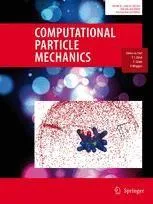
Computational Particle Mechanics
基本信息
期刊简写:
COMPUT PART MECH
影响因子:
2.8
ISSN:
2196-4378
研究领域:
ENGINEERING TECHNOLOGY
h-index:
16
自引率:
14.3%
年发文量:
155
SCI收录来源:
Science Citation Index Expanded
期刊官网:
https://www.springer.com/40571
期刊介绍:
Computational Particle Mechanics (CPM) publishes original articles addressing the modeling and simulation of systems involving particle mechanics and methods. It enhances communication among researchers in engineering and applied sciences who use "particles'' in one form or another in their research. The phrase "particle methods/mechanics'' has now come to encompass a variety of topics, including: Particles as a physical unit in granular media, particulate flows, plasmas, swarms, agents Particles representing material phases in continua at the meso-, micro-and nano-scale and Particles as a discretization unit in continua and discontinua in numerical methods such as Discrete Element Methods (DEM), Particle Finite Element Methods (PFEM), Molecular Dynamics (MD) and Smoothed Particle Hydrodynamics (SPH), etc. CPM focuses on the above topics and welcomes their use on a variety of applications, such as: Particulate and granular flow problems motivated by high-tech industrial processes such as those found in additive manufacturing, spray, deposition, etc., Manufacturing processes involving forming, cutting, compaction, etc., Fluid-structure interaction problems accounting for free surface flow effects in civil and marine engineering, etch as water jets, wave loads, ship hydrodynamics, debris flows, etc., Coupled multiphysical phenomena involving solid, fluid, thermal, electromagnetic and optical systems, etc., Material design/functionalization using particles to modify base materials, etc., Biomedical engineering, involving cell mechanics, molecular dynamics and scale-bridging, and Impact resulting in fracture and fragmentation. Modeling and simulation of systems involving particles and particle methods Real-world applications in manufacturing, marine engineering and biomedical engineering
CiteScore
CiteScore
5.7
SJR
0.845
SNIP
1.289
| 学科 | 排名 | 百分位 |
|---|---|---|
MathematicsNumerical Analysis |
12 / 88 | 86% |
期刊统计
6 issues per year
期/年
Submission to first decision (median): 6 days
审稿周期
£2490/$3790/€2890
论文处理费
投稿信息
投稿网址:
https://www.editorialmanager.com/jcpm相关文献
Mercury or silver atoms bridging trinuclear titanium imido–nitrido systems
Avelino Martín, Noelia Martínez-Espada, Miguel Mena, Marta E. G. Mosquera, Adrián Pérez-Redondo, Carlos Yélamos
2008-11-11
Communication
DOI: 10.1039/B814982H
A robust strategy for the preparation of libraries of metallopeptides. A new paradigm for the discovery of targeted molecular imaging and therapy agents
Andrea F. Armstrong, Nick Oakley, Shannon Parker, Patrick W. Causey, Jennifer Lemon, Alfredo Capretta, Craig Zimmerman, John Joyal, Francis Appoh, Jon Zubieta, John W. Babich, Gurmit Singh, John F. Valliant
2008-09-24
Communication
DOI: 10.1039/B810706H
Relaxation rates for spirocyclohexyl nitroxyl radicals are suitable for interspin distance measurements at temperatures up to about 125 K
Velavan Kathirvelu, Christopher Smith, Christopher Parks, Md. Abdul Mannan, Yozo Miura, Keizo Takeshita, Sandra S. Eaton, Gareth R. Eaton
2008-11-25
Communication
DOI: 10.1039/B817758A
Sensitive liposomes encoded with oligonucleotideamphiphiles: a biocompatible switch
Gregory Giannone
2008-09-23
Communication
DOI: 10.1039/B812398E
Facile synthesis of carbon nanotube/natural bentonite composites as a stable catalyst for styrene synthesis
Jian Zhang, Jan Mizera, Frank Girgsdies, Ning Wang, Sharifah Bee Abd Hamid, Robert Schlögl, Dang Sheng Su
2008-11-11
Communication
DOI: 10.1039/B815335C
Photoinitiated polymerisation of monolithic stationary phases in polyimide coated capillaries using visible region LEDs
Zarah Walsh, Silvija Abele, Brian Lawless, Dominik Heger, Petr Klán, Michael C. Breadmore, Brett Paull, Mirek Macka
2008-11-07
Communication
DOI: 10.1039/B816958F
Selectivity control in enantioselective four-component reactions of aryl diazoacetates with alcohols, aldehydes and amines: an efficient approach to synthesizing chiral β-amino-α-hydroxyesters
Xinfang Xu, Jing Zhou, Liping Yang, Wenhao Hu
2008-11-11
Communication
DOI: 10.1039/B816104F
Thermoresponsive dendronized polymers with tunable lower critical solution temperatures
Wen Li, A. Dieter Schlüter
2008-09-23
Communication
DOI: 10.1039/B811464A
An alternative approach to develop a highly sensitive and selective chemosensor for the colorimetric sensing of cyanide in water
Xiaoding Lou, Liyao Zhang, Jingui Qin, Zhen Li
2008-10-01
Communication
DOI: 10.1039/B812746H
Enzyme-mediated sol–gel processing of alkoxysilanes
Mark Frampton, Ateeya Vawda, Jackie Fletcher, Paul M. Zelisko
2008-09-23
Communication
DOI: 10.1039/B812389F
您可能还喜欢
化合物问答
4-[4-三氟甲基苯基]恶唑(CAS号:1126636-40-5)通常如何合成?
4-[4-三氟甲基苯基]恶唑通常通过将4-三氟甲基苯酚与异硫氰酸苯酯在有机溶剂中进行酯化反应合成。该反应可在无水条件下,使用适当的催化剂,如四丁基氢氧化铵,以提...
1126636-40-54-(4-(Trifluoromethy...
59729-32-71-[3-(Dimethylamino)...
化合物问答
RockPhos Pd G3(CAS号:2009020-38-4)通常如何合成?
RockPhos Pd G3 通常通过钯催化偶联反应合成,使用配体 (2'-Amino-2-biphenylyl)(methanesulfonato-kappa...
2009020-38-4(2'-Amino-2-biphenyl...
化合物问答
1-哌啶甲酰胺(CAS号:2158-03-4)的市场或研究趋势如何?
1-哌啶甲酰胺作为有机合成中的重要中间体,其市场需求主要受医药、农药、染料等行业推动。近年来,随着新药开发和绿色化学的发展,该化合物的研究趋势集中在开发更高效、...
2158-03-41-Piperidinecarboxam...
化合物问答
2-(二苯基膦基)乙胺(CAS号:4848-43-5)适用哪些法规指南?
2-(二苯基膦基)乙胺适用于多种法规指南,包括但不限于《全球化学品统一分类和标签制度》(GHS),欧盟《化学品注册、评估、授权和限制》法规(REACH),以及美...
4848-43-52-(Diphenylphosphino...
化合物问答
如何储存间苯二甲酸二烯丙酯(CAS号:1087-21-4)?
间苯二甲酸二烯丙酯应储存在阴凉、干燥、通风良好的地方,远离火源和热源。储存容器应密封,避免光照和高温。储存温度应控制在25℃以下,相对湿度应低于80%。避免与其...
1087-21-4Diallyl isophthalate
化合物问答
什么是间甲苯异硫代异氰酸酯(CAS号:621-30-7)?
间甲苯异硫代异氰酸酯是一种有机化合物,分子式为C7H7NO2S,具有刺激性气味。它是一种重要的有机合成中间体,在合成其他化合物时广泛应用。
621-30-71-Isothiocyanato-3-m...
化合物问答
在合成中是否有N-Boc-D-苯丙氨醇(CAS号:106454-69-7)的替代品?
在合成中,可以考虑使用N-Cbz-D-苯丙氨醇或N-Fmoc-D-苯丙氨醇作为替代品。这些化合物同样具有保护氨基的功能,且在合成过程中表现出良好的反应性能。
106454-69-72-Methyl-2-propanyl ...
化合物问答
3-羟甲基-2-氧异丙基吡啶(CAS号:954240-50-7)的主要用途是什么?
3-羟甲基-2-氧异丙基吡啶主要用于有机合成领域,可以作为合成其他药物、农药或精细化学品的中间体。此外,它还可能在实验室研究中作为特定反应的前体或溶剂。
954240-50-7(2-Isopropoxy-3-pyri...
化合物问答
6-氨基-9-甲基嘌呤(CAS号:700-00-5)应用于哪些行业?
6-氨基-9-甲基嘌呤目前主要应用于医药行业,作为某些药物的中间体。此外,它还可能用于聚合物、传感器和半导体的某些领域,作为功能性单体或掺杂剂。
700-00-59-Methyl-9H-purin-6-...
推荐化合物

![2-Bromodibenzo[b,d]furan structure](https://cnstatic.chemtradehub.com/structs/86-/86-76-0-1814.webp "2-Bromodibenzo[b,d]furan structure")

![3-[(4-Nitrobenzyl)oxy]-3-oxopropanoic Acid structure](https://cnstatic.chemtradehub.com/structs/773/77359-11-6-0d04.webp "3-[(4-Nitrobenzyl)oxy]-3-oxopropanoic Acid structure")
![2-{3-[4-(3-Chlorophenyl)-1-piperazinyl]propyl}[1,2,4]triazolo[4,3-a]pyridin-3(2H)-one hydrochloride (1:1) structure](https://cnstatic.chemtradehub.com/structs/253/25332-39-2-496e.webp "2-{3-[4-(3-Chlorophenyl)-1-piperazinyl]propyl}[1,2,4]triazolo[4,3-a]pyridin-3(2H)-one hydrochloride (1:1) structure")

推荐供应商





免责声明
本页面提供的学术期刊信息仅供参考和研究使用。我们与任何期刊出版商均无关联,也不处理投稿事宜。如有投稿相关咨询,请直接联系相关期刊出版商。
如发现页面信息有误,请发送邮件至 support@chemtradehub.com 联系我们。我们将及时核实并处理您的问题。