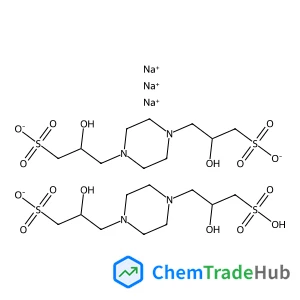
3,3'-(Piperazine-1,4-diyl)bis(2-hydroxypropane-1-sulfonic acid) Sodium Salt
CAS号:
108321-08-0
分子式:
C20H41N4Na3O16S4
The interaction of CO2 with a clean Cu(110) surface and with pre-adsorbed oxygen and hydrogen on this surface has been studied in ultra-high vacuum at temperatures between 20 and 500 K with temperature programmed thermal desorption, low-energy electron diffraction, Auger electron spectroscopy, high-resolution electron energy loss spectroscopy and work function change measurements. CO2 adsorbs only molecularly on the clean and on the hydrogen(1×2) and oxygen(2×1) reconstructed Cu(110) surface, respectively. The initial sticking probability of CO2 is not affected by co-adsorption of oxygen or hydrogen, although the CO2 adsorption is energetically stabilised in this case by 1.3 and 5.4 kJ mol-1, respectively. On clean Cu(110), the isosteric heat of adsorption rises with coverage from ∽13 to 25 kJ mol-1 at saturation. High-resolution electron energy loss spectroscopy suggests that the isolated carbon dioxide molecule is adsorbed in a linear configuration on the clean and on the reconstructed surfaces, while for coverages >0.1 three-dimensional clustering occurs. Our experiments reveal that neither dissociation into oxygen and carbon monoxide nor hydrogenation of carbon dioxide occurs under the experimental conditions.

Construction and Building Materials

Composite Interfaces
Advanced Composite Materials

Applied Composite Materials
Journal of Physical Organic Chemistry
Chemistry of Materials

Cement and Concrete Composites

Computational Materials Science
Bio-Medical Materials and Engineering

Journal of Computer-Aided Molecular Design
Yasuhiro Nishiyama, Akira Fujii, Hajime Mori
DOI: 10.1039/C9RE00265K
Dnyaneshwar Aand, Bhushan Mahajan, Srihari Pabbaraja, Ajay K. Singh
DOI: 10.1039/C9RE00110G
Karel Mařík, Linda Tichá, Lucie Vobecká, Michal Přibyl
DOI: 10.1039/C9RE00482C
Massimo Rosa, Debora Marani, Giovanni Perin, Søren Bredmose Simonsen, Philipp Zielke, Antonella Glisenti, Ragnar Kiebach, Andreas Lesch, Vincenzo Esposito
DOI: 10.1039/C9RE00334G
Thomas H. Rehm, Patrick Löb, Albert Renken
DOI: 10.1039/C9RE90029B
DOI: 10.1039/C9RE00422J
Eiji Yamaguchi, Nao Taguchi, Akichika Itoh
DOI: 10.1039/C9RE00061E
Gianpiero Forte, Isabella Chiarotto, Frank Richter, Vinh Trieu, Marta Feroci
DOI: 10.1039/C7RE00101K
Zhaobing Shen, Hong Zhao, Yue Liu, Zeyuan Kan, Ping Xing, Jinguang Zhong
DOI: 10.1039/C7RE00201G
该化合物适用的法规指南包括GHS(全球化学品统一分类和标签制度)分类为特定目标器官毒性-单次接触类别3;根据欧盟REACH法规,该化合物需要进行注册和评估;在美...
在合成中,可以考虑使用一些类似的化合物作为4-(4-氯苯基)-1H-咪唑的替代品,如4-(4-溴苯基)-1H-咪唑或4-(4-甲氧基苯基)-1H-咪唑。这些化合...
N~2~-甲基丙氨酸酰胺是一种有机化合物,其化学名为2-(Methylamino)propanamide。它是一种酰胺类化合物,分子式为C4H10N2O,相对分...
处理含有N-苄基-3-氨基氧杂环丁烷草酸盐(CAS号:1956341-96-0)的废料时,应首先确保遵循相关法规要求,如GHS和REACH等。通常,废液应先进行...
4-溴-2-氯-6-甲基苯甲酸是一种固体化合物,具有较高的熔点和较低的沸点。它的分子量为261.03 g/mol。该化合物在水中几乎不溶,在有机溶剂中溶解度适中...
该化合物通常通过缩合反应合成,典型的方法是将2,5-二氯嘧啶与N-甲基苯甲酰胺在碱性条件下进行偶联反应。常用的碱包括NaH、LDA等强碱。该合成路线具有较高的选...
3,5-二溴-4-甲基苯胺在某些合成路线中可能没有直接替代品。然而,在某些应用场景下,可以考虑使用其他类似结构的化合物如3,5-二溴-4-硝基苯胺或3,5-二碘...
2-氯喹啉-4-羧酸甲酯主要用于有机合成和药物合成领域,作为中间体或原料。它在合成某些药物和染料时具有重要作用。此外,该化合物还可能用于某些特定的化学研究中。
6-溴-8-氯咪唑[1,2-a]吡啶在操作过程中需要谨慎以确保安全。该化合物具有一定的毒性,吸入其蒸气或粉尘可能导致呼吸道刺激。处理时应佩戴适当的防护装备,如手...

Physical Chemistry Chemical Physics (PCCP) is an international journal co-owned by 19 physical chemistry and physics societies from around the world. This journal publishes original, cutting-edge research in physical chemistry, chemical physics and biophysical chemistry. To be suitable for publication in PCCP, articles must include significant innovation and/or insight into physical chemistry; this is the most important criterion that reviewers and Editors will judge against when evaluating submissions. The journal has a broad scope and welcomes contributions spanning experiment, theory, computation and data science. Topical coverage includes spectroscopy, dynamics, kinetics, statistical mechanics, thermodynamics, electrochemistry, catalysis, surface science, quantum mechanics, quantum computing and machine learning. Interdisciplinary research areas such as polymers and soft matter, materials, nanoscience, energy, surfaces/interfaces, and biophysical chemistry are welcomed if they demonstrate significant innovation and/or insight into physical chemistry. Joined experimental/theoretical studies are particularly appreciated when complementary and based on up-to-date approaches.
![O-Benzyl-N-[(9H-fluoren-9-ylmethoxy)carbonyl]-N-methyl-L-threonine structure](https://cnstatic.chemtradehub.com/structs/198/198561-81-8-a56e.webp "O-Benzyl-N-[(9H-fluoren-9-ylmethoxy)carbonyl]-N-methyl-L-threonine structure")