

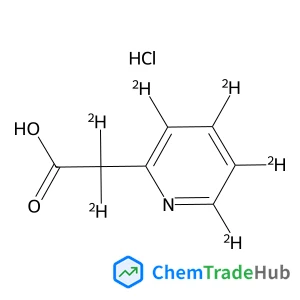
2,2-dideuterio-2-(3,4,5,6-tetradeuterio-2-pyridyl)acetic acid;hydrochloride
CAS号:
1329799-67-8
分子式:
C7H2ClD6NO2
An upper limit for the rate coefficient for the reaction of was measured to be 5.7×10⁻¹⁵ cm3 molecule−1 s−1 at 240 K. OH radicals were produced ia pulsed photolysis of a mixture of O3 and H2, ia the reaction of O(1D) with H2, in the presence of an excess of N2O5 with SF6 as the bath gas. The temporal profiles of OH, which followed pseudo-first order kinetics, were monitored by laser induced fluorescence. Concentrations of N2O5 were determined by UV/visible absorption. Using this limit for k1, the potential role of N2O5 loss and conversion to HNO3 due to reaction (1) in the stratosphere is deduced to be negligible relative to known pathways.
Stefania Perticaroli, Marco Paolantoni, Paola Sassi, Silvia Corezzi, Assunta Morresi
DOI: 10.1039/C4CP00840E
Bin Yan, Sander Jaeqx, Wim J. van der Zande, Anouk M. Rijs
DOI: 10.1039/C4CP00810C
Christopher M. Lee, Kabindra Kafle, Yong Bum Park, Seong H. Kim
DOI: 10.1039/C4CP00515E
Wen Huang, Chee Kwan Gan, Gengchiau Liang
DOI: 10.1039/C4CP00487F
Xinrui Miao, Li Xu, Lihua Cui, Wenli Deng
DOI: 10.1039/C4CP00871E
Jia Gao, Yueh-Lin Loo
DOI: 10.1039/C4CP00665H
W. A. D. Pires, J. D. Garrido, M. A. C. Nascimento, M. Y. Ballester
DOI: 10.1039/C4CP01363H
Hongxin Zhang, Shurong Wang, Yanshuang Wang, Jiedi Yang, Xueling Gao, Liwei Wang
DOI: 10.1039/C4CP00356J
C. B. M. Groß, T. J. Dillon, J. N. Crowley
DOI: 10.1039/C4CP01108B
Marco Ferretti, Vladimir I. Novoderezhkin, Elisabet Romero, Ramunas Augulis, Anjali Pandit, Donatas Zigmantas, Rienk van Grondelle
DOI: 10.1039/C3CP54634A
8-溴-4-羟基-6-(三氟甲氧基)喹啉-3-羧酸乙酯应储存在阴凉、干燥的地方,避免光照和高温。建议使用密封容器进行储存,以防止水分和空气的影响。
2,2-二(2-呋喃基)丙烷的研究趋势主要集中在新型材料的开发和应用,如高分子材料、有机光电材料等。市场趋势方面,随着环保要求的提高和新材料的应用,该化合物的需...
对于含有螺[呋喃并[3,4-b]吡啶-5(7H),4'-哌啶]-7-酮盐酸盐的废料,应首先进行分类和分离,以减少危险物质的数量。随后,可以考虑通过化学氧化、生物...
Cinnamyl 3-氨基丁-2-烯酸在接触皮肤和眼睛时可能会引起刺激。应避免吸入其粉尘和烟雾。操作时应穿戴适当的个人防护装备,如手套、护目镜和实验室外套。
反式-2-十二碳烯二酸在医药、材料科学等领域有一定的应用,但其市场相对较小。近年来,由于环保意识的提升,对环境友好型化学品的需求增加,研究倾向于开发更绿色的合成...
(9ci)-1H-苯并咪唑-5-乙酸是一种含氮杂环化合物,其化学结构为1H-苯并咪唑-5-乙酸。该化合物具有特定的分子式C8H7NO2,属于有机酸类化合物。
酞菁蓝主要用作颜料和染料,广泛应用于塑料、油墨、涂料、纺织品及橡胶工业中。它也用于光敏材料,如太阳能电池和光刻胶。在医疗领域,酞菁蓝因其光敏特性被用于某些光动力...
5-甲基-1,2,3,4-四氢异喹啉在使用和储存时需要谨慎处理。它具有一定的毒性,应避免吸入其蒸气或直接接触皮肤和眼睛。操作此化合物时,建议佩戴防护眼镜、实验服...
含有3',4',5'-三甲氧基苯乙酮的废液应首先确保其是否为危险废物,根据当地法规确定处理方法。通常,这类有机废液可以采用中和反应降低其pH值,然后通过蒸馏或萃...
KI-7应储存在通风良好的干燥环境中,避免光照和高温。建议使用密封容器储存,并保持在阴凉处。储存温度应控制在室温范围内,一般建议不超过25°C。避免与氧化剂接触...

Physical Chemistry Chemical Physics (PCCP) is an international journal co-owned by 19 physical chemistry and physics societies from around the world. This journal publishes original, cutting-edge research in physical chemistry, chemical physics and biophysical chemistry. To be suitable for publication in PCCP, articles must include significant innovation and/or insight into physical chemistry; this is the most important criterion that reviewers and Editors will judge against when evaluating submissions. The journal has a broad scope and welcomes contributions spanning experiment, theory, computation and data science. Topical coverage includes spectroscopy, dynamics, kinetics, statistical mechanics, thermodynamics, electrochemistry, catalysis, surface science, quantum mechanics, quantum computing and machine learning. Interdisciplinary research areas such as polymers and soft matter, materials, nanoscience, energy, surfaces/interfaces, and biophysical chemistry are welcomed if they demonstrate significant innovation and/or insight into physical chemistry. Joined experimental/theoretical studies are particularly appreciated when complementary and based on up-to-date approaches.