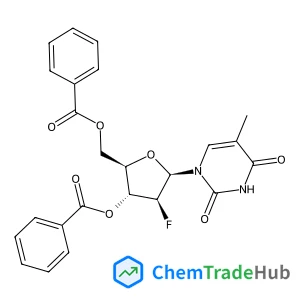
1-(3',5'-Di-O-benzoyl-2'-deoxy-2'-fluoro-b-D-arabinofuranosyl)thymine
CAS号:
97614-47-6
分子式:
C24H21FN2O7
The first page of this article is displayed as the abstract.
Journal of the Chinese Chemical Society
Chemistry of Heterocyclic Compounds
Biopolymers
Chemical & Pharmaceutical Bulletin
Bulletin of the Chemical Society of Japan
Anti-Corrosion Methods and Materials
Canadian Metallurgical Quarterly
Cement and Concrete Research
Advances in Colloid and Interface Science

Analyst
Markus Schörner, Stefanie Kämmerle, Dorothea Wisser, Benjamin Baier, Martin Hartmann, Matthias Thommes, Marco Haumann
DOI: 10.1039/D2RE00143H
Christel Olivier Lenge Mbuya, Chike George Okoye-Chine, Katu Ramutsindela, Linda L. Jewell, Mike Scurrell
DOI: 10.1039/D2RE00024E
Thomas Roider, Norbert Frommknecht, Alexandra Höltzel, Ulrich Tallarek
DOI: 10.1039/D2RE00142J
Yanzhe Yu, Yonggen Lu, Xisong Cheng, Lei Han, Changling Yang
DOI: 10.1039/D2RE00060A
Qiang Geng, Guoqiang Huang
DOI: 10.1039/D1RE00569C
Jean-Luc Beulay, Eric Valery, Peter Satzer
DOI: 10.1039/D2RE00022A
Jianguo Liu, Xinghua Zhang, Lungang Chen, Longlong Ma, Qi Zhang
DOI: 10.1039/D2RE00180B
Philipp Schwiderowski, Sascha Stürmer
DOI: 10.1039/D2RE00185C
Qandeel Saleem, Milad Torabfam
DOI: 10.1039/D2RE00049K
Nat Phongprueksathat, Thanakorn Thanasujaree, Thirasak Rirksomboon
DOI: 10.1039/D1RE00561H
随着环保要求的提高和安全意识的增强,该化合物的研究和应用趋势正逐渐转向更安全、更环境友好的替代品。市场关注点主要集中在开发新型合成方法和绿色化学路径,以减少有害...
处理含有2,9 - 二苯基 - 1,10 - 菲罗啉的废料时,应先将其收集在适当的容器中,避免与其他化学品混合。随后,可以通过水解或氧化等方法进行处理,直至达到...
处理(6-氯-吡嗪-3-基)-(4-乙基-哌嗪-1-基)-甲酮时,应穿戴适当的个人防护装备(PPE),包括手套、护目镜和实验室外套。在通风橱中操作以确保良好的通...
在处理(R)-2-氯-1-(2,4-二氯苯基)乙醇时,应佩戴防护眼镜、实验室外套和手套,确保通风橱开启以减少接触和吸入的风险。避免直接接触皮肤和眼睛。处理过程中...
可考虑使用类似结构的化合物作为替代品,如3-氯-6-(哌啶-1-基)吡嗪或3-氯-6-(2-氯哌啶-1-基)吡嗪,这些化合物在结构上与目标化合物相似,可能具有相...
该化合物可以通过乙酸乙酯与5-溴-1H-苯并三氮唑的反应合成,通常在无水条件下进行。合成过程中,需要使用适当的溶剂如乙酸乙酯,并在适当的温度下反应。该反应具有较...
一水硫酸镁是一种无机化合物,化学式为MgSO₄·H₂O,CAS号为14168-73-1。它由镁离子、硫酸根离子和一个结晶水分子组成,通常呈现为白色粉末或颗粒状固...
氘代-1,3-二氯-2-丙醇主要应用于医药和有机合成领域,作为研究化合物的氘代替代品,用于标记和追踪反应过程。此外,在聚合物和半导体生产中也有一定的应用潜力。
氰乙酸环己酯应储存在阴凉、干燥、通风良好的环境中,远离火源和热源,防止阳光直射。储存容器应密封良好,避免与空气接触,防止发生不必要的反应。
目前,2-碘-4-硝基苯胺在医药和农药领域有一定的研究和应用,尤其是在开发新型药物和农药产品方面。然而,由于其潜在的环境和健康风险,行业正趋向于寻找更为安全和环...

ChemComm publishes urgent research which is of outstanding significance and interest to experts in the field, while also appealing to the journal’s broad chemistry readership. Our communication format is ideally suited to short, urgent studies that are of such importance that they require accelerated publication. Our scope covers all topics in chemistry, and research at the interface of chemistry and other disciplines (such as materials science, nanoscience, physics, engineering and biology) where there is a significant novelty in the chemistry aspects. Major topic areas covered include: Analytical Chemistry Catalysis Chemical Biology and medicinal chemistry Computational Chemistry and Machine Learning Energy and sustainable chemistry Environmental Chemistry Green Chemistry Inorganic Chemistry Materials Chemistry Nanoscience Organic Chemistry Physical Chemistry Polymer Chemistry Supramolecular Chemistry