





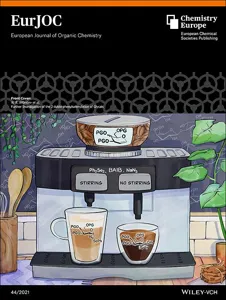


Computer simulations of micelle fission
文献信息
发布日期
2010-02-11
DOI
10.1039/B918449J
影响因子
3.676
作者
Juanjuan Gao, Shuangyang Li, Xianren Zhang, Wenchuan Wang
查看原文
摘要
In this work, we study the fission process of large micelles by using dissipative particle dynamics. In general, there exist four different stages during a fission process. For the first stage, the morphological transition to the dumbbell intermediate structures occurs due to a perturbation, in this case, a change in head–head interaction. Then, in the next stage the dumbbell-like intermediate structure fluctuates for a longer or less time until it reaches mechanical instability. Simulation results indicate that the fluctuation of the intermediate structure in this stage can be regarded as a nucleation process. In the third stage, the neck breaks as a result of continuous narrowing. In the last stage the two or more freshly formed, small micelles retract and equilibrate to their final shapes. Simulation results demonstrate that the first, second and third stages are characterized by distinct dynamic features, depending on the surfactant architecture. It is found that surfactant architecture controls the micelle fission process, especially for the second stage, similar to the way it controls the size and shape of the aggregates at equilibrium. Since for most cases it is the second stage that dominates the lifetime of a micelle, we suggest that the molecule packing parameter is not only a predictor of the shape and size of aggregates, but also a predictor of kinetic properties for micelle fission.
相关文献
New equations of state for the hard polyhedron fluids
Hua Jiang, A. Mulero
2019-05-23
Paper
DOI: 10.1039/C9CP02033K
A new electrochemical cell with a uniformly accessible electrode to study fast catalytic reactions
Jean-Vincent Daurelle, Vincent Fourmond, Jérôme Vicente
2019-05-10
Paper
DOI: 10.1039/C9CP01487J
Understanding the affinity of bis-exTTF macrocyclic receptors towards fullerene recognition
Joaquín Calbo, Alberto de Juan, Juan Aragó, Julia Villalva, Emilio M. Pérez, Enrique Ortí
2019-05-20
Paper
DOI: 10.1039/C9CP01735F
Wetting properties of porous high temperature polymer electrolyte fuel cells materials with phosphoric acid
J. Halter, T. Gloor, B. Amoroso, F. N. Büchi
2019-06-06
Paper
DOI: 10.1039/C9CP02149C
On the preparation and NMR spectroscopic characterization of potassium aluminium tetrahydride KAlH4
Bodo Zibrowius, Michael Felderhoff
2019-05-17
Paper
DOI: 10.1039/C9CP01059A
Chemical equilibria of aqueous ammonium–carboxylate systems in aqueous bulk, close to and at the water–air interface
Yina Salamanca Blanco, Önder Topel, Éva G. Bajnóczi, Olle Björneholm, Ingmar Persson
2019-05-22
Paper
DOI: 10.1039/C9CP02449B
Spectroscopic diagnostic for the ring-size of carbohydrates in the gas phase: furanose and pyranose forms of GalNAc
Baptiste Schindler, Laurent Legentil, Abdul-Rhaman Allouche, Vincent Ferrières
2019-05-23
Paper
DOI: 10.1039/C8CP04082F
Tetrel bonding interaction: an analysis with the block-localized wavefunction (BLW) approach
Changwei Wang, Yama Aman, Xiaoxi Ji, Yirong Mo
2019-05-09
Paper
DOI: 10.1039/C9CP01710K
High bond difference parameter-induced low thermal transmission in carbon allotropes with sp2 and sp3 hybridization
Shenghong Ju, Bin Wen, Yuwen Zhang, Roderick Melnik
2019-05-13
Paper
DOI: 10.1039/C9CP01029G
Solvent viscosity-dependent isomerization equilibrium of tetramethoxy-substituted bianthrone
Yasukazu Hirao, Yosuke Hamamoto, Nobuhiro Nagamachi, Takashi Kubo
2019-05-22
Paper
DOI: 10.1039/C9CP01836K
您可能还喜欢
化合物问答
如何处理含有顺-二(2,2'-联吡啶)二氯化钌(II)二水合物(CAS号:67776-38-9)的废料?
处理含有该化合物的废料时,应先收集并分类,然后根据其危险特性选择合适的处理方法。推荐采用焚烧或由专业机构进行安全处理,以确保符合环保法规的要求。处理过程中应佩戴...
67776-38-93-{[(2R,3R,4S,5R,6R)...
化合物问答
4-amino-2-bromo-3-iodopyridine(CAS号:1300750-77-9)的市场或研究趋势如何?
4-氨基-2-溴-3-碘吡啶主要应用于药物合成和研究领域,尤其是在抗病毒和抗癌药物的研发中。随着新型药物的需求增加,该化合物的研究趋势较好。市场方面,由于其特殊...
1300750-77-92-bromo-3-iodopyridi...
化合物问答
4-乙酰基氨基-2-氨基-苯甲酸(CAS号:43134-76-5)的市场或研究趋势如何?
当前,4-乙酰基氨基-2-氨基-苯甲酸(CAS号:43134-76-5)在医药和化工领域有一定的应用。随着药物研发的进展,该化合物在新型药物设计中的应用可能增加...
43134-76-54-Acetamido-2-aminob...
化合物问答
庚a氟-1-(1-碘-1,2,2,2-四氟乙氧基)丙烷(CAS号:107432-46-2)的市场或研究趋势如何?
该化合物目前主要用于特定的工业应用,如氟聚合物的合成。市场趋势显示,由于其独特的结构和性能,未来可能在新型氟材料和特种化学品领域有更多的应用。研究趋势方面,主要...
107432-46-21,1,1,2,2,3,3-Heptaf...
化合物问答
在合成中是否有Propargyl-PEG13-bromide(CAS号:2055105-25-2)的替代品?
可以考虑使用1,3-丁二烯-1-炔-3-基-聚乙二醇-13-溴化物作为Propargyl-PEG13-bromide的替代品,因为两者在结构上相似,均可用于合成...
2055105-25-2Propargyl-peg13-brom...
化合物问答
2-氨基-6-甲氧基嘌呤(CAS号:20535-83-5)安全吗?
2-氨基-6-甲氧基嘌呤在正常使用条件下相对安全,但在操作时仍需注意防护措施,如佩戴手套和护目镜,避免吸入或接触皮肤和眼睛。
20535-83-56-Methoxy-7H-purin-2...
化合物问答
2-甲基-3-溴苯乙酸乙酯(CAS号:1261862-72-9)适用哪些法规指南?
该化合物根据其化学性质和潜在危害,可能适用于GHS(全球化学品统一分类和标签制度)的分类标准。具体分类需依据其毒性和燃烧危险性进行评估。此外,欧洲化学品管理局(...
1261862-72-9Ethyl (3-bromo-2-met...
化合物问答
4,4-二甲基吡咯烷-3-羧酸盐酸盐(CAS号:1351343-41-3)应用于哪些行业?
4,4-二甲基吡咯烷-3-羧酸盐酸盐在医药、聚合物和传感器领域有应用。在医药领域,它可以作为某些药物的中间体;在聚合物领域,它可用作某些聚合物的稳定剂;在传感器...
1351343-41-34,4-Dimethyl-3-pyrro...
化合物问答
处理5-Hydroxy-7-methoxy-2-(4-methoxyphenyl)-4-oxo-4H-chromen-6-yl 2-O-beta-D-xylopyranosyl-beta-D-glucopyranoside(CAS号:149998-39-0)时应注意哪些实验室安全事项?
处理该化合物时应注意使用个人防护装备(如手套、护目镜和实验服),在通风橱中操作。避免直接接触皮肤和吸入,泄漏时应立即清理并使用适当的吸收材料。参考安全数据表(S...
149998-39-05-Hydroxy-7-methoxy-...
化合物问答
7-甲基-1,2,3,4-四氢-吖啶-9-甲酸(CAS号:345621-27-4)的市场或研究趋势如何?
该化合物在医药研究中具有潜在应用价值,特别是在抗癌药物研发方面。随着研究的深入,对其合成方法的优化和生物活性的进一步探索将成为研究热点。
345621-27-47-Methyl-1,2,3,4-tet...
来源期刊
Physical Chemistry Chemical Physics

CiteScore:
5.5
自引率:
10.3%
年发文量:
3036
Physical Chemistry Chemical Physics (PCCP) is an international journal co-owned by 19 physical chemistry and physics societies from around the world. This journal publishes original, cutting-edge research in physical chemistry, chemical physics and biophysical chemistry. To be suitable for publication in PCCP, articles must include significant innovation and/or insight into physical chemistry; this is the most important criterion that reviewers and Editors will judge against when evaluating submissions. The journal has a broad scope and welcomes contributions spanning experiment, theory, computation and data science. Topical coverage includes spectroscopy, dynamics, kinetics, statistical mechanics, thermodynamics, electrochemistry, catalysis, surface science, quantum mechanics, quantum computing and machine learning. Interdisciplinary research areas such as polymers and soft matter, materials, nanoscience, energy, surfaces/interfaces, and biophysical chemistry are welcomed if they demonstrate significant innovation and/or insight into physical chemistry. Joined experimental/theoretical studies are particularly appreciated when complementary and based on up-to-date approaches.
推荐化合物

![N-[(5,6-Dichloro-1H-benzimidazol-2-yl)methyl]-9-(1-methyl-1H-pyrazol-4-yl)-2-(4-morpholinyl)-9H-purin-6-amine structure](https://cnstatic.chemtradehub.com/structs/238/2387704-62-1-25f4.webp "N-[(5,6-Dichloro-1H-benzimidazol-2-yl)methyl]-9-(1-methyl-1H-pyrazol-4-yl)-2-(4-morpholinyl)-9H-purin-6-amine structure")
推荐供应商






免责声明
本页面提供的学术期刊信息仅供参考和研究使用。我们与任何期刊出版商均无关联,也不处理投稿事宜。如有投稿相关咨询,请直接联系相关期刊出版商。
如发现页面信息有误,请发送邮件至 support@chemtradehub.com 联系我们。我们将及时核实并处理您的问题。