









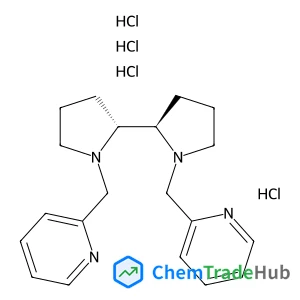
(2R,2'R)-1,1'-Bis(2-pyridinylmethyl)-2,2'-bipyrrolidine tetrahydrochloride
CAS号:
1228077-88-0
分子式:
C20H30Cl4N4
Guy Bouchoux, Sihua Huang, Bhawani Singh Inda
Acid–base thermochemistry of isolated aliphatic amino acids (denoted AAA): glycine, alanine, valine, leucine, isoleucine and proline has been examined theoretically by quantum chemical computations at the G3MP2B3 level. Conformational analysis on neutral, protonated and deprotonated species has been used to identify the lowest energy conformers and to estimate the population of conformers expected to be present at thermal equilibrium at 298 K. Comparison of the G3MP2B3 theoretical proton affinities, PA, and ΔHacid with experimental results is shown to be correct if experimental thermochemistry is re-evaluated and adapted to the most recent acidity–basicity scales. From this point of view, a set of evaluated proton affinities of 887, 902, 915, 916, 919 and 941 kJ mol−1, and a set of evaluated ΔHacid of 1433, 1430, 1423, 1423, 1422 and 1426 kJ mol−1, is proposed for glycine, alanine, valine, leucine, isoleucine and proline, respectively. Correlations with structural parameters (Taft's σα polarizability parameter and molecular size) suggest that polarizability of the side chain is the major origin of the increase in PA and decrease in ΔHacid along the homologous series glycine, alanine, valine and leucine/isoleucine. Heats of formation of gaseous species AAA, AAAH+ and [AAA−H]− were computed at the G3MP2B3 level. The present study provides previously unavailable ΔfH°298 for the ionized species AAAH+ and [AAA−H]−. Comparison with Benson's estimate, and correlation with molecular size, show that several experimental ΔfH°298 values of neutral or gaseous AAA might be erroneous.
Wentan Liu, Jie Ke, Chuan He
DOI: 10.1039/D1SC02614C
Shougo Higashi, Takashi Tachikawa, Keiichiro Oh-ishi, Keisuke Shigetoh, Kensuke Takechi, Atsushi Beniya
DOI: 10.1039/D0TA07707K
Liat Avram, Yoram Cohen
DOI: 10.1039/C4CS00197D
Ning Yang, Cheng Zhu, Yihua Chen, Huachao Zai, Chenyue Wang, Xi Wang, Hao Wang, Sai Ma, Ziyan Gao, Xueyun Wang, Jiawang Hong, Yang Bai, Huanping Zhou
DOI: 10.1039/D0EE01736A
DOI: 10.1039/C9TA12170F
DOI: 10.1039/JA9860100100
Gangjian Tan, Fengyuan Shi, Jeff W. Doak, Hui Sun, Li-Dong Zhao, Pengli Wang, Ctirad Uher, Chris Wolverton, Vinayak P. Dravid
DOI: 10.1039/C4EE01463D
Jiu Wang, Pawan Kumar, Heng Zhao, Md Golam Kibria, Jinguang Hu
DOI: 10.1039/D1GC02307A
P11作为一种化学化合物,需要谨慎处理。一般来说,该化合物无毒,但在操作过程中仍需遵循实验室安全规定,避免皮肤接触和吸入。建议在通风良好的环境中操作,并佩戴适当...
氨甲环酸杂质C通常通过氨甲环酸的衍生物与环己烯进行缩合反应合成。常见的合成方法包括一步合成法和多步合成法,其中多步合成法可以提高产物的选择性和产率。反应通常在无...
(±)-茉莉酸的合成通常采用生物合成或者化学合成的方法。化学合成方法中,可以通过2-戊烯-1-醇与环戊酮的缩合反应,再经过氧化反应得到目标产物。该反应需要温和的...
(4S,4'S)-2,2'-(1,1-环己烷二基)双(4-异丙基-4,5-二氢-1,3-噁唑)属于有机化合物,应遵循实验室安全规范。在操作时应佩戴适当的个人防护...
6-苄氧基-5-甲氧基-2-羧基吲哚是一种有机化合物,分子式为C16H15NO3。它是一种含有苄氧基、甲氧基和羧基官能团的吲哚衍生物。
丙二酸丁酯乙酯属于易燃物质,具有一定的毒性。在操作时应佩戴防护眼镜和手套,避免接触皮肤和眼睛。储存时应远离热源和火源,避免阳光直射,以减少火灾和爆炸的风险。
2-碘-3-甲基吡嗪作为一种特殊结构的化合物,目前在工业和学术研究中的应用相对有限。然而,随着对特定化学结构及其潜在应用的深入研究,预计未来可能在农药、医药等领...
千层纸素A-7-0-β-D-葡萄糖醛酸苷甲酯是一种白色结晶固体,分子量为616.27 g/mol。该化合物在水中溶解度较低,在有机溶剂中溶解度较高。其反应活性主...
7-苄基-4,7-二氮杂螺[2.5]辛烷是一种有机化合物,其结构由一个环状的7-苄基-4,7-二氮杂螺环和一个苯基组成。该化合物的分子式为C14H16N2。它具...
丁酰胺酸甲酯的合成中可能的替代品包括其他氨基酸衍生物,如乙酰胺酸甲酯或丙酰胺酸甲酯。这些替代品在某些合成路线中可能更为便利或成本更低。

Physical Chemistry Chemical Physics (PCCP) is an international journal co-owned by 19 physical chemistry and physics societies from around the world. This journal publishes original, cutting-edge research in physical chemistry, chemical physics and biophysical chemistry. To be suitable for publication in PCCP, articles must include significant innovation and/or insight into physical chemistry; this is the most important criterion that reviewers and Editors will judge against when evaluating submissions. The journal has a broad scope and welcomes contributions spanning experiment, theory, computation and data science. Topical coverage includes spectroscopy, dynamics, kinetics, statistical mechanics, thermodynamics, electrochemistry, catalysis, surface science, quantum mechanics, quantum computing and machine learning. Interdisciplinary research areas such as polymers and soft matter, materials, nanoscience, energy, surfaces/interfaces, and biophysical chemistry are welcomed if they demonstrate significant innovation and/or insight into physical chemistry. Joined experimental/theoretical studies are particularly appreciated when complementary and based on up-to-date approaches.
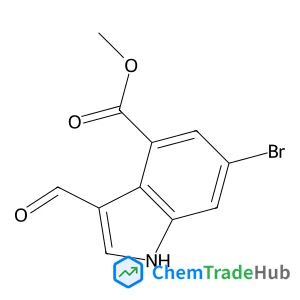
![7-Bromo-5-chloro-1H-pyrazolo[4,3-b]pyridine structure](https://cnstatic.chemtradehub.com/structs/135/1351813-70-1-a716.webp "7-Bromo-5-chloro-1H-pyrazolo[4,3-b]pyridine structure")
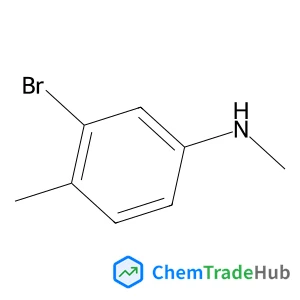
![(3E)-3-[4-Hydroxy-3,5-bis(2-methyl-2-propanyl)benzylidene]dihydro-2(3H)-furanone structure](https://cnstatic.chemtradehub.com/structs/102/102271-49-8-cba7.webp "(3E)-3-[4-Hydroxy-3,5-bis(2-methyl-2-propanyl)benzylidene]dihydro-2(3H)-furanone structure")


