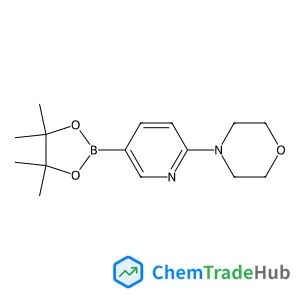
4-(5-(4,4,5,5-tetramethyl-1,3,2-dioxaborolan-2-yl)pyridin-2-yl)morpholine
CAS号:
485799-04-0
分子式:
C15H23BN2O3
Toyonobu Usuki, Nanae Yasuda, Masahiro Yoshizawa-Fujita, Masahiro Rikukawa
Shikimic acid, the starting material in the commercial synthesis of oseltamivir phosphate (Tamiflu®), was efficiently extracted and isolated from Ginkgo biloba leaves utilizing the ionic liquid 1-butyl-3-methylimidazolium chloride ([bmim]Cl), which dissolves cellulose.
Saudi Pharmaceutical Journal
Chemistry Education Research and Practice
Current Opinion in Solid State & Materials Science
Russian Journal of Bioorganic Chemistry
Russian Journal of General Chemistry
Drug Discovery Today
Journal of Peptide Science

Chemical Communications
Crystallography Reports
Russian Journal of Coordination Chemistry
Sachiko I. Matsushita
DOI: 10.1039/B313410E
Rajesh G. Gonnade, Mohan M. Bhadbhade, Mysore S. Shashidhar
DOI: 10.1039/B410051D
Siddharth V. Patwardhan, Niloy Mukherjee, Miriam Steinitz-Kannan, Stephen J. Clarson
DOI: 10.1039/B302056H
Luke E. Turner, Matthew G. Thorn, Phillip E. Fanwick, Ian P. Rothwell
DOI: 10.1039/B212724E
Yu Wang, William B. Euler, Brett L. Lucht
DOI: 10.1039/B312537H
Seong Il Yoo, Byeong-Hyeok Sohn, Wang-Cheol Zin, Sung-Jin An, Gyu-Chul Yi
DOI: 10.1039/B409934F
Svetlana L. Kachkarova-Sorokina, Pierre Gallezot, Alexander B. Sorokin
DOI: 10.1039/B411694A
François Stoffelbach, Rinaldo Poli
DOI: 10.1039/B409992C
Paula Alvarez-Bercedo, Andrew D. Bond, Robert Haigh, Alexander D. Hopkins, Gavin T. Lawson, Mary McPartlin, David Moncrieff, Marta E. Gonzalez Mosquera, Jeremy M. Rawson, Anthony D. Woods, Dominic S. Wright
DOI: 10.1039/B300522D
处理含有8-氯咪唑并[1,2-A]吡嗪的废料时,应首先将其收集并进行化学回收或降解。如果无法回收,需采用安全的化学处理方法,如中和、氧化还原或沉淀。处理过程中需...
Calhex 231 hydrochloride 需要遵循《全球化学品统一分类和标签制度》(GHS)的分类和标签要求,以及欧盟的《化学品注册、评估、授权和限制条...
11-Beta,17-alpha,21-三羟基-5-beta-孕烯-3,20-二酮是一种无色结晶性粉末,分子量为372.45 g/mol。该化合物在水中的溶解度...
处理5-异丙基-1,3,4-恶二唑-2-羧酸时应注意以下安全事项:穿戴适当的个人防护装备,包括实验室外套、手套和护目镜;操作应在通风橱中进行,以减少吸入或接触有...
Benzyl 3-bromopropanoate属于有毒物质,吸入、摄入或皮肤接触均可能对人体造成伤害。操作时应佩戴防护眼镜、口罩和手套,避免吸入蒸汽和直接接触...
(R)-N-苄氧羰基-3,4-二氢-1H-异喹啉羧酸是一种含有苄氧羰基和异喹啉环结构的化合物,分子式为C17H15NO3。它是一种有机化合物,具有一定的生物活性...
可以考虑使用1-苄基吡啶-3-羧酸盐作为1-苄基吡啶嗡-3-羧酸盐的替代品。此外,还可以探索其他类似物,如1-苄基吡啶-3-氨基甲酸酯等。具体的替代品选择需根据...
(2,6-二甲基吡啶-3-基)甲醇在使用时需注意安全,应避免吸入其蒸汽,接触皮肤和眼睛。操作应在通风良好的环境中进行,佩戴适当的个人防护装备。
5-溴-2-乙烯基吡啶是一种有机化合物,外观为白色固体,具有良好的结晶性。分子量约为190.03 g/mol。它的溶解性在水中较差,但在有机溶剂如二氯甲烷、甲醇...
2-羟基-3-硝基-5-甲基吡啶主要应用于医药、聚合物和半导体行业。在医药领域,它可以用作合成其他药物的中间体。在聚合物领域,它可以作为功能性单体参与聚合反应,...
ChemComm publishes urgent research which is of outstanding significance and interest to experts in the field, while also appealing to the journal’s broad chemistry readership. Our communication format is ideally suited to short, urgent studies that are of such importance that they require accelerated publication. Our scope covers all topics in chemistry, and research at the interface of chemistry and other disciplines (such as materials science, nanoscience, physics, engineering and biology) where there is a significant novelty in the chemistry aspects. Major topic areas covered include: Analytical Chemistry Catalysis Chemical Biology and medicinal chemistry Computational Chemistry and Machine Learning Energy and sustainable chemistry Environmental Chemistry Green Chemistry Inorganic Chemistry Materials Chemistry Nanoscience Organic Chemistry Physical Chemistry Polymer Chemistry Supramolecular Chemistry