





Peptide-based lipid mimetics with tunable core properties viathiol–alkyne chemistry
文献信息
发布日期
2011-03-08
DOI
10.1039/C1PY00003A
影响因子
5.582
作者
Jacob G. Ray, Jack T. Ly, Daniel A. Savin
查看原文
摘要
Thiol–alkyne chemistry is utilized to produce peptide-based A2B star polymers. This topography resembles a phospholipid where the polypeptide B block represents a functional, polar head group and the A blocks represent lipophilic units. We utilize a convergent, modular approach to produce lipid mimetics through conjugation of poly(L-glutamic acid) with three different lipophilic moieties (octadecane, cholesterol and polyhedral oligomeric silsesquioxane). All samples are shown to self-assemble in aqueous solution into pH-responsive vesicles. The self-assembly and pH-responsiveness were characterized using circular dichroism spectroscopy and light scattering. Detailed light scattering experiments determined that the aggregation number of the vesicles remains nearly constant as a function of pH, suggesting that the pH-responsiveness is a result of both the helix–coil transition as well as a change in chain packing at the vesicle interface.
相关文献
Identification of intermediates of a molecular ruthenium catalyst for water oxidation using in situ electrochemical X-ray absorption spectroscopy
Huacai Yan, Fusheng Li, Qingyu Kong
2021-10-12
Paper
DOI: 10.1039/D1CP03837K
Mechanical properties and thermal conductivity of newly introduced graphene-like borophanes: a reactive molecular dynamics study
2021-08-02
Paper
DOI: 10.1039/D1CP01831K
Polymer network formation mechanism of multifunctional poly(ethylene glycol)s in ionic liquid electrolyte with a lithium salt
Asumi Ishikawa, Namie Ikeda, Shuichi Maeda, Kenta Fujii
2021-07-27
Paper
DOI: 10.1039/D1CP02710G
Theoretical characterization of zeolite encapsulated platinum clusters in the presence of water molecules
2021-10-07
Paper
DOI: 10.1039/D1CP03766H
Ground and excited electronic structure analysis of XM4 (X = N, P and M = Li, Na) and their anions
2021-06-30
Paper
DOI: 10.1039/D1CP02273C
An augmented (multi-descriptor) grouping algorithm to optimize chemical ordering in nanoalloys
Davide Fioravanti, Giovanni Barcaro, Alessandro Fortunelli
2021-09-21
Paper
DOI: 10.1039/D1CP03583E
Excited states of modified oxygen-deficient centers and Si quantum dots in Gd-implanted silica glasses: emission dynamics and lifetime distributions
A. F. Zatsepin, Yu. A. Kuznetsova, E. S. Trofimova, V. A. Pustovarov
2021-09-24
Paper
DOI: 10.1039/D1CP03826E
Computational investigations of selected enzymes from two iron and α-ketoglutarate-dependent families
Madison B. Berger, Alice R. Walker, Erik Antonio Vázquez-Montelongo, G. Andrés Cisneros
2021-09-24
Perspective
DOI: 10.1039/D1CP03800A
Dissolution kinetics of a sodium borosilicate glass in Tris buffer solutions: impact of Tris concentration and acid (HCl/HNO3) identity
Nicholas Stone-Weiss, Nicholas J. Smith, Randall E. Youngman, Eric M. Pierce, Ashutosh Goel
2021-07-08
Paper
DOI: 10.1039/D0CP06425D
An evaluation of solvent effects and ethanol oxidation
Yuhan Mei, N. Aaron Deskins
2021-07-19
Paper
DOI: 10.1039/D1CP00630D
您可能还喜欢
化合物问答
2-(甲基磺酰基)嘧啶-5-胺(CAS号:56621-92-2)适用哪些法规指南?
该化合物适用的法规指南包括GHS(全球化学品统一分类和标签制度)分类为特定目标器官毒性-单次接触类别3;根据欧盟REACH法规,该化合物需要进行注册和评估;在美...
56621-92-22-(Methylsulfonyl)py...
化合物问答
在合成中是否有4-(4-氯苯基)-1H-咪唑(CAS号:35512-29-9)的替代品?
在合成中,可以考虑使用一些类似的化合物作为4-(4-氯苯基)-1H-咪唑的替代品,如4-(4-溴苯基)-1H-咪唑或4-(4-甲氧基苯基)-1H-咪唑。这些化合...
35512-29-94-(4-Chlorophenyl)-1...
化合物问答
什么是N~2~-甲基丙氨酸酰胺(CAS号:32012-16-1)?
N~2~-甲基丙氨酸酰胺是一种有机化合物,其化学名为2-(Methylamino)propanamide。它是一种酰胺类化合物,分子式为C4H10N2O,相对分...
32012-16-12-(Methylamino)propa...
化合物问答
如何处理含有N-苄基-3-氨基氧杂环丁烷草酸盐(CAS号:1956341-96-0)的废料?
处理含有N-苄基-3-氨基氧杂环丁烷草酸盐(CAS号:1956341-96-0)的废料时,应首先确保遵循相关法规要求,如GHS和REACH等。通常,废液应先进行...
1956341-96-0N-Benzyloxetan-3-ami...
化合物问答
4-bromo-2-chloro-6-methylbenzoic acid(CAS号:877149-07-0)的物理化学性质是什么?
4-溴-2-氯-6-甲基苯甲酸是一种固体化合物,具有较高的熔点和较低的沸点。它的分子量为261.03 g/mol。该化合物在水中几乎不溶,在有机溶剂中溶解度适中...
877149-07-04-Bromo-2-chloro-6-m...
化合物问答
2-[(2,5-二氯-4-嘧啶)氨基]-N-甲基苯甲酰胺(CAS号:761440-08-8)通常如何合成?
该化合物通常通过缩合反应合成,典型的方法是将2,5-二氯嘧啶与N-甲基苯甲酰胺在碱性条件下进行偶联反应。常用的碱包括NaH、LDA等强碱。该合成路线具有较高的选...
761440-08-82-[(2,5-dichloropyri...
4752-10-71,4-Dichlorophthalaz...
化合物问答
在合成中是否有3,5-二溴-4-甲基苯胺(CAS号:13194-73-5)的替代品?
3,5-二溴-4-甲基苯胺在某些合成路线中可能没有直接替代品。然而,在某些应用场景下,可以考虑使用其他类似结构的化合物如3,5-二溴-4-硝基苯胺或3,5-二碘...
13194-73-53,5-Dibromo-4-methyl...
化合物问答
2-氯喹啉-4-羧酸甲酯(CAS号:62482-26-2)的主要用途是什么?
2-氯喹啉-4-羧酸甲酯主要用于有机合成和药物合成领域,作为中间体或原料。它在合成某些药物和染料时具有重要作用。此外,该化合物还可能用于某些特定的化学研究中。
62482-26-2Methyl 2-chloro-4-qu...
化合物问答
i>]吡啶(CAS号:474708-88-8)安全吗?
6-溴-8-氯咪唑[1,2-a]吡啶在操作过程中需要谨慎以确保安全。该化合物具有一定的毒性,吸入其蒸气或粉尘可能导致呼吸道刺激。处理时应佩戴适当的防护装备,如手...
474708-88-86-Bromo-8-chloroimid...
来源期刊
Polymer Chemistry

CiteScore:
8.6
自引率:
7.3%
年发文量:
457
Polymer Chemistry welcomes submissions in all areas of polymer science that have a strong focus on macromolecular chemistry. Manuscripts may cover a broad range of fields, yet no direct application focus is required.
推荐化合物
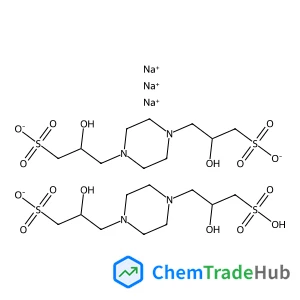
3,3'-(Piperazine-1,4-diyl)bis(2-hydroxypropane-1-sulfonic acid) Sodium Salt
CAS号:
108321-08-0
分子式:
C20H41N4Na3O16S4
![(3R)-3-(3-Fluorophenyl)-3-({[(2-methyl-2-propanyl)oxy]carbonyl}amino)propanoic acid structure](https://cnstatic.chemtradehub.com/structs/500/500789-04-8-20dd.webp "(3R)-3-(3-Fluorophenyl)-3-({[(2-methyl-2-propanyl)oxy]carbonyl}amino)propanoic acid structure")
推荐供应商





免责声明
本页面提供的学术期刊信息仅供参考和研究使用。我们与任何期刊出版商均无关联,也不处理投稿事宜。如有投稿相关咨询,请直接联系相关期刊出版商。
如发现页面信息有误,请发送邮件至 support@chemtradehub.com 联系我们。我们将及时核实并处理您的问题。