


Nylon 3 synthesized by ring opening polymerization with a metal-free catalyst
文献信息
发布日期
2011-10-19
DOI
10.1039/C1PY00334H
影响因子
5.582
作者
Hongjun Yang, Junpeng Zhao, Manqing Yan, Stergios Pispas
查看原文
摘要
We have synthesized nylon 3 via ring opening polymerization of 2-azetidinone (β-lactam) with 1-tert-butyl-4,4,4-tris(dimethylamino)-2,2-bis[tris(dimethylamino)- phosphoranylidenamino]-2Λ5,4Λ5-catenadi(phosphazene) (t-BuP4) as the catalyst in a mixture of dimethylacetamide (DMAc) and LiCl. The polymers have been characterized by nuclear magnetic resonance spectroscopy (NMR), Fourier transform infrared spectroscopy (FTIR), X-ray diffraction (XRD), laser light scattering (LLS) and viscometry. The synthesized nylon 3 is a linear and crystalline polymer with a molecular weight as high as 105 g mol−1. The intrinsic viscosity ([η]) relates to the weight average molecular weight (Mw) as [η] = 1.02 × 10⁻⁴Mw0.91. The effects of solvent, temperature and catalyst concentration on the polymerization have been examined. The molecular weight and yield increases with the amount of LiCl in the polymerization mixture, but both of them decrease with temperature at a temperature above 50 °C. As the catalyst concentration increases, the yield and the molecular weight of nylon 3 decrease. The possible mechanism for the initiation of polymerization is discussed.
期刊推荐
Current Opinion in Colloid & Interface Science
Russian Journal of General Chemistry
Saudi Pharmaceutical Journal

Russian Journal of Bioorganic Chemistry

Acta Materialia
Russian Journal of Applied Chemistry
Journal of Peptide Science
New Journal of Chemistry

Chemical Communications
Organic Process Research & Development
相关文献
Detailed kinetics of tetrafluoroethene ozonolysis
Minh v. Duong, Hieu T. Nguyen, Lam K. Huynh
2018-10-18
Paper
DOI: 10.1039/C8CP05386C
Topologically close-packed characteristic of amorphous tantalum
Zhizhou Wu, Lin Lang, Aibing Yu, Quan Xie, Rangsu Liu
2018-10-18
Paper
DOI: 10.1039/C8CP05897K
Atomistic determination of the surface structure of Cu2O(111): experiment and theory
Rui Zhang, Liang Li, Kelvin B. Chang, Maria K. Y. Chan, Jeffrey R. Guest
2018-10-12
Paper
DOI: 10.1039/C8CP06023A
Theoretical analysis of crystallization by homogeneous nucleation of water droplets
Kyoko K. Tanaka, Yuki Kimura
2019-01-05
Paper
DOI: 10.1039/C8CP06650G
Ice-binding site of surface-bound type III antifreeze protein partially decoupled from water
Dominique Verreault, Sarah Alamdari, Steven J. Roeters, Ravindra Pandey, Jim Pfaendtner
2018-09-17
Paper
DOI: 10.1039/C8CP03382J
Molecular dynamics study on ions and water confined in the nanometer channel of Friedel's salt: structure, dynamics and interfacial interaction
Penggang Wang, Yuting Jia, Tao Li, Dongshuai Hou, Qi Zheng
2018-09-25
Paper
DOI: 10.1039/C8CP02450B
The effect of two types of dibenzoannulation of pentalene on molecular energies and magnetically induced currents
Marija Baranac-Stojanović, Milovan Stojanović
2019-01-15
Paper
DOI: 10.1039/C8CP07875K
Tuning the oscillatory dynamics of the Belousov–Zhabotinsky reaction using ruthenium nanoparticle decorated graphene
D. Jaya Prasanna Kumar, Sachin Verma, Kabeer Jasuja, Pratyush Dayal
2019-01-16
Paper
DOI: 10.1039/C8CP06766J
The low temperature D+ + H2 → HD + H+ reaction rate coefficient: a ring polymer molecular dynamics and quasi-classical trajectory study
Somnath Bhowmick, Duncan Bossion, Yohann Scribano, Yury V. Suleimanov
2018-09-26
Paper
DOI: 10.1039/C8CP05398G
您可能还喜欢
化合物问答
2-(甲基磺酰基)嘧啶-5-胺(CAS号:56621-92-2)适用哪些法规指南?
该化合物适用的法规指南包括GHS(全球化学品统一分类和标签制度)分类为特定目标器官毒性-单次接触类别3;根据欧盟REACH法规,该化合物需要进行注册和评估;在美...
56621-92-22-(Methylsulfonyl)py...
化合物问答
在合成中是否有4-(4-氯苯基)-1H-咪唑(CAS号:35512-29-9)的替代品?
在合成中,可以考虑使用一些类似的化合物作为4-(4-氯苯基)-1H-咪唑的替代品,如4-(4-溴苯基)-1H-咪唑或4-(4-甲氧基苯基)-1H-咪唑。这些化合...
35512-29-94-(4-Chlorophenyl)-1...
化合物问答
什么是N~2~-甲基丙氨酸酰胺(CAS号:32012-16-1)?
N~2~-甲基丙氨酸酰胺是一种有机化合物,其化学名为2-(Methylamino)propanamide。它是一种酰胺类化合物,分子式为C4H10N2O,相对分...
32012-16-12-(Methylamino)propa...
化合物问答
如何处理含有N-苄基-3-氨基氧杂环丁烷草酸盐(CAS号:1956341-96-0)的废料?
处理含有N-苄基-3-氨基氧杂环丁烷草酸盐(CAS号:1956341-96-0)的废料时,应首先确保遵循相关法规要求,如GHS和REACH等。通常,废液应先进行...
1956341-96-0N-Benzyloxetan-3-ami...
化合物问答
4-bromo-2-chloro-6-methylbenzoic acid(CAS号:877149-07-0)的物理化学性质是什么?
4-溴-2-氯-6-甲基苯甲酸是一种固体化合物,具有较高的熔点和较低的沸点。它的分子量为261.03 g/mol。该化合物在水中几乎不溶,在有机溶剂中溶解度适中...
877149-07-04-Bromo-2-chloro-6-m...
化合物问答
2-[(2,5-二氯-4-嘧啶)氨基]-N-甲基苯甲酰胺(CAS号:761440-08-8)通常如何合成?
该化合物通常通过缩合反应合成,典型的方法是将2,5-二氯嘧啶与N-甲基苯甲酰胺在碱性条件下进行偶联反应。常用的碱包括NaH、LDA等强碱。该合成路线具有较高的选...
761440-08-82-[(2,5-dichloropyri...
4752-10-71,4-Dichlorophthalaz...
化合物问答
在合成中是否有3,5-二溴-4-甲基苯胺(CAS号:13194-73-5)的替代品?
3,5-二溴-4-甲基苯胺在某些合成路线中可能没有直接替代品。然而,在某些应用场景下,可以考虑使用其他类似结构的化合物如3,5-二溴-4-硝基苯胺或3,5-二碘...
13194-73-53,5-Dibromo-4-methyl...
化合物问答
2-氯喹啉-4-羧酸甲酯(CAS号:62482-26-2)的主要用途是什么?
2-氯喹啉-4-羧酸甲酯主要用于有机合成和药物合成领域,作为中间体或原料。它在合成某些药物和染料时具有重要作用。此外,该化合物还可能用于某些特定的化学研究中。
62482-26-2Methyl 2-chloro-4-qu...
化合物问答
i>]吡啶(CAS号:474708-88-8)安全吗?
6-溴-8-氯咪唑[1,2-a]吡啶在操作过程中需要谨慎以确保安全。该化合物具有一定的毒性,吸入其蒸气或粉尘可能导致呼吸道刺激。处理时应佩戴适当的防护装备,如手...
474708-88-86-Bromo-8-chloroimid...
来源期刊
Polymer Chemistry

CiteScore:
8.6
自引率:
7.3%
年发文量:
457
Polymer Chemistry welcomes submissions in all areas of polymer science that have a strong focus on macromolecular chemistry. Manuscripts may cover a broad range of fields, yet no direct application focus is required.
推荐化合物
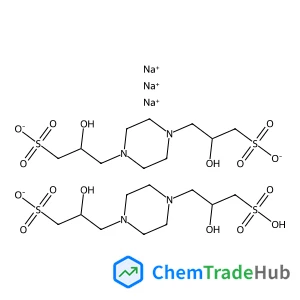
3,3'-(Piperazine-1,4-diyl)bis(2-hydroxypropane-1-sulfonic acid) Sodium Salt
CAS号:
108321-08-0
分子式:
C20H41N4Na3O16S4
![2,4,5-Trichloro-7H-pyrrolo[2,3-d]pyrimidine structure](https://cnstatic.chemtradehub.com/structs/105/1053228-28-6-fba3.webp "2,4,5-Trichloro-7H-pyrrolo[2,3-d]pyrimidine structure")
![O-Benzyl-N-[(9H-fluoren-9-ylmethoxy)carbonyl]-N-methyl-L-threonine structure](https://cnstatic.chemtradehub.com/structs/198/198561-81-8-a56e.webp "O-Benzyl-N-[(9H-fluoren-9-ylmethoxy)carbonyl]-N-methyl-L-threonine structure")
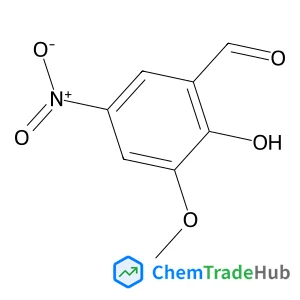
推荐供应商






免责声明
本页面提供的学术期刊信息仅供参考和研究使用。我们与任何期刊出版商均无关联,也不处理投稿事宜。如有投稿相关咨询,请直接联系相关期刊出版商。
如发现页面信息有误,请发送邮件至 support@chemtradehub.com 联系我们。我们将及时核实并处理您的问题。