


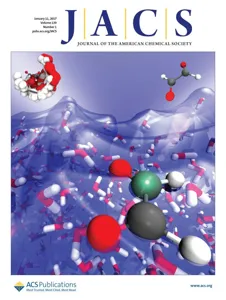


Hydrated-ion ordering in electrical double layers
文献信息
发布日期
2012-03-22
DOI
10.1039/C2CP40255F
影响因子
3.676
作者
Tanja Drobek, Tobias Balmer
查看原文
摘要
In this work we revisit the surface forces measured between two atomically flat mica surfaces submerged in a reservoir of potassium nitrate (KNO3) solution. We consider a comprehensive range of concentrations from 0.08 mM to 2.6 M. The significantly improved resolution available from the extended surface force apparatus (eSFA) allows the distinction of hydration structures and hydrated-ion correlations. Above concentrations of 0.3 mM, hydrated-ion correlations give rise to multiple collective transitions (4 ± 1 Å) in the electrical double layers upon interpenetration. These features are interpreted as the result of hydrated-ion ordering (e.g. layering), in contrast to the traditional interpretation invoking water layering. The hydrated-ion layer adjacent to the surface (i.e. outer Helmholtz layer) is particularly well defined and plays a distinctive role. It can be either collectively expelled in a 5.8 ± 0.3 Å film-thickness transition or collectively forced to associate with the surface by external mechanical work. The latter is observed as a characteristic 2.9 ± 0.3 Å film-thickness transition along with an abrupt decrease of surface adhesion at concentrations above 1 mM. At concentrations as low as 20 mM, attractive surface forces are measured in deviation to the DLVO theory. The hydration number in the confined electrolyte seems to be significantly below that of the bulk. A 1–3 nm thick ionic layer solidifies at the surfaces at concentrations >100 mM, i.e. below bulk saturation.
相关文献
Thiol–isocyanate “click” reactions: rapid development of functional polymeric surfaces
Ryan M. Hensarling, Santosh B. Rahane, Arthur P. LeBlanc, Bradley J. Sparks, Evan M. White, Jason Locklin, Derek L. Patton
2010-10-18
Communication
DOI: 10.1039/C0PY00292E
Organic-inorganic nanocomposites synthesized viaminiemulsion polymerization
Min Chen, Limin Wu
2010-11-15
Review Article
DOI: 10.1039/C0PY00284D
Polymeric vesicles with well-defined poly(methyl methacrylate) (PMMA) brushes via surface-initiated photopolymerization (SIPP)
Fengting Chen, Xuesong Jiang, Rui Liu, Jie Yin
2010-11-05
Paper
DOI: 10.1039/C0PY00288G
One-step preparation of fluorescent inorganic–organic hybrid material used for explosive sensing
Qi Chen, Ding Zhou, Jie Cao, Yu-Jian He, Bao-Hang Han
2011-02-21
Paper
DOI: 10.1039/C1PY00012H
Synthesis, characterization and cellular internalization of poly(2-hydroxyethyl methacrylate) bearing α-d-mannopyranose
Makoto Obata, Mayumi Shimizu, Tomoko Ohta, Aya Matsushige, Kaoru Iwai, Shiho Hirohara, Masao Tanihara
2010-11-26
Paper
DOI: 10.1039/C0PY00326C
BF3·Et2O-mediated Friedel–Crafts C–H bond polymerization to synthesize π-conjugation-interrupted polymer semiconductors
Zheng-Dong Liu, Yong-Zheng Chang, Chang-Jin Ou, Jin-Yi Lin, Ling-Hai Xie, Cheng-Rong Yin, Ming-Deng Yi, Yan Qian, Nai-En Shi, Wei Huang
2011-07-27
Communication
DOI: 10.1039/C1PY00203A
Design and synthesis of thermo-responsive hyperbranched poly(amine-ester)s as acid-sensitive drug carriers
Yan Pang, Jinyao Liu, Yue Su, Jieli Wu, Lijuan Zhu, Deyue Yan, Bangshang Zhu
2011-04-20
Paper
DOI: 10.1039/C1PY00053E
Dual-stimuli sensitive nanogels fabricated by self-association of thiolated hydroxypropyl cellulose
Junjun Tan, Hongliang Kang, Ruigang Liu
2010-11-25
Paper
DOI: 10.1039/C0PY00348D
Phase separated structures in tethered dPS–PMMA copolymer films revealed using X-ray scattering with a novel contrast enhancement agent
Benjamin M. D. O'Driscoll, Gemma E. Newby, Ian W. Hamley
2010-11-10
Paper
DOI: 10.1039/C0PY00289E
您可能还喜欢
化合物问答
2-(甲基磺酰基)嘧啶-5-胺(CAS号:56621-92-2)适用哪些法规指南?
该化合物适用的法规指南包括GHS(全球化学品统一分类和标签制度)分类为特定目标器官毒性-单次接触类别3;根据欧盟REACH法规,该化合物需要进行注册和评估;在美...
56621-92-22-(Methylsulfonyl)py...
化合物问答
在合成中是否有4-(4-氯苯基)-1H-咪唑(CAS号:35512-29-9)的替代品?
在合成中,可以考虑使用一些类似的化合物作为4-(4-氯苯基)-1H-咪唑的替代品,如4-(4-溴苯基)-1H-咪唑或4-(4-甲氧基苯基)-1H-咪唑。这些化合...
35512-29-94-(4-Chlorophenyl)-1...
化合物问答
什么是N~2~-甲基丙氨酸酰胺(CAS号:32012-16-1)?
N~2~-甲基丙氨酸酰胺是一种有机化合物,其化学名为2-(Methylamino)propanamide。它是一种酰胺类化合物,分子式为C4H10N2O,相对分...
32012-16-12-(Methylamino)propa...
化合物问答
如何处理含有N-苄基-3-氨基氧杂环丁烷草酸盐(CAS号:1956341-96-0)的废料?
处理含有N-苄基-3-氨基氧杂环丁烷草酸盐(CAS号:1956341-96-0)的废料时,应首先确保遵循相关法规要求,如GHS和REACH等。通常,废液应先进行...
1956341-96-0N-Benzyloxetan-3-ami...
化合物问答
4-bromo-2-chloro-6-methylbenzoic acid(CAS号:877149-07-0)的物理化学性质是什么?
4-溴-2-氯-6-甲基苯甲酸是一种固体化合物,具有较高的熔点和较低的沸点。它的分子量为261.03 g/mol。该化合物在水中几乎不溶,在有机溶剂中溶解度适中...
877149-07-04-Bromo-2-chloro-6-m...
化合物问答
2-[(2,5-二氯-4-嘧啶)氨基]-N-甲基苯甲酰胺(CAS号:761440-08-8)通常如何合成?
该化合物通常通过缩合反应合成,典型的方法是将2,5-二氯嘧啶与N-甲基苯甲酰胺在碱性条件下进行偶联反应。常用的碱包括NaH、LDA等强碱。该合成路线具有较高的选...
761440-08-82-[(2,5-dichloropyri...
4752-10-71,4-Dichlorophthalaz...
化合物问答
在合成中是否有3,5-二溴-4-甲基苯胺(CAS号:13194-73-5)的替代品?
3,5-二溴-4-甲基苯胺在某些合成路线中可能没有直接替代品。然而,在某些应用场景下,可以考虑使用其他类似结构的化合物如3,5-二溴-4-硝基苯胺或3,5-二碘...
13194-73-53,5-Dibromo-4-methyl...
化合物问答
2-氯喹啉-4-羧酸甲酯(CAS号:62482-26-2)的主要用途是什么?
2-氯喹啉-4-羧酸甲酯主要用于有机合成和药物合成领域,作为中间体或原料。它在合成某些药物和染料时具有重要作用。此外,该化合物还可能用于某些特定的化学研究中。
62482-26-2Methyl 2-chloro-4-qu...
化合物问答
i>]吡啶(CAS号:474708-88-8)安全吗?
6-溴-8-氯咪唑[1,2-a]吡啶在操作过程中需要谨慎以确保安全。该化合物具有一定的毒性,吸入其蒸气或粉尘可能导致呼吸道刺激。处理时应佩戴适当的防护装备,如手...
474708-88-86-Bromo-8-chloroimid...
来源期刊
Physical Chemistry Chemical Physics

CiteScore:
5.5
自引率:
10.3%
年发文量:
3036
Physical Chemistry Chemical Physics (PCCP) is an international journal co-owned by 19 physical chemistry and physics societies from around the world. This journal publishes original, cutting-edge research in physical chemistry, chemical physics and biophysical chemistry. To be suitable for publication in PCCP, articles must include significant innovation and/or insight into physical chemistry; this is the most important criterion that reviewers and Editors will judge against when evaluating submissions. The journal has a broad scope and welcomes contributions spanning experiment, theory, computation and data science. Topical coverage includes spectroscopy, dynamics, kinetics, statistical mechanics, thermodynamics, electrochemistry, catalysis, surface science, quantum mechanics, quantum computing and machine learning. Interdisciplinary research areas such as polymers and soft matter, materials, nanoscience, energy, surfaces/interfaces, and biophysical chemistry are welcomed if they demonstrate significant innovation and/or insight into physical chemistry. Joined experimental/theoretical studies are particularly appreciated when complementary and based on up-to-date approaches.
推荐化合物
![Benzyl spiro[indole-3,4'-piperidine]-1(2H)-carboxylate hydrochloride (1:1) structure](https://cnstatic.chemtradehub.com/structs/159/159635-46-8-8de0.webp "Benzyl spiro[indole-3,4'-piperidine]-1(2H)-carboxylate hydrochloride (1:1) structure")
Benzyl spiro[indole-3,4'-piperidine]-1(2H)-carboxylate hydrochloride (1:1)
CAS号:
159635-46-8
分子式:
C20H23ClN2O2
推荐供应商






免责声明
本页面提供的学术期刊信息仅供参考和研究使用。我们与任何期刊出版商均无关联,也不处理投稿事宜。如有投稿相关咨询,请直接联系相关期刊出版商。
如发现页面信息有误,请发送邮件至 support@chemtradehub.com 联系我们。我们将及时核实并处理您的问题。