








Self-healing systems based on disulfide–thiol exchange reactions
文献信息
发布日期
2013-03-13
DOI
10.1039/C3PY00087G
影响因子
5.582
作者
Mark Pepels, Ivo Filot, Han Goossens
查看原文
摘要
New thermoset systems based on disulfide bonds were synthesized with self-healing capabilities. The self-healing mechanism is not related to disulfide–disulfide exchange reactions, but to thiol–disulfide exchange reactions that are pH-dependent. Stress relaxation experiments showed large relaxation for systems having PTM2 as a curing agent, which indicates that the system can rearrange its molecular structure as a mechanism to release stress. However, relaxation rates decreased for samples tested longer after production. This indicates the disappearance of thiol-groups probably caused by thiol–thiol oxidation.
相关文献
Direct determination of rate constants for coupling between aromatic radical anions and alkyl and benzyl radicals by laser-flash photolysis
Torben Lund, Peter Christensen, Robert Wilbrandt
2003-02-20
Paper
DOI: 10.1039/B209594G
Cascade intramolecular rearrangement/cycloaddition of nitrocyclopropane carboxylates with alkynes/alkenes: access to uncommon bi(hetero)cyclic systems
Rohit Kumar Varshnaya, Priyanka Singh, Navpreet Kaur, Prabal Banerjee
2021-01-21
Research Article
DOI: 10.1039/D0QO01535K
Correction: Fused ambipolar aza-isoindigos with NIR absorption
Danlei Zhu, Hailiang Liao, Sheik Haseena, Mahesh Kumar Ravva, Shengyu Cong, Liuyuan Lan, Yazhou Wang, Zhengke Li, Lang Jiang, Wan Yue
2021-03-03
Correction
DOI: 10.1039/D1QO90017J
Metallaphotoredox-catalyzed C–H activation: regio-selective annulation of allenes with benzamide‡
Zihao Zhu, Yuyuan Chen, Xueyao Li, Qingyun Yang, Jie Xia, Wenxuan Zhang, Chao Zhang, Song Wu
2021-01-04
Research Article
DOI: 10.1039/D0QO01127D
A [15]paracyclophenone and its fluorenone-containing derivatives: syntheses and binding to nerve agent mimics via aryl-CH hydrogen bonding interactions
Peiren Liu, Hongliang Wang, Hong Zeng, Xin Hong, Feihe Huang
2020-05-14
Research Article
DOI: 10.1039/D0QO00456A
Theoretical study of rhodium- and cobalt-catalyzed decarboxylative transformations of isoxazolones: origin of product selectivity
Wei Rong, Tian Zhang, Ting Li, Juan Li
2021-01-26
Research Article
DOI: 10.1039/D0QO01498B
A unique high-diversity natural product collection as a reservoir of new therapeutic leads
Francesca Ghirga, Deborah Quaglio, Mattia Mori, Silvia Cammarone, Antonia Iazzetti, Antonella Goggiamani, Cinzia Ingallina, Bruno Botta, Andrea Calcaterra
2020-12-11
Review Article
DOI: 10.1039/D0QO01210F
A mechanistic study of the manganese porphyrin-catalyzed C–H isocyanation reaction
Ning Liu, Xiahe Chen, Liyuan Jin, Yun-Fang Yang, Yuan-Bin She
2021-02-18
Research Article
DOI: 10.1039/D0QO01442G
您可能还喜欢
化合物问答
4-[4-三氟甲基苯基]恶唑(CAS号:1126636-40-5)通常如何合成?
4-[4-三氟甲基苯基]恶唑通常通过将4-三氟甲基苯酚与异硫氰酸苯酯在有机溶剂中进行酯化反应合成。该反应可在无水条件下,使用适当的催化剂,如四丁基氢氧化铵,以提...
1126636-40-54-(4-(Trifluoromethy...
59729-32-71-[3-(Dimethylamino)...
化合物问答
RockPhos Pd G3(CAS号:2009020-38-4)通常如何合成?
RockPhos Pd G3 通常通过钯催化偶联反应合成,使用配体 (2'-Amino-2-biphenylyl)(methanesulfonato-kappa...
2009020-38-4(2'-Amino-2-biphenyl...
化合物问答
1-哌啶甲酰胺(CAS号:2158-03-4)的市场或研究趋势如何?
1-哌啶甲酰胺作为有机合成中的重要中间体,其市场需求主要受医药、农药、染料等行业推动。近年来,随着新药开发和绿色化学的发展,该化合物的研究趋势集中在开发更高效、...
2158-03-41-Piperidinecarboxam...
化合物问答
2-(二苯基膦基)乙胺(CAS号:4848-43-5)适用哪些法规指南?
2-(二苯基膦基)乙胺适用于多种法规指南,包括但不限于《全球化学品统一分类和标签制度》(GHS),欧盟《化学品注册、评估、授权和限制》法规(REACH),以及美...
4848-43-52-(Diphenylphosphino...
化合物问答
如何储存间苯二甲酸二烯丙酯(CAS号:1087-21-4)?
间苯二甲酸二烯丙酯应储存在阴凉、干燥、通风良好的地方,远离火源和热源。储存容器应密封,避免光照和高温。储存温度应控制在25℃以下,相对湿度应低于80%。避免与其...
1087-21-4Diallyl isophthalate
化合物问答
什么是间甲苯异硫代异氰酸酯(CAS号:621-30-7)?
间甲苯异硫代异氰酸酯是一种有机化合物,分子式为C7H7NO2S,具有刺激性气味。它是一种重要的有机合成中间体,在合成其他化合物时广泛应用。
621-30-71-Isothiocyanato-3-m...
化合物问答
在合成中是否有N-Boc-D-苯丙氨醇(CAS号:106454-69-7)的替代品?
在合成中,可以考虑使用N-Cbz-D-苯丙氨醇或N-Fmoc-D-苯丙氨醇作为替代品。这些化合物同样具有保护氨基的功能,且在合成过程中表现出良好的反应性能。
106454-69-72-Methyl-2-propanyl ...
化合物问答
3-羟甲基-2-氧异丙基吡啶(CAS号:954240-50-7)的主要用途是什么?
3-羟甲基-2-氧异丙基吡啶主要用于有机合成领域,可以作为合成其他药物、农药或精细化学品的中间体。此外,它还可能在实验室研究中作为特定反应的前体或溶剂。
954240-50-7(2-Isopropoxy-3-pyri...
化合物问答
6-氨基-9-甲基嘌呤(CAS号:700-00-5)应用于哪些行业?
6-氨基-9-甲基嘌呤目前主要应用于医药行业,作为某些药物的中间体。此外,它还可能用于聚合物、传感器和半导体的某些领域,作为功能性单体或掺杂剂。
700-00-59-Methyl-9H-purin-6-...
来源期刊
Polymer Chemistry

CiteScore:
8.6
自引率:
7.3%
年发文量:
457
Polymer Chemistry welcomes submissions in all areas of polymer science that have a strong focus on macromolecular chemistry. Manuscripts may cover a broad range of fields, yet no direct application focus is required.
推荐化合物
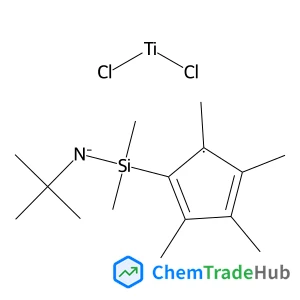
2,3,4,5-TETRAMETHYLCYCLOPENTADIENEDIMETHYLSILYL-TERT-BUTYLAMIDO TITANIUM DICHLORIDE
CAS号:
135072-61-6
分子式:
C15H27Cl2NSiTi-
推荐供应商




免责声明
本页面提供的学术期刊信息仅供参考和研究使用。我们与任何期刊出版商均无关联,也不处理投稿事宜。如有投稿相关咨询,请直接联系相关期刊出版商。
如发现页面信息有误,请发送邮件至 support@chemtradehub.com 联系我们。我们将及时核实并处理您的问题。