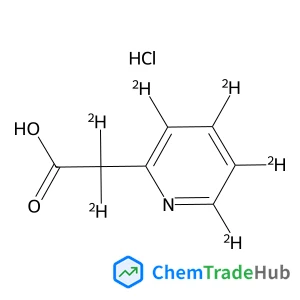
2,2-dideuterio-2-(3,4,5,6-tetradeuterio-2-pyridyl)acetic acid;hydrochloride
CAS号:
1329799-67-8
分子式:
C7H2ClD6NO2
Rong Jin, Chao Lin, Aoneng Cao
In this study, water-soluble chitosan–glycolic acid (GA)/tyrosine (Tyr) conjugates (denoted as CH–GA/Tyr) are designed and prepared for fast, in situ formation of hydrogels by tyrosinase or horseradish peroxidase (HRP)-mediated crosslinking under physiological conditions. These CH–GA/Tyr conjugates with a phenol group and primary amine in tyrosine residue are readily obtained by conjugating GA and N-tert-butoxycarbonyl (Boc)–tyrosine to native chitosan and then deprotection of the Boc group. The CH–GA20/Tyr14 with a degree of substitution (DS, defined as the number of substituted NH2 groups per 100 glucopyranose rings of chitosan) of GA of 20 and the DS of Tyr of 14 displays higher water solubility with a maximum pH value of 14.0 when compared to native chitosan, CH–GA20 and phloretic acid-coupled CH–GA20. Both tyrosinase and HRP can effectively crosslink CH–GA/Tyr conjugates to form hydrogels. HRP can mediate a faster gelation process than tyrosinase. The gelation time of the CH–GA/Tyr hydrogels may be adjusted from seconds to minutes by modulating the concentration of the enzymes/conjugates and DS of Tyr residue. Rheological analysis results show that these hydrogels are elastic and that the HRP-crosslinked hydrogels have higher storage modulus as compared to the tyrosinase-crosslinked hydrogels. The tyrosinase-crosslinked hydrogels have lower cytotoxicity as compared to the HRP-crosslinked hydrogels when NIH/3T3 cells are encapsulated in these hydrogels. Further, the tyrosinase-based hydrogels can maintain high survival of chondrocytes over 14 days. The results of this study show that the tyrosinase-crosslinked chitosan-based hydrogels have high potential for cartilage tissue engineering.
Russian Journal of Bioorganic Chemistry
Russian Journal of Organic Chemistry

New Journal of Chemistry

Chemistry Education Research and Practice

Journal of Natural Medicines
Russian Journal of Coordination Chemistry

Saudi Pharmaceutical Journal
Organic Process Research & Development
Nature Medicine

Russian Chemical Bulletin
DOI: 10.1039/D1CP02632A
Fei Li, Dong Wang, Xue-Qing Gong
DOI: 10.1039/D1CP02787E
Long Zhao, Matthew Prendergast, Ralf I. Kaiser, Bo Xu, Wenchao Lu, Musahid Ahmed, A. Hasan Howlader, Stanislaw F. Wnuk, Alexander S. Korotchenko, Mikhail M. Evseev, Eugene K. Bashkirov, Alexander M. Mebel
DOI: 10.1039/D1CP02169A
Travis Sikes, Colin Banyon, Rachel A. Schwind, Patrick T. Lynch, Andrea Comandini, Raghu Sivaramakrishnan, Robert S. Tranter
DOI: 10.1039/D1CP02437J
Luisa Weirich, Christian Merten
DOI: 10.1039/D1CP01846A
DOI: 10.1039/D1CP90169A
Sharmin Akter, Jorge A. Vargas, Kamal Sharkas, Juan E. Peralta, Koblar A. Jackson
DOI: 10.1039/D0CP06512A
Shun Kataoka, Makoto Harada, Tetsuo Okada
DOI: 10.1039/D1CP01655E
Shashwat Singh, Valérie Pralong, Prabeer Barpanda
DOI: 10.1039/D1CP01741A
1,2-环己二酮环乙缩醛应储存在阴凉、干燥、通风良好的地方,避免阳光直射。建议使用密封容器保存,并保持环境温度在室温范围内,远离火源和热源。
Ecopladib作为一种新型的药物,主要应用于治疗高胆固醇等疾病。目前,市场和研究趋势显示,Ecopladib因其独特的药理作用而受到关注。随着对心血管疾病治...
2,3-二甲基-3H-咪唑[4,5-c]吡啶通常通过咪唑和2,3-二甲基吡啶的缩合反应合成。具体来说,将咪唑和2,3-二甲基吡啶在适当的溶剂中进行加热或加压反应...
该化合物在药物化学和有机合成中有一定的应用。近年来,随着对新型药物化合物的需求增加,该化合物的研究趋势主要集中在探索其生物活性,尤其是其在神经系统疾病治疗中的潜...
盐酸甘氨酸丁酯应储存在阴凉、干燥、通风良好的地方,避免阳光直射和高温环境,温度应控制在25℃以下。储存容器应密封,避免与空气中的水分和酸性物质接触,以防发生水解...
2-碘-N,N-二甲基苯胺是一种有机化合物,化学名为2-Iodo-N,N-dimethylbenzamide。其分子式为C<sub>9</sub>H<sub>1...
随着医药、农药和新材料领域的发展,该化合物作为关键中间体的应用日益增多。特别是在药物合成中,由于其独特的化学性质,可以用于合成多种药物分子。未来的研究趋势可能集...
2,4-二溴-6-三氟甲基嘧啶通常通过溴化反应合成。首先,将6-三氟甲基嘧啶与溴化剂(如液溴)在适当的溶剂(如二氯甲烷、四氢呋喃)中反应,加入适当的催化剂(如四...

Polymer Chemistry welcomes submissions in all areas of polymer science that have a strong focus on macromolecular chemistry. Manuscripts may cover a broad range of fields, yet no direct application focus is required.