


Multi-stimuli responsive polymers – the all-in-one talents
文献信息
发布日期
2013-08-07
DOI
10.1039/C3PY00880K
影响因子
5.582
作者
Florian D. Jochum, Patrick Theato
查看原文
摘要
Stimuli-responsive polymers have gained increasing attention, which is attributed to the manifold applications they can be used for. Several years' intensive research was invested in stimuli-responsive polymers. Their stimuli-responsiveness led not only to novel responsive groups, which enabled the translation of an external physical impact into a change of a material property, but also to polymers that are equipped with more than one responsive group. The integration of several responsive moieties within one polymer yields smart polymers exhibiting complex responsive behaviour of the polymers. This review summarises recent developments in the area of multi-stimuli responsive polymers, laying the focus on the improved, multifaceted response of polymer materials depending on the impact of several external stimuli.
期刊推荐

Current Opinion in Colloid & Interface Science

Russian Journal of Organic Chemistry
Journal of Natural Medicines
Russian Journal of Bioorganic Chemistry

Chemical Communications
Current Opinion in Solid State & Materials Science
Acta Materialia

Russian Journal of Applied Chemistry

Organic Process Research & Development
Russian Chemical Bulletin
相关文献
Wide-angle X-ray scattering and molecular dynamics simulations of supercooled protein hydration water
Maddalena Bin, Rafat Yousif, Sharon Berkowicz, Sudipta Das, Daniel Schlesinger, Fivos Perakis
2021-07-12
Paper
DOI: 10.1039/D1CP02126E
Mechanical properties of nonstoichiometric cubic titanium carbide TiCy
2021-08-16
Paper
DOI: 10.1039/D1CP02697F
Effect of solvent motions on the dynamics of the Diels–Alder reaction
Xiaoyong Zhang, Jeremy N. Harvey
2021-12-13
Paper
DOI: 10.1039/D1CP05272A
Ultrafast vibrational wave packet dynamics of the aqueous tyrosyl radical anion induced by photodetachment
Muhammad Shafiq Bin Mohd Yusof, Yong Liang Lim, Zhi-Heng Loh
2021-08-16
Paper
DOI: 10.1039/D1CP02975D
Fluorescence band exchange narrowing in a series of squaraine oligomers: energetic vs. structural disorder
Arthur Turkin, Pavel Malý
2021-08-12
Paper
DOI: 10.1039/D1CP02136B
Polar zinc oxide surface in electrolyte solutions: an atomic view of reconstruction, hydration and surface states
Yudai Samejima, Seiichiro Nakabayashi
2021-08-04
Paper
DOI: 10.1039/D1CP02371C
Structure and solvation dynamics of the hydroxide ion in ice-like water clusters: a CCSD(T) and car–parrinello molecular dynamics study
2021-08-24
Paper
DOI: 10.1039/D1CP02524D
Mechanistic insight into the roles of anions and cations in the degradation of poly(ethylene terephthalate) catalyzed by ionic liquids
Lei Zhou, Xingmei Lu, Yao Li, Xiaoqian Yao, Shenyu Cheng, Gangwei Chen, Chengsheng Ge
2021-08-16
Paper
DOI: 10.1039/D1CP02038B
First principles calculations on lithium diffusion near the surface and in the bulk of Fe-doped LiCoPO4
Kuan-Ching Wu, Chieh-Ming Hsieh, Bor Kae Chang
2021-12-07
Paper
DOI: 10.1039/D1CP04517B
Ground and excited electronic structures of metal encapsulated nanocages: the cases of endohedral M@C20H20 (M = K, Rb, Ca, Sr) and M@C36H36 (M = Na, K, Rb)
2021-08-03
Paper
DOI: 10.1039/D1CP03146E
您可能还喜欢
化合物问答
如何储存1,2-环己二酮环乙缩醛(CAS号:4746-96-7)?
1,2-环己二酮环乙缩醛应储存在阴凉、干燥、通风良好的地方,避免阳光直射。建议使用密封容器保存,并保持环境温度在室温范围内,远离火源和热源。
4746-96-71,4-Dioxaspiro[4.5]d...
化合物问答
Ecopladib(CAS号:381683-92-7)的市场或研究趋势如何?
Ecopladib作为一种新型的药物,主要应用于治疗高胆固醇等疾病。目前,市场和研究趋势显示,Ecopladib因其独特的药理作用而受到关注。随着对心血管疾病治...
381683-92-7Ecopladib
化合物问答
2,3-Dimethyl-3H-imidazo[4,5-c]pyridine(CAS号:52538-09-7)通常如何合成?
2,3-二甲基-3H-咪唑[4,5-c]吡啶通常通过咪唑和2,3-二甲基吡啶的缩合反应合成。具体来说,将咪唑和2,3-二甲基吡啶在适当的溶剂中进行加热或加压反应...
52538-09-72,3-Dimethyl-3H-imid...
化合物问答
2,3,4,5-tetrahydro-1H-3-苯并氮杂环;盐酸盐(CAS号:17379-01-0)的市场或研究趋势如何?
该化合物在药物化学和有机合成中有一定的应用。近年来,随着对新型药物化合物的需求增加,该化合物的研究趋势主要集中在探索其生物活性,尤其是其在神经系统疾病治疗中的潜...
17379-01-02,3,4,5-Tetrahydro-1...
68-90-6(2-Ethyl-1-benzofura...
化合物问答
如何储存盐酸甘氨酸丁酯(CAS号:13048-99-2)?
盐酸甘氨酸丁酯应储存在阴凉、干燥、通风良好的地方,避免阳光直射和高温环境,温度应控制在25℃以下。储存容器应密封,避免与空气中的水分和酸性物质接触,以防发生水解...
13048-99-2Butyl glycinate hydr...
化合物问答
什么是2-Iodo-N,N-dimethylbenzamide(CAS号:54616-46-5)?
2-碘-N,N-二甲基苯胺是一种有机化合物,化学名为2-Iodo-N,N-dimethylbenzamide。其分子式为C<sub>9</sub>H<sub>1...
54616-46-52-Iodo-N,N-dimethylb...
16817-90-6N-Cyclohexylglycinam...
化合物问答
5-溴-2-(4H-1,2,4-三唑-4-基)吡啶(CAS号:959240-99-4)的市场或研究趋势如何?
随着医药、农药和新材料领域的发展,该化合物作为关键中间体的应用日益增多。特别是在药物合成中,由于其独特的化学性质,可以用于合成多种药物分子。未来的研究趋势可能集...
959240-99-45-Bromo-2-(4H-1,2,4-...
化合物问答
2,4-二溴-6-三氟甲基嘧啶(CAS号:785778-00-9)通常如何合成?
2,4-二溴-6-三氟甲基嘧啶通常通过溴化反应合成。首先,将6-三氟甲基嘧啶与溴化剂(如液溴)在适当的溶剂(如二氯甲烷、四氢呋喃)中反应,加入适当的催化剂(如四...
785778-00-92,4-Dibromo-6-(trifl...
来源期刊
Polymer Chemistry

CiteScore:
8.6
自引率:
7.3%
年发文量:
457
Polymer Chemistry welcomes submissions in all areas of polymer science that have a strong focus on macromolecular chemistry. Manuscripts may cover a broad range of fields, yet no direct application focus is required.
推荐化合物
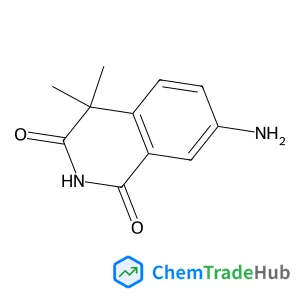
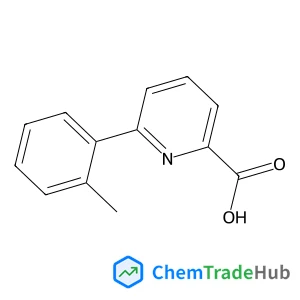
推荐供应商





免责声明
本页面提供的学术期刊信息仅供参考和研究使用。我们与任何期刊出版商均无关联,也不处理投稿事宜。如有投稿相关咨询,请直接联系相关期刊出版商。
如发现页面信息有误,请发送邮件至 support@chemtradehub.com 联系我们。我们将及时核实并处理您的问题。