







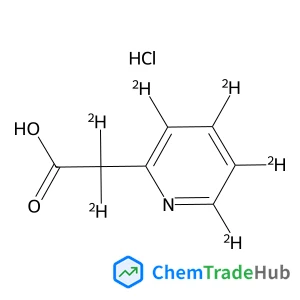
2,2-dideuterio-2-(3,4,5,6-tetradeuterio-2-pyridyl)acetic acid;hydrochloride
CAS号:
1329799-67-8
分子式:
C7H2ClD6NO2
Shampa R. Samanta, Hao-Jan Sun, David M. Haddleton, Virgil Percec
Herein we report the self-activation and activation of Cu(0) wire used to form a catalyst in single-electron transfer living radical polymerization (SET-LRP) in two fluorinated alcohols employed as solvents, 2,2,2-trifluoroethanol (TFE) and 2,2,3,3-tetrafluoropropanol (TFP). Self-activation and activation of Cu(0) wire by TFP exhibit a stronger increase of the apparent rate constant of propagation, kappp, compared to TFE. SET-LRP of methyl acrylate (MA) in DMSO catalyzed with TFP-activated Cu(0) wire showed a comparable kappp value to that of the hydrazine-activated Cu(0) wire-catalyzed counterpart. SET-LRP catalyzed with Cu(0) wire pretreated with TFE or TFP, and the in situactivation of Cu(0) wire while using TFE or TFP as solvent, proceeded with no initial induction period and exhibits predictable molecular weight evolution with conversion and narrow molecular weight distribution.
Neda Rahmani, Mohammad Ebrahim Ghazi, Morteza Izadifard, Alireza Shabani, Jost Adam
DOI: 10.1039/D1CP02479E
Shashwat Singh, Valérie Pralong, Prabeer Barpanda
DOI: 10.1039/D1CP01741A
M. Davoudiniya, K. Mirabbaszadeh
DOI: 10.1039/D1CP00340B
Kai Guo, Sitong Liu, Haoming Tu, Zhikun Wang, Liang Chen, Haiqing Lin, Maosheng Miao, Jing Xu, Wei Liu
DOI: 10.1039/D1CP03069H
Ignacio Sanchez-Burgos, Eduardo Sanz, Carlos Vega, Jorge R. Espinosa
DOI: 10.1039/D1CP01784E
Chiara Negri, Gabriele Deplano, Kirill A. Lomachenko, Ton V. W. Janssens, Elisa Borfecchia, Gloria Berlier, Silvia Bordiga
DOI: 10.1039/D1CP01754C
Shun Kataoka, Makoto Harada, Tetsuo Okada
DOI: 10.1039/D1CP01655E
Anna Maria Ferrari, Khaled E. El-Kelany, Francesco Silvio Gentile, Maddalena D’Amore, Roberto Dovesi
DOI: 10.1039/D1CP02363B
Georgia L. Thornton, Ryan Phelps, Andrew J. Orr-Ewing
DOI: 10.1039/D1CP03137F
Eitan Yohanan
DOI: 10.1039/D1CP05383C
1,2-环己二酮环乙缩醛应储存在阴凉、干燥、通风良好的地方,避免阳光直射。建议使用密封容器保存,并保持环境温度在室温范围内,远离火源和热源。
Ecopladib作为一种新型的药物,主要应用于治疗高胆固醇等疾病。目前,市场和研究趋势显示,Ecopladib因其独特的药理作用而受到关注。随着对心血管疾病治...
2,3-二甲基-3H-咪唑[4,5-c]吡啶通常通过咪唑和2,3-二甲基吡啶的缩合反应合成。具体来说,将咪唑和2,3-二甲基吡啶在适当的溶剂中进行加热或加压反应...
该化合物在药物化学和有机合成中有一定的应用。近年来,随着对新型药物化合物的需求增加,该化合物的研究趋势主要集中在探索其生物活性,尤其是其在神经系统疾病治疗中的潜...
盐酸甘氨酸丁酯应储存在阴凉、干燥、通风良好的地方,避免阳光直射和高温环境,温度应控制在25℃以下。储存容器应密封,避免与空气中的水分和酸性物质接触,以防发生水解...
2-碘-N,N-二甲基苯胺是一种有机化合物,化学名为2-Iodo-N,N-dimethylbenzamide。其分子式为C<sub>9</sub>H<sub>1...
随着医药、农药和新材料领域的发展,该化合物作为关键中间体的应用日益增多。特别是在药物合成中,由于其独特的化学性质,可以用于合成多种药物分子。未来的研究趋势可能集...
2,4-二溴-6-三氟甲基嘧啶通常通过溴化反应合成。首先,将6-三氟甲基嘧啶与溴化剂(如液溴)在适当的溶剂(如二氯甲烷、四氢呋喃)中反应,加入适当的催化剂(如四...

Polymer Chemistry welcomes submissions in all areas of polymer science that have a strong focus on macromolecular chemistry. Manuscripts may cover a broad range of fields, yet no direct application focus is required.
phosphoryl}methyl 4-methylbenzenesulfonate structure](https://cnstatic.chemtradehub.com/structs/864/864068-45-1-ba7c.webp "{[3-(Hexadecyloxy)propoxy](hydroxy)phosphoryl}methyl 4-methylbenzenesulfonate structure")
![(2E)-3-(3-Chlorophenyl)-N-{2-[4-(methylsulfonyl)-1-piperazinyl]-2-oxoethyl}acrylamide structure](https://cnstatic.chemtradehub.com/structs/250/2505001-54-5-c1e9.webp "(2E)-3-(3-Chlorophenyl)-N-{2-[4-(methylsulfonyl)-1-piperazinyl]-2-oxoethyl}acrylamide structure")




