


phosphoryl}methyl 4-methylbenzenesulfonate structure](https://cnstatic.chemtradehub.com/structs/864/864068-45-1-ba7c.webp "{[3-(Hexadecyloxy)propoxy](hydroxy)phosphoryl}methyl 4-methylbenzenesulfonate structure")
Combined in situ infrared and mass spectrometric analysis of high-energy heavy ion induced degradation of polyvinyl polymers
文献信息
发布日期
2013-10-01
DOI
10.1039/C3PY01062G
影响因子
5.582
作者
Wolfgang Ensinger
查看原文
摘要
Degradation of polyvinyl polymers (polyvinyl formal, polyvinyl alcohol, and polyvinyl acetate) by high-energy heavy ions was analysed with in situ mass spectrometry and infrared spectroscopy. Both at room temperature and at cryogenic temperature, the polymers are severely damaged by scission of side chains and the polymer backbone, releasing a large number of molecular fragments. Correlation of structural analysis of the damaged polymer and mass analysis of its volatile fragments gives plausible reaction mechanisms for the ion induced degradation. These are compared to thermal degradation. The differences found between the two degradation processes are due to the non-equilibrium character of the ion based process with its high electronic excitation and ionisation. The results are of practical relevance for applications of the polymers in devices of particle accelerators and space vehicles.
期刊推荐

Chemistry Education Research and Practice

Journal of Natural Medicines
Organic Process Research & Development
Current Opinion in Colloid & Interface Science
Journal of Peptide Science
Crystallography Reports

Chemical Communications
Saudi Pharmaceutical Journal
Russian Journal of General Chemistry
Nature Medicine
相关文献
Fluorescence band exchange narrowing in a series of squaraine oligomers: energetic vs. structural disorder
Arthur Turkin, Pavel Malý
2021-08-12
Paper
DOI: 10.1039/D1CP02136B
Mechanical properties of nonstoichiometric cubic titanium carbide TiCy
2021-08-16
Paper
DOI: 10.1039/D1CP02697F
Defect evolution behaviors from single sulfur point vacancies to line vacancies in monolayer molybdenum disulfide
Xiaoyong Yang, Ming Jiang, Lixin Chen, Zhiwen Chen
2021-08-10
Paper
DOI: 10.1039/D1CP02852A
First-principles prediction of strain-induced gas-sensing tuning in tin sulfide
Xin Shen, Yinan Bai
2021-08-06
Paper
DOI: 10.1039/D1CP02770K
Electronic structures and properties of dianionic pentacarbonyls [TM(CO)5]2− (TM = Cr, Mo, W)
Gerui Pei, Cong-Cong Shu, Mengyang Li, Zhong-Ming Sun, Tao Yang
2021-08-03
Paper
DOI: 10.1039/D1CP01592C
Adsorption of the amyloid β40 monomer on charged gold nanoparticles and slabs: a molecular dynamics study
Pandurangan Kalipillai, Ethayaraja Mani
2021-08-02
Paper
DOI: 10.1039/D1CP01652K
Experimental and computational investigation of the bond energy of thorium dicarbonyl cation and theoretical elucidation of its isomerization mechanism to the thermodynamically most stable isomer, thorium oxide ketenylidene cation, OTh+CCO
Arjun Kafle, P. B. Armentrout
2021-12-07
Paper
DOI: 10.1039/D1CP04263G
Massive dipoles across the metal–semiconductor cluster interface: towards chemically controlled rectification
Dinesh Bista, Turbasu Sengupta, Shiv N. Khanna
2021-08-11
Paper
DOI: 10.1039/D1CP02420E
The n-type and p-type conductivity mechanisms of the bulk BiOCl photocatalyst from hybrid density functional theory calculations
Bo Kong, Wentao Wang
2021-08-17
Paper
DOI: 10.1039/D1CP02794H
您可能还喜欢
化合物问答
如何储存1,2-环己二酮环乙缩醛(CAS号:4746-96-7)?
1,2-环己二酮环乙缩醛应储存在阴凉、干燥、通风良好的地方,避免阳光直射。建议使用密封容器保存,并保持环境温度在室温范围内,远离火源和热源。
4746-96-71,4-Dioxaspiro[4.5]d...
化合物问答
Ecopladib(CAS号:381683-92-7)的市场或研究趋势如何?
Ecopladib作为一种新型的药物,主要应用于治疗高胆固醇等疾病。目前,市场和研究趋势显示,Ecopladib因其独特的药理作用而受到关注。随着对心血管疾病治...
381683-92-7Ecopladib
化合物问答
2,3-Dimethyl-3H-imidazo[4,5-c]pyridine(CAS号:52538-09-7)通常如何合成?
2,3-二甲基-3H-咪唑[4,5-c]吡啶通常通过咪唑和2,3-二甲基吡啶的缩合反应合成。具体来说,将咪唑和2,3-二甲基吡啶在适当的溶剂中进行加热或加压反应...
52538-09-72,3-Dimethyl-3H-imid...
化合物问答
2,3,4,5-tetrahydro-1H-3-苯并氮杂环;盐酸盐(CAS号:17379-01-0)的市场或研究趋势如何?
该化合物在药物化学和有机合成中有一定的应用。近年来,随着对新型药物化合物的需求增加,该化合物的研究趋势主要集中在探索其生物活性,尤其是其在神经系统疾病治疗中的潜...
17379-01-02,3,4,5-Tetrahydro-1...
68-90-6(2-Ethyl-1-benzofura...
化合物问答
如何储存盐酸甘氨酸丁酯(CAS号:13048-99-2)?
盐酸甘氨酸丁酯应储存在阴凉、干燥、通风良好的地方,避免阳光直射和高温环境,温度应控制在25℃以下。储存容器应密封,避免与空气中的水分和酸性物质接触,以防发生水解...
13048-99-2Butyl glycinate hydr...
化合物问答
什么是2-Iodo-N,N-dimethylbenzamide(CAS号:54616-46-5)?
2-碘-N,N-二甲基苯胺是一种有机化合物,化学名为2-Iodo-N,N-dimethylbenzamide。其分子式为C<sub>9</sub>H<sub>1...
54616-46-52-Iodo-N,N-dimethylb...
16817-90-6N-Cyclohexylglycinam...
化合物问答
5-溴-2-(4H-1,2,4-三唑-4-基)吡啶(CAS号:959240-99-4)的市场或研究趋势如何?
随着医药、农药和新材料领域的发展,该化合物作为关键中间体的应用日益增多。特别是在药物合成中,由于其独特的化学性质,可以用于合成多种药物分子。未来的研究趋势可能集...
959240-99-45-Bromo-2-(4H-1,2,4-...
化合物问答
2,4-二溴-6-三氟甲基嘧啶(CAS号:785778-00-9)通常如何合成?
2,4-二溴-6-三氟甲基嘧啶通常通过溴化反应合成。首先,将6-三氟甲基嘧啶与溴化剂(如液溴)在适当的溶剂(如二氯甲烷、四氢呋喃)中反应,加入适当的催化剂(如四...
785778-00-92,4-Dibromo-6-(trifl...
来源期刊
Polymer Chemistry

CiteScore:
8.6
自引率:
7.3%
年发文量:
457
Polymer Chemistry welcomes submissions in all areas of polymer science that have a strong focus on macromolecular chemistry. Manuscripts may cover a broad range of fields, yet no direct application focus is required.
推荐化合物
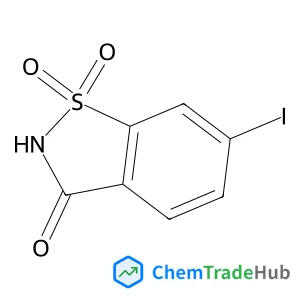

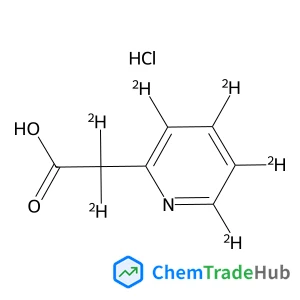
2,2-dideuterio-2-(3,4,5,6-tetradeuterio-2-pyridyl)acetic acid;hydrochloride
CAS号:
1329799-67-8
分子式:
C7H2ClD6NO2
推荐供应商







免责声明
本页面提供的学术期刊信息仅供参考和研究使用。我们与任何期刊出版商均无关联,也不处理投稿事宜。如有投稿相关咨询,请直接联系相关期刊出版商。
如发现页面信息有误,请发送邮件至 support@chemtradehub.com 联系我们。我们将及时核实并处理您的问题。