



Multi-stimuli responsive supramolecular diblock copolymers
文献信息
发布日期
2013-10-03
DOI
10.1039/C3PY01093G
影响因子
5.582
作者
L. Sambe, F. Stoffelbach, J. Lyskawa, F. Delattre, M. Bria, F. X. Sauvage, M. Sliwa, V. Humblot, B. Charleux, G. Cooke, P. Woisel
查看原文
摘要
A well-defined cyclobis(paraquat-p-phenylene) (CBPQT4+) end-functionalized poly(n-butyl acrylate) 3 was prepared via RAFT polymerization using a new trithiocarbonate CBPQT4+ derivative 2 as a reversible chain transfer agent. We have shown that the electron-poor CBPQT4+ moiety at the α-chain-end could be specifically modified by complex formation with various functionalized macromolecules featuring complementary electron rich end groups, thereby leading to the corresponding supramolecular diblock copolymers. The latter could be conveniently disassembled upon heating, by applying electrochemical redox processes or by the addition of a competing molecular guest. Furthermore, we can generate new diblock architectures upon the addition of an appropriately functionalized polymer. We also describe preliminarily results regarding the formation of nanostructured architectures both in solution and in thin films.
相关文献
Electrochemical Pourbaix diagrams of Mg–Zn alloys from first-principles calculations and experimental thermodynamic data
Dominik Legut
2021-08-06
Paper
DOI: 10.1039/D1CP02754A
A Dirac nodal surface semi-metallic carbon-based structure as a universal anode material for metal-ion batteries with high performance
Shouren Zhang, Huili Liu, Yadan Zhang, Shuaiwei Wang, Baocheng Yang
2021-08-06
Paper
DOI: 10.1039/D1CP02306C
Directed gas-phase preparation of the elusive phosphinosilylidyne (SiPH2, X2A′′) and cis/trans phosphinidenesilyl (HSiPH; X2A′) radicals under single-collision conditions
Chao He, Shane J. Goettl, Zhenghai Yang, Srinivas Doddipatla, Ralf I. Kaiser, Mateus Xavier Silva, Breno R. L. Galvão
2021-08-12
Paper
DOI: 10.1039/D1CP02812J
Fcc vs. hcp competition in colloidal hard-sphere nucleation: on their relative stability, interfacial free energy and nucleation rate
Ignacio Sanchez-Burgos, Eduardo Sanz, Carlos Vega, Jorge R. Espinosa
2021-08-13
Paper
DOI: 10.1039/D1CP01784E
Electronic structures and properties of dianionic pentacarbonyls [TM(CO)5]2− (TM = Cr, Mo, W)
Gerui Pei, Cong-Cong Shu, Mengyang Li, Zhong-Ming Sun, Tao Yang
2021-08-03
Paper
DOI: 10.1039/D1CP01592C
Kinetics and energetic analysis of the slow dispersive electron transfer from nano-TiO2 to O2 by in situ diffusion reflectance and Laplace transform
Zhizhou Wu, Liuyang Li, Xuedong Zhou, Xiujian Zhao, Baoshun Liu
2021-09-01
Paper
DOI: 10.1039/D1CP03135J
Fitting potential energy and induced dipole surfaces of the van der Waals complex CH4–N2 using non-product quadrature grids
Yulia N. Kalugina, Iouli E. Gordon
2021-08-04
Paper
DOI: 10.1039/D1CP02161C
Expression of concern: Preparation and characterization of nano-sized Pt–Ru/C catalysts and their superior catalytic activities for methanol and ethanol oxidation
2021-08-18
Expression of Concern
DOI: 10.1039/D1CP90169A
The effect of interlayer stacking arrangements in two dimensional NiOOH on water oxidation catalysis
Eitan Yohanan
2021-12-09
Paper
DOI: 10.1039/D1CP05383C
Defect evolution behaviors from single sulfur point vacancies to line vacancies in monolayer molybdenum disulfide
Xiaoyong Yang, Ming Jiang, Lixin Chen, Zhiwen Chen
2021-08-10
Paper
DOI: 10.1039/D1CP02852A
您可能还喜欢
化合物问答
如何储存1,2-环己二酮环乙缩醛(CAS号:4746-96-7)?
1,2-环己二酮环乙缩醛应储存在阴凉、干燥、通风良好的地方,避免阳光直射。建议使用密封容器保存,并保持环境温度在室温范围内,远离火源和热源。
4746-96-71,4-Dioxaspiro[4.5]d...
化合物问答
Ecopladib(CAS号:381683-92-7)的市场或研究趋势如何?
Ecopladib作为一种新型的药物,主要应用于治疗高胆固醇等疾病。目前,市场和研究趋势显示,Ecopladib因其独特的药理作用而受到关注。随着对心血管疾病治...
381683-92-7Ecopladib
化合物问答
2,3-Dimethyl-3H-imidazo[4,5-c]pyridine(CAS号:52538-09-7)通常如何合成?
2,3-二甲基-3H-咪唑[4,5-c]吡啶通常通过咪唑和2,3-二甲基吡啶的缩合反应合成。具体来说,将咪唑和2,3-二甲基吡啶在适当的溶剂中进行加热或加压反应...
52538-09-72,3-Dimethyl-3H-imid...
化合物问答
2,3,4,5-tetrahydro-1H-3-苯并氮杂环;盐酸盐(CAS号:17379-01-0)的市场或研究趋势如何?
该化合物在药物化学和有机合成中有一定的应用。近年来,随着对新型药物化合物的需求增加,该化合物的研究趋势主要集中在探索其生物活性,尤其是其在神经系统疾病治疗中的潜...
17379-01-02,3,4,5-Tetrahydro-1...
68-90-6(2-Ethyl-1-benzofura...
化合物问答
如何储存盐酸甘氨酸丁酯(CAS号:13048-99-2)?
盐酸甘氨酸丁酯应储存在阴凉、干燥、通风良好的地方,避免阳光直射和高温环境,温度应控制在25℃以下。储存容器应密封,避免与空气中的水分和酸性物质接触,以防发生水解...
13048-99-2Butyl glycinate hydr...
化合物问答
什么是2-Iodo-N,N-dimethylbenzamide(CAS号:54616-46-5)?
2-碘-N,N-二甲基苯胺是一种有机化合物,化学名为2-Iodo-N,N-dimethylbenzamide。其分子式为C<sub>9</sub>H<sub>1...
54616-46-52-Iodo-N,N-dimethylb...
16817-90-6N-Cyclohexylglycinam...
化合物问答
5-溴-2-(4H-1,2,4-三唑-4-基)吡啶(CAS号:959240-99-4)的市场或研究趋势如何?
随着医药、农药和新材料领域的发展,该化合物作为关键中间体的应用日益增多。特别是在药物合成中,由于其独特的化学性质,可以用于合成多种药物分子。未来的研究趋势可能集...
959240-99-45-Bromo-2-(4H-1,2,4-...
化合物问答
2,4-二溴-6-三氟甲基嘧啶(CAS号:785778-00-9)通常如何合成?
2,4-二溴-6-三氟甲基嘧啶通常通过溴化反应合成。首先,将6-三氟甲基嘧啶与溴化剂(如液溴)在适当的溶剂(如二氯甲烷、四氢呋喃)中反应,加入适当的催化剂(如四...
785778-00-92,4-Dibromo-6-(trifl...
来源期刊
Polymer Chemistry

CiteScore:
8.6
自引率:
7.3%
年发文量:
457
Polymer Chemistry welcomes submissions in all areas of polymer science that have a strong focus on macromolecular chemistry. Manuscripts may cover a broad range of fields, yet no direct application focus is required.
推荐化合物
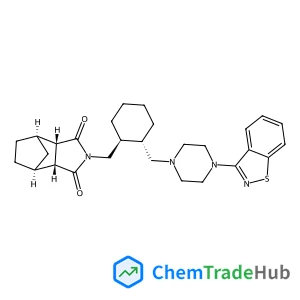
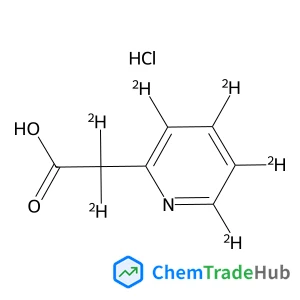
2,2-dideuterio-2-(3,4,5,6-tetradeuterio-2-pyridyl)acetic acid;hydrochloride
CAS号:
1329799-67-8
分子式:
C7H2ClD6NO2
推荐供应商




免责声明
本页面提供的学术期刊信息仅供参考和研究使用。我们与任何期刊出版商均无关联,也不处理投稿事宜。如有投稿相关咨询,请直接联系相关期刊出版商。
如发现页面信息有误,请发送邮件至 support@chemtradehub.com 联系我们。我们将及时核实并处理您的问题。