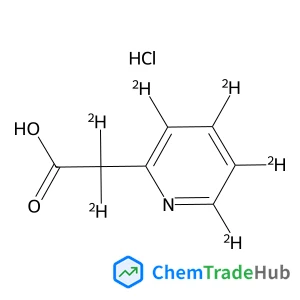
2,2-dideuterio-2-(3,4,5,6-tetradeuterio-2-pyridyl)acetic acid;hydrochloride
CAS号:
1329799-67-8
分子式:
C7H2ClD6NO2
Phosphorylated polypeptides represent promising biomimetic macromolecules for various regenerative applications. However to date, large-scale synthesis of phosphorylated polypeptides with controlled degrees of phosphorylation has not been achieved, restricting research in phosphorylated proteins to their central roles in biomineralization pathways. Here, we present a co-polypeptide synthesis strategy based on the Ring-Opening Polymerization (ROP) of N-carboxyanhydrides (NCAs), followed by controlled phosphorylation of serine (Ser) residues. The molecular design, including amino acid composition and molecular weight of polypeptides, mimicked the intriguing phosphorylated protein Pc-3 secreted by the sandcastle tube worm Phragmatopoma californica, which is a major constituent of the glue produced by the animal to bind hard particles together for their protective tubes. Pc-3 is comprised of mostly Ser and tyrosine (Tyr), with up to 70% of Ser residues phosphorylated into phospho-serine (pSer) giving rise to the high net negative charge of Pc-3. Three NCA monomers were synthesized, namely Ser with free –OH groups, and Ser and Tyr with protected –OH groups, and subsequently polymerized with various feeding ratios in order to obtain a broad range of final amino acid compositions. In the final step, phosphorylation targeting free –OH groups of Ser was conducted. With this strategy, the degree of phosphorylation is governed by the initial amount of unprotected –OH groups of the precursor Ser–NCA, and the final co-polypeptides contain relative amounts of Tyr and pSer that can be tailored, yielding a composition and molecular weight (MW) that closely match those of Pc-3. This control of phosphorylation leads to polypeptides exhibiting a wide range of zeta potential values between −20 and −50 mV. Using analytical assays, including Dynamic Light Scattering (DLS), Surface Plasmon Resonance (SPR), and Quartz Crystal Microbalance with Dissipation (QCM-D), we demonstrate that these phosphorylated polypeptides exhibit affinity towards divalent ions such as Ca2+, thus opening the door for their usage as scaffolds for mineralized tissue repair or as a major component of biocompatible adhesives.
Russian Journal of General Chemistry

Chemical Communications
Nature Medicine
Drug Discovery Today
Journal of Saudi Chemical Society

Journal of Natural Medicines

Russian Journal of Organic Chemistry
Russian Journal of Coordination Chemistry

Chemistry Education Research and Practice

Saudi Pharmaceutical Journal
Stefan Milenkovic, Igor V. Bodrenko, Armando Carpaneto
DOI: 10.1039/D1CP02947A
J. A. Gibbard, E. Castracane, A. I. Krylov, R. E. Continetti
DOI: 10.1039/D1CP02972J
Zhizhou Wu, Liuyang Li, Xuedong Zhou, Xiujian Zhao, Baoshun Liu
DOI: 10.1039/D1CP03135J
William A. Elliott, R. John Clark, James G. Sutjianto, Jeremy C. Palmer, Jeffrey D. Rimer
DOI: 10.1039/D1CP02619D
Anna Maria Ferrari, Khaled E. El-Kelany, Francesco Silvio Gentile, Maddalena D’Amore, Roberto Dovesi
DOI: 10.1039/D1CP02363B
Jemma A. Gibbard, Connor J. Clarke, Jan R. R. Verlet
DOI: 10.1039/D1CP03075B
DOI: 10.1039/D1CP02524D
Sharmin Akter, Jorge A. Vargas, Kamal Sharkas, Juan E. Peralta, Koblar A. Jackson
DOI: 10.1039/D0CP06512A
Peipei Jin, Xueli Wang, Haifeng Pan
DOI: 10.1039/D1CP04811B
Fei Li, Dong Wang, Xue-Qing Gong
DOI: 10.1039/D1CP02787E
1,2-环己二酮环乙缩醛应储存在阴凉、干燥、通风良好的地方,避免阳光直射。建议使用密封容器保存,并保持环境温度在室温范围内,远离火源和热源。
Ecopladib作为一种新型的药物,主要应用于治疗高胆固醇等疾病。目前,市场和研究趋势显示,Ecopladib因其独特的药理作用而受到关注。随着对心血管疾病治...
2,3-二甲基-3H-咪唑[4,5-c]吡啶通常通过咪唑和2,3-二甲基吡啶的缩合反应合成。具体来说,将咪唑和2,3-二甲基吡啶在适当的溶剂中进行加热或加压反应...
该化合物在药物化学和有机合成中有一定的应用。近年来,随着对新型药物化合物的需求增加,该化合物的研究趋势主要集中在探索其生物活性,尤其是其在神经系统疾病治疗中的潜...
盐酸甘氨酸丁酯应储存在阴凉、干燥、通风良好的地方,避免阳光直射和高温环境,温度应控制在25℃以下。储存容器应密封,避免与空气中的水分和酸性物质接触,以防发生水解...
2-碘-N,N-二甲基苯胺是一种有机化合物,化学名为2-Iodo-N,N-dimethylbenzamide。其分子式为C<sub>9</sub>H<sub>1...
随着医药、农药和新材料领域的发展,该化合物作为关键中间体的应用日益增多。特别是在药物合成中,由于其独特的化学性质,可以用于合成多种药物分子。未来的研究趋势可能集...
2,4-二溴-6-三氟甲基嘧啶通常通过溴化反应合成。首先,将6-三氟甲基嘧啶与溴化剂(如液溴)在适当的溶剂(如二氯甲烷、四氢呋喃)中反应,加入适当的催化剂(如四...

Polymer Chemistry welcomes submissions in all areas of polymer science that have a strong focus on macromolecular chemistry. Manuscripts may cover a broad range of fields, yet no direct application focus is required.