


Contact angles of surfactant solutions on heterogeneous surfaces
文献信息
发布日期
2014-10-24
DOI
10.1039/C4CP03760J
影响因子
3.676
作者
J. A. W. Elliott, A. Amirfazli
查看原文
摘要
Using Gibbs' adsorption equation and a literature isotherm, a new general model to predict the contact angle of surfactant solutions on (smooth or rough) chemically heterogeneous surfaces is constructed based on the Cassie equation. The model allows for adsorption at the liquid–vapor, solid–liquid, and solid–vapor interfaces. Solid–vapor adsorption is allowed in order to model the autophobic effect on hydrophilic surfaces. Using representative values for the coefficients which describe adsorption at each interface, model predictions for contact angles as a function of f parameters (area fractions) and surfactant concentration are made for heterogeneous surfaces made up of different materials. On smooth surfaces, the f parameters serve as weighting factors determining how to combine the effects of surfactant adsorption on each material to predict the behavior on the heterogeneous surface. Due to the non-linear nature of the model, the inclusion of a small amount of hydrophobic material has a greater effect on a predominantly hydrophilic material than vice versa, explaining the result seen in literature that a small amount of hydrophobic contamination (such as oil) significantly increases contact angle on a hydrophilic surface. The fact that even a small amount of heterogeneity can greatly change experimental results could lead to incorrect experimental conclusions about surfactant adsorption if a surface were wrongly assumed to be homogeneous. Model predictions rapidly become more complex as the number of differently wettable materials present on the surface increases. Also, an approximately equal weighting of different materials generally leads to more complex behaviors compared to heterogeneous surfaces composed largely of a single material. Rough heterogeneous surfaces follow previous results for surfactant wetting of rough homogeneous surfaces, leading to an amplification/attenuation of surfactant effects for penetrated/unpenetrated wetting, and further increasing the complexity of predictions. These potential complexities point to the importance of characterizing the heterogeneities of any surface under consideration. With proper characterization, the model described in this paper will allow for prediction of contact angles on all types of heterogeneous surfaces, and design of surfaces for specific interactions with surfactant solutions.
期刊推荐

Main Group Chemistry

Herald of the Russian Academy of Sciences

Journal of Chemical Sciences
Polycyclic Aromatic Compounds

Chinese Journal of Chemistry

Topics in Catalysis

Medicinal Chemistry Research
Journal of the Indian Institute of Science

Journal of Asian Natural Products Research
Critical Reviews in Solid State and Materials Sciences
相关文献
Stereoselective and regioselective 5-exo-dig cyclization of 8-alkynylnaphthalen-1-amines for the synthesis of (E)-2-(arylthio)alkylene-1,2-dihydrobenzo[cd]indoles
Cheng Bi, Lianpeng Zhang, Guanyinsheng Qiu, Xiaofang Li, Jinzhong Yao, Hongwei Zhou
2018-03-29
Paper
DOI: 10.1039/C8OB00556G
Pillar[5]arene-based ion-pair recognition for constructing a [2]pseudorotaxane with supramolecular interaction induced LCST behavior
Ming Li
2021-05-10
Research Article
DOI: 10.1039/D1QO00457C
Rh(iii)-Catalyzed regioselective mono- and di-iodination of azobenzenes using alkyl iodide
Jixing Li, Wenxia Cong, Jinlong Zhang, Huameng Yang, Gaoxi Jiang
2018-04-17
Paper
DOI: 10.1039/C8OB00318A
Facile synthesis of substituted diaryl sulfones via a [3 + 3] benzannulation strategy
Xiang-zheng Tang, Lang Tong, Hua-ju Liang, Jie Liang, Yong Zou, Xue-jing Zhang, Ming Yan, Albert S. C. Chan
2018-04-18
Communication
DOI: 10.1039/C8OB00662H
A nitroreductase and acidity detecting dual functional ratiometric fluorescent probe for selectively imaging tumor cells
Zhaoshuai He, Yajie Chou, Hanxin Zhou, Han Zhang, Tanyu Cheng, Guohua Liu
2018-03-29
Paper
DOI: 10.1039/C8OB00670A
The control of stereochemistry by the pentafluorosulfanyl group
Paul R. Savoie, Cortney N. von Hahmann, Alexander Penger, Zheng Wei, John T. Welch
2018-04-07
Paper
DOI: 10.1039/C7OB03146G
Recent advances in the functionalization of saturated cyclic amines
Yan He, Zhi Zheng, Jintao Yang, Xinying Zhang, Xuesen Fan
2021-05-11
Review Article
DOI: 10.1039/D1QO00171J
Iodine-catalyzed oxidative annulation of 3-cyanoacetylindoles with benzylamines: facile access to 5-(3-indolyl)oxazoles
Xiaozu Liu, Yuxiang Zhou, Guojun Chen, Zhongqin Yang, Qin Li, Peijun Liu
2018-04-26
Communication
DOI: 10.1039/C8OB00833G
C8-Guanine modifications: effect on Z-DNA formation and its role in cancer
V. Vongsutilers, P. M. Gannett
2018-03-02
Review Article
DOI: 10.1039/C8OB00030A
您可能还喜欢
化合物问答
4-[[6-(3-苯基苯基)-7H-嘌呤-2-基]氨基]苯磺酰胺(CAS号:2079895-42-2)适用哪些法规指南?
该化合物需遵循REACH法规以确保其安全使用和管理。同时,根据其潜在的生物降解性和毒性,也需要符合GHS分类中的相应要求。此外,若用于医药或食品相关领域,则还需...
2079895-42-24-{[6-(3-Biphenylyl)...
化合物问答
反式-度骨化醇(CAS号:74007-20-8)的物理化学性质是什么?
反式-度骨化醇是一种脂溶性维生素D3的衍生物,呈无色或白色结晶性粉末,不溶于水,溶于乙醇、丙酮、氯仿等有机溶剂。其分子式为C28H44O,分子量为404.65。...
74007-20-8trans-Doxercalcifero...
化合物问答
莲花掌苷(CAS号:59282-56-3)的市场或研究趋势如何?
莲花掌苷作为一种天然产物,近年来在抗炎、抗癌等生物活性研究方面显示出一定的潜力,因此市场需求逐渐增长。市场动态方面,随着天然产物开发的深入,预计该化合物的研究会...
59282-56-3Lindleyin
化合物问答
2-溴-6-(吡咯烷-1-基)吡啶-4-硼酸频那醇酯(CAS号:1150271-64-9)应用于哪些行业?
2-溴-6-(吡咯烷-1-基)吡啶-4-硼酸频那醇酯在医药领域有着广泛的应用,它可以用作药物合成中的中间体。此外,它还可以用于有机合成,特别是在构建复杂杂环化合...
1150271-64-92-Bromo-6-(1-pyrroli...
化合物问答
什么是methyl 2-(4-bromophenyl)-3-methylbutanoate(CAS号:1061284-70-5)?
methyl 2-(4-溴苯基)-3-甲基丁酸甲酯是一种化学物质,分子式为C12H13BrO2。它是一种有机化合物,具有一定的挥发性和易燃性。
1061284-70-52-(4-Bromo-phenyl)-3...
化合物问答
CJC1-295(CAS号:863288-34-0)的物理化学性质是什么?
CJC1-295是一种具有复杂肽链结构的化合物,其分子量约为1875 Da。该化合物在水中具有一定的溶解性,但在有机溶剂中的溶解性不佳。它是一种反应活性化合物,...
863288-34-0L-tyrosyl-D-alanyl-L...
化合物问答
三正丁基锍碘(CAS号:18146-62-8)的市场或研究趋势如何?
三正丁基锍碘作为一种重要的有机硫化合物,主要用于有机合成中作为亲电试剂。近年来,由于其在合成中的广泛应用,市场对其需求持续增长。此外,随着绿色化学的发展,对其替...
18146-62-8Tributylsulfonium io...
化合物问答
雌二醇-[13C3]同位素内标(CAS号:1261254-48-1)通常如何合成?
雌二醇-[13C3]同位素内标通常通过在雌二醇分子中引入[13C3]同位素来合成。常见的方法是通过化学标记反应,如与[13C3]标记的甲基溴化物进行亲核取代反应...
1261254-48-117beta-Estradiol-2,3...
化合物问答
N1-(2-吡啶甲基)-N2-(2-甲基-1-萘基)草酰胺(CAS号:2611225-93-3)的物理化学性质是什么?
N1-(2-吡啶甲基)-N2-(2-甲基-1-萘基)草酰胺为固体化合物,具有良好的结晶形态,分子量为340.34 g/mol。该化合物在水中的溶解度较低,但在有...
2611225-93-3N-(2-Methyl-1-naphth...
化合物问答
如何处理含有十五碳烯酸甲酯(顺-10)(C15:1)标准品(CAS号:90176-52-6)的废料?
含有十五碳烯酸甲酯(顺-10)(C15:1)标准品的废料应首先进行适当收集和储存,避免与其他化学品混合。然后,可采用焚烧或交由专业废物处理公司进行处理。处理过程...
90176-52-6(Z)-10-Pentadecenoic...
来源期刊
Physical Chemistry Chemical Physics

CiteScore:
5.5
自引率:
10.3%
年发文量:
3036
Physical Chemistry Chemical Physics (PCCP) is an international journal co-owned by 19 physical chemistry and physics societies from around the world. This journal publishes original, cutting-edge research in physical chemistry, chemical physics and biophysical chemistry. To be suitable for publication in PCCP, articles must include significant innovation and/or insight into physical chemistry; this is the most important criterion that reviewers and Editors will judge against when evaluating submissions. The journal has a broad scope and welcomes contributions spanning experiment, theory, computation and data science. Topical coverage includes spectroscopy, dynamics, kinetics, statistical mechanics, thermodynamics, electrochemistry, catalysis, surface science, quantum mechanics, quantum computing and machine learning. Interdisciplinary research areas such as polymers and soft matter, materials, nanoscience, energy, surfaces/interfaces, and biophysical chemistry are welcomed if they demonstrate significant innovation and/or insight into physical chemistry. Joined experimental/theoretical studies are particularly appreciated when complementary and based on up-to-date approaches.
推荐化合物
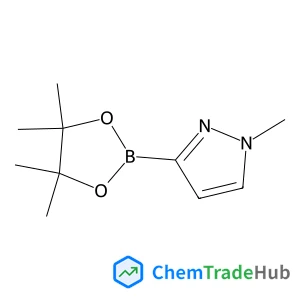
1-Methyl-3-(4,4,5,5-tetramethyl-1,3,2-dioxaborolan-2-yl)-1H-pyrazole
CAS号:
1020174-04-2
分子式:
C10H17BN2O2
推荐供应商





免责声明
本页面提供的学术期刊信息仅供参考和研究使用。我们与任何期刊出版商均无关联,也不处理投稿事宜。如有投稿相关咨询,请直接联系相关期刊出版商。
如发现页面信息有误,请发送邮件至 support@chemtradehub.com 联系我们。我们将及时核实并处理您的问题。