


Thermo-responsive gold/poly(vinyl alcohol)-b-poly(N-vinylcaprolactam) core–corona nanoparticles as a drug delivery system
文献信息
发布日期
2014-05-09
DOI
10.1039/C4PY00352G
影响因子
5.582
作者
Christophe Detrembleur, Marie Hurtgen, Antoine Debuigne, Marie-Claire De Pauw-Gillet, Stéphane Mornet, Etienne Duguet, Christine Jérôme
查看原文
摘要
Core–corona gold/poly(vinyl alcohol)-b-poly(N-vinylcaprolactam) nanoparticles (gold@PVOH-b-PNVCL NPs) were fabricated via an in situ method, where a gold salt was reduced within the macromolecular aqueous solution. Arrangement of macromolecular chains on the surface of gold cores was studied by transmission electron microscopy (TEM), X-ray photoelectron spectroscopy and infrared spectroscopy. The responsiveness to temperature and the preserved colloidal stability of the gold@PVOH-b-PNVCL NPs above the lower critical solution temperature (LCST) were confirmed by dynamic light scattering and turbidity measurements. The drug loading capacity (DLC of ca. 1.3–2.8 wt%) of the gold@PVOH-b-PNVCL NPs as a drug delivery system (DDS) was tested with Nadolol®, a hydrophilic drug, and the release behaviours were studied at several temperatures. PVOH-b-PNVCL copolymers with an LCST of a few degrees above the biological temperature (37 °C), for example, PVOH180-b-PNVCL110 (LCST of 41 °C), are preferential, due to the slower release at 37 °C, but a faster release at temperatures that are a few degrees higher. The cytocompatibility of the gold@PVOH-b-PNVCL NPs against mouse fibroblastic L929 cells was evaluated via the MTS assay. Cellular uptake within MEL-5 human melanoma cells was studied by confocal laser scanning microscopy, fluorescence-activated cell sorting and TEM techniques and it showed that gold@PVOH-b-PNVCL NPs preferably accumulated within the cellular cytoplasm, with an incubation concentration and period-dependent uptake process. All these results corroborated a general utility of these thermo-responsive gold@PVOH-b-PNVCL NPs for drug delivery and controlled drug release.
期刊推荐
Drug Discovery Today
Current Opinion in Colloid & Interface Science
Nature Medicine
Russian Chemical Bulletin
Russian Journal of Bioorganic Chemistry

Current Opinion in Solid State & Materials Science

New Journal of Chemistry
Journal of Saudi Chemical Society
Organic Process Research & Development

Journal of Natural Medicines
相关文献
Static and dynamic scavenging of ammoniated electrons by nitromethane
Nicolás Rivas, Germán Sciaini, Ernesto Marceca
2019-09-16
Paper
DOI: 10.1039/C9CP03342D
Effects of different surface functionalization on the electronic properties and contact types of graphene/functionalized-GeC van der Waals heterostructures
Tan Phat Dao, M. Idrees, Huynh V. Phuc, Nguyen N. Hieu, Nguyen T. T. Binh, Hoi B. Dinh, B. Amin, Chuong V. Nguyen
2020-03-13
Paper
DOI: 10.1039/C9CP07009E
Effect of mild nanoscopic confinement on the dynamics of ionic liquids
Daria Noferini, Olaf Holderer, Henrich Frielinghaus
2020-04-09
Paper
DOI: 10.1039/C9CP05200C
HERFD-XANES probes of electronic structures of ironII/III carbene complexes
Om Prakash, Hao Fan, Lisa H. M. de Groot, Valtýr Freyr Hlynsson, Simon Kaufhold, Olga Gordivska, Nicolás Velásquez, Pavel Chabera, Pieter Glatzel, Kenneth Wärnmark, Petter Persson, Jens Uhlig
2020-04-16
Paper
DOI: 10.1039/C9CP06309A
A unique pentagonal network structure of the NiS2 monolayer with high stability and a tunable bandgap
2020-03-07
Paper
DOI: 10.1039/D0CP00434K
Interfacial anomaly in low global warming potential refrigerant blends as predicted by molecular dynamics simulations
Yuting Li, Wael A. Fouad
2019-09-19
Paper
DOI: 10.1039/C9CP03231B
Electric-field control of single-molecule tautomerization
Shai Mangel, Katharina Polyudov, Christian Dette, Tobias Wollandt, Paul Punke, Dongzhe Li, Roberto Urcuyo, Soon Jung Jung
2020-02-25
Paper
DOI: 10.1039/C9CP06868F
Micro-kinetic model of electrochemical carbon dioxide reduction over platinum in non-aqueous solvents
Brian A. Rohr, Aayush R. Singh, Joseph A. Gauthier, Michael J. Statt, Jens K. Nørskov
2020-02-10
Paper
DOI: 10.1039/C9CP05751J
Simulation guided design of silver nanostructures for plasmon-enhanced fluorescence, singlet oxygen generation and SERS applications
2020-02-07
Paper
DOI: 10.1039/C9CP06029D
您可能还喜欢
化合物问答
如何储存1,2-环己二酮环乙缩醛(CAS号:4746-96-7)?
1,2-环己二酮环乙缩醛应储存在阴凉、干燥、通风良好的地方,避免阳光直射。建议使用密封容器保存,并保持环境温度在室温范围内,远离火源和热源。
4746-96-71,4-Dioxaspiro[4.5]d...
化合物问答
Ecopladib(CAS号:381683-92-7)的市场或研究趋势如何?
Ecopladib作为一种新型的药物,主要应用于治疗高胆固醇等疾病。目前,市场和研究趋势显示,Ecopladib因其独特的药理作用而受到关注。随着对心血管疾病治...
381683-92-7Ecopladib
化合物问答
2,3-Dimethyl-3H-imidazo[4,5-c]pyridine(CAS号:52538-09-7)通常如何合成?
2,3-二甲基-3H-咪唑[4,5-c]吡啶通常通过咪唑和2,3-二甲基吡啶的缩合反应合成。具体来说,将咪唑和2,3-二甲基吡啶在适当的溶剂中进行加热或加压反应...
52538-09-72,3-Dimethyl-3H-imid...
化合物问答
2,3,4,5-tetrahydro-1H-3-苯并氮杂环;盐酸盐(CAS号:17379-01-0)的市场或研究趋势如何?
该化合物在药物化学和有机合成中有一定的应用。近年来,随着对新型药物化合物的需求增加,该化合物的研究趋势主要集中在探索其生物活性,尤其是其在神经系统疾病治疗中的潜...
17379-01-02,3,4,5-Tetrahydro-1...
68-90-6(2-Ethyl-1-benzofura...
化合物问答
如何储存盐酸甘氨酸丁酯(CAS号:13048-99-2)?
盐酸甘氨酸丁酯应储存在阴凉、干燥、通风良好的地方,避免阳光直射和高温环境,温度应控制在25℃以下。储存容器应密封,避免与空气中的水分和酸性物质接触,以防发生水解...
13048-99-2Butyl glycinate hydr...
化合物问答
什么是2-Iodo-N,N-dimethylbenzamide(CAS号:54616-46-5)?
2-碘-N,N-二甲基苯胺是一种有机化合物,化学名为2-Iodo-N,N-dimethylbenzamide。其分子式为C<sub>9</sub>H<sub>1...
54616-46-52-Iodo-N,N-dimethylb...
16817-90-6N-Cyclohexylglycinam...
化合物问答
5-溴-2-(4H-1,2,4-三唑-4-基)吡啶(CAS号:959240-99-4)的市场或研究趋势如何?
随着医药、农药和新材料领域的发展,该化合物作为关键中间体的应用日益增多。特别是在药物合成中,由于其独特的化学性质,可以用于合成多种药物分子。未来的研究趋势可能集...
959240-99-45-Bromo-2-(4H-1,2,4-...
化合物问答
2,4-二溴-6-三氟甲基嘧啶(CAS号:785778-00-9)通常如何合成?
2,4-二溴-6-三氟甲基嘧啶通常通过溴化反应合成。首先,将6-三氟甲基嘧啶与溴化剂(如液溴)在适当的溶剂(如二氯甲烷、四氢呋喃)中反应,加入适当的催化剂(如四...
785778-00-92,4-Dibromo-6-(trifl...
来源期刊
Polymer Chemistry

CiteScore:
8.6
自引率:
7.3%
年发文量:
457
Polymer Chemistry welcomes submissions in all areas of polymer science that have a strong focus on macromolecular chemistry. Manuscripts may cover a broad range of fields, yet no direct application focus is required.
推荐化合物
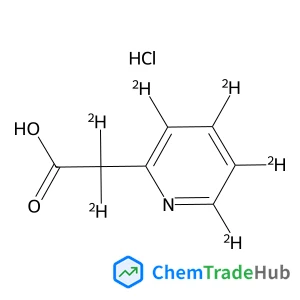
2,2-dideuterio-2-(3,4,5,6-tetradeuterio-2-pyridyl)acetic acid;hydrochloride
CAS号:
1329799-67-8
分子式:
C7H2ClD6NO2
推荐供应商





免责声明
本页面提供的学术期刊信息仅供参考和研究使用。我们与任何期刊出版商均无关联,也不处理投稿事宜。如有投稿相关咨询,请直接联系相关期刊出版商。
如发现页面信息有误,请发送邮件至 support@chemtradehub.com 联系我们。我们将及时核实并处理您的问题。