







Dispersion RAFT polymerization: comparison between the monofunctional and bifunctional macromolecular RAFT agents
文献信息
发布日期
2014-08-22
DOI
10.1039/C4PY01069H
影响因子
5.582
作者
Chengqiang Gao, Shentong Li, Quanlong Li, Pengfei Shi, Sayyar Ali Shah, Wangqing Zhang
查看原文
摘要
Bifunctional macromolecular RAFT (macro-RAFT) agent mediated polymerization affords one-step synthesis of the BAB triblock copolymer, which has special morphology. However, the bifunctional macro-RAFT agent mediated polymerization under heterogeneous conditions is rarely reported. In this contribution, the dispersion RAFT polymerizations of styrene in a methanol–water mixture mediated with poly(ethylene glycol) based monofunctional and bifunctional macro-RAFT agents, which afford the AB diblock copolymer of poly(ethylene glycol)-block-polystyrene (mPEG-b-PS) and the BAB triblock copolymer of polystyrene-block-poly(ethylene glycol)-block-polystyrene (PS-b-PEG-b-PS), respectively, are compared. It is found that these two dispersion RAFT polymerizations have similar polymerization rates, and almost full monomer conversion can be achieved. The molecular weight of both the mPEG-b-PS diblock copolymer and the PS-b-PEG-b-PS triblock copolymer linearly increases with the monomer conversion, whereas the control over the polydispersity index (PDI) of the PS-b-PEG-b-PS triblock copolymer is not as good as that of the mPEG-b-PS diblock copolymer. The monofunctional macro-RAFT agent mediated dispersion polymerization affords the in situ synthesis of mPEG-b-PS colloidal nanoparticles, which can be uniformly distributed in the polymerization medium and whose size increases with the extension of the solvophobic PS block, whereas the bifunctional macro-RAFT agent mediated dispersion polymerization leads to a mixture of colloidal nanoparticles and gel-like networks of the PS-b-PEG-b-PS triblock copolymer.
相关文献
Controlling the stereoselectivity of rac-LA polymerization by chiral recognition induced the formation of homochiral dimeric metal alkoxides
P. Horeglad, A. Litwińska, M. Dranka, G. Z. Żukowska, M. Michalak
2016-01-13
Paper
DOI: 10.1039/C5PY02005K
Synthesis, characterization and device optimisation of new poly(benzo[1,2-b:4,5-b′]dithiophene-alt-thieno[3,4-d]thiazole) derivatives for solar cell applications
Nicolas Zindy, Pierre-Olivier Morin, Martijn M. Wienk, René A. J. Janssen, Mario Leclerc
2015-04-15
Paper
DOI: 10.1039/C5PY00164A
Thermochromic polyethylene films doped with perylene chromophores: experimental evidence and methods for characterization of their phase behaviour
Marco Carlotti, Giuseppa Gullo, Antonella Battisti
2015-04-20
Paper
DOI: 10.1039/C5PY00486A
Interpenetrating poly(urethane-urea)–polydimethylsiloxane networks designed as active elements in electromechanical transducers
C. Tugui, S. Vlad, M. Iacob, C. D. Varganici, L. Pricop, M. Cazacu
2016-03-16
Paper
DOI: 10.1039/C6PY00157B
A poloxamer-polypeptide thermosensitive hydrogel as a cell scaffold and sustained release depot
Ji-Yu Lin, Yuan-Kai Lin, Sydney Peng, Li-Yu Lee, Chieh-Nan Chen, I-Ming Chu
2016-03-31
Paper
DOI: 10.1039/C5PY02067K
Cross-linked ROMP polymers based on odourless dicyclopentadiene derivatives
Sukdeb Saha, Yakov Ginzburg, Illya Rozenberg, Olga Iliashevsky, Amos Ben-Asuly, N. Gabriel Lemcoff
2016-04-14
Communication
DOI: 10.1039/C6PY00378H
Programmed liquid crystal elastomers with tunable actuation strain
T. J. White
2015-05-29
Paper
DOI: 10.1039/C5PY00640F
Synthesis of highly porous poly(tert-butyl acrylate)-b-polysulfone-b-poly(tert-butyl acrylate) asymmetric membranes
Yihui Xie, Nicolas Moreno, Hong Cheng, Pei-Ying Hong, Rachid Sougrat, Ali R. Behzad, Russell Tayouo, Suzana P. Nunes
2016-03-24
Paper
DOI: 10.1039/C6PY00215C
Multi-stimuli responsive supramolecular polymers and their electrospun nanofibers
Jianzhuang Chen, Shuangshuang Zhang, Fugen Sun, Nan Li, Kun Cui, Jianping He, Dechao Niu, Yongsheng Li
2016-03-30
Paper
DOI: 10.1039/C6PY00445H
您可能还喜欢
化合物问答
如何储存1,2-环己二酮环乙缩醛(CAS号:4746-96-7)?
1,2-环己二酮环乙缩醛应储存在阴凉、干燥、通风良好的地方,避免阳光直射。建议使用密封容器保存,并保持环境温度在室温范围内,远离火源和热源。
4746-96-71,4-Dioxaspiro[4.5]d...
化合物问答
Ecopladib(CAS号:381683-92-7)的市场或研究趋势如何?
Ecopladib作为一种新型的药物,主要应用于治疗高胆固醇等疾病。目前,市场和研究趋势显示,Ecopladib因其独特的药理作用而受到关注。随着对心血管疾病治...
381683-92-7Ecopladib
化合物问答
2,3-Dimethyl-3H-imidazo[4,5-c]pyridine(CAS号:52538-09-7)通常如何合成?
2,3-二甲基-3H-咪唑[4,5-c]吡啶通常通过咪唑和2,3-二甲基吡啶的缩合反应合成。具体来说,将咪唑和2,3-二甲基吡啶在适当的溶剂中进行加热或加压反应...
52538-09-72,3-Dimethyl-3H-imid...
化合物问答
2,3,4,5-tetrahydro-1H-3-苯并氮杂环;盐酸盐(CAS号:17379-01-0)的市场或研究趋势如何?
该化合物在药物化学和有机合成中有一定的应用。近年来,随着对新型药物化合物的需求增加,该化合物的研究趋势主要集中在探索其生物活性,尤其是其在神经系统疾病治疗中的潜...
17379-01-02,3,4,5-Tetrahydro-1...
68-90-6(2-Ethyl-1-benzofura...
化合物问答
如何储存盐酸甘氨酸丁酯(CAS号:13048-99-2)?
盐酸甘氨酸丁酯应储存在阴凉、干燥、通风良好的地方,避免阳光直射和高温环境,温度应控制在25℃以下。储存容器应密封,避免与空气中的水分和酸性物质接触,以防发生水解...
13048-99-2Butyl glycinate hydr...
化合物问答
什么是2-Iodo-N,N-dimethylbenzamide(CAS号:54616-46-5)?
2-碘-N,N-二甲基苯胺是一种有机化合物,化学名为2-Iodo-N,N-dimethylbenzamide。其分子式为C<sub>9</sub>H<sub>1...
54616-46-52-Iodo-N,N-dimethylb...
16817-90-6N-Cyclohexylglycinam...
化合物问答
5-溴-2-(4H-1,2,4-三唑-4-基)吡啶(CAS号:959240-99-4)的市场或研究趋势如何?
随着医药、农药和新材料领域的发展,该化合物作为关键中间体的应用日益增多。特别是在药物合成中,由于其独特的化学性质,可以用于合成多种药物分子。未来的研究趋势可能集...
959240-99-45-Bromo-2-(4H-1,2,4-...
化合物问答
2,4-二溴-6-三氟甲基嘧啶(CAS号:785778-00-9)通常如何合成?
2,4-二溴-6-三氟甲基嘧啶通常通过溴化反应合成。首先,将6-三氟甲基嘧啶与溴化剂(如液溴)在适当的溶剂(如二氯甲烷、四氢呋喃)中反应,加入适当的催化剂(如四...
785778-00-92,4-Dibromo-6-(trifl...
来源期刊
Polymer Chemistry

CiteScore:
8.6
自引率:
7.3%
年发文量:
457
Polymer Chemistry welcomes submissions in all areas of polymer science that have a strong focus on macromolecular chemistry. Manuscripts may cover a broad range of fields, yet no direct application focus is required.
推荐化合物
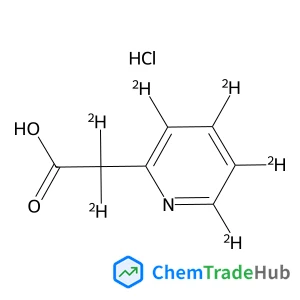
2,2-dideuterio-2-(3,4,5,6-tetradeuterio-2-pyridyl)acetic acid;hydrochloride
CAS号:
1329799-67-8
分子式:
C7H2ClD6NO2

![(3R,5R)-1-[(Benzyloxy)carbonyl]-5-methyl-3-piperidinecarboxylic acid structure](https://cnstatic.chemtradehub.com/structs/126/1269757-29-0-c552.webp "(3R,5R)-1-[(Benzyloxy)carbonyl]-5-methyl-3-piperidinecarboxylic acid structure")
(3R,5R)-1-[(Benzyloxy)carbonyl]-5-methyl-3-piperidinecarboxylic acid
CAS号:
1269757-29-0
分子式:
C15H19NO4
推荐供应商




免责声明
本页面提供的学术期刊信息仅供参考和研究使用。我们与任何期刊出版商均无关联,也不处理投稿事宜。如有投稿相关咨询,请直接联系相关期刊出版商。
如发现页面信息有误,请发送邮件至 support@chemtradehub.com 联系我们。我们将及时核实并处理您的问题。