




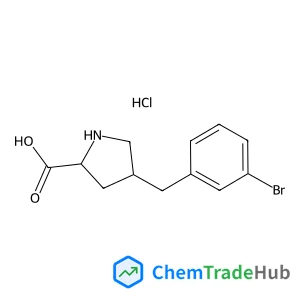
(2S,4R)-4-(3-Bromobenzyl)pyrrolidine-2-carboxylic acid hydrochloride
CAS号:
1049734-10-2
分子式:
C12H15BrClNO2
N. Kodiah Beyeh, Sandip Bhowmik, Fangfang Pan, K. Rissanen
N-Cyclohexyl ammonium resorcinarene halides, stabilized by an intricate array of hydrogen bonds in a cavitand-like assembly, form multivalent halogen-bonded deep-cavity cavitands with perfluoroiodobenzenes. As observed from the macromolar to infinite concentration range through crystal growth and single crystal X-ray analyses, four 1,4-diiodotetrafluorobenzenes form moderate halogen bonds with the bromides of the N-cyclohexyl ammonium resorcinarene bromides leading to a deep-cavity cavitand-like structure. In this assembly, the N-cyclohexyl ammonium resorcinarene bromide also acts as a guest and sits in the upper cavity of the assembly interacting with the 1,4-diiodotetrafluorobenzene through strong π⋯π interactions. Solvent molecules act as guests and are located deep in the cavity of the resorcinarene skeleton. In the millimolar range, 1H and 19F NMR spectroscopic analyses confirm halogen bonding in solution. Fast exchange binding of electron rich fluorophores (naphthalene, anthracene and pyrene) in the upper layer of these assemblies was also observed in the millimolar range while in the micromolar range, using fluorescence analysis, no binding of the fluorophores was observed.
Jennifer A. Lyn, Michael H. Ramsey, Andrew P. Damant, Roger Wood
DOI: 10.1039/B709539M
Dimitrios S. Elenis, Penelope C. Ioannou
DOI: 10.1039/B818516F
Peggy Gunkel-Grillon, Jacques Buffle
DOI: 10.1039/B802685H
Xiaoying Ye, Stanislav S. Rubakhin, Jonathan V. Sweedler
DOI: 10.1039/B716174C
Zhenjing Zhuang, Xiaodong Su, Hongyan Yuan, Qun Sun, Dan Xiao, Martin M. F. Choi
DOI: 10.1039/B712970J
Yaqiong Wen, Hongyan Yuan, Jianfei Mao, Martin M. F. Choi
DOI: 10.1039/B812750F
Joel Tellinghuisen
DOI: 10.1039/B708709H
3-表南美楝属二醇是一种具有特定立体化学结构的化合物,其分子式为C31H52O2,属于甾醇类化合物。它具有光学活性,是一种复杂的有机分子,主要存在于一些植物中。
3-羧基-5-碘苯甲酸甲酯主要应用于医药行业,作为合成某些药物中间体的重要原料。此外,它还可能用于聚合物的改性、传感器的制备以及半导体材料的制备等领域。
3-Bromoindolin-2-one是一种含有溴代基团的吲哚酮衍生物,分子式为C9H7BrNO。它是一种无色固体,具有一定的挥发性,熔点为158-159°C...
对于含有该化合物的废液,应先进行中和处理,然后根据其毒性和活性选择合适的处置方法。可以考虑焚烧处理或由专业的化学品废物处理公司进行无害化处理。处理过程中需注意环...
ANGIOTENSIN 1/2 + A (2 - 8)是一种蛋白质类化合物,具有典型的蛋白质性质。它的分子量约为5900 Da。该化合物在水中具有一定的溶解性,...
应将该化合物存放在阴凉干燥、通风良好的地方,避免阳光直射。建议将化合物密封保存在避光的、干燥的容器中,远离火源和高温环境。
苏丹红IV氘代物 标准品是一种含有氘代标记的苏丹红IV化合物,是一种用于化合物分析、结构确证以及代谢研究的标准物质。
该化合物需要遵循《全球化学品统一分类和标签制度》(GHS)中的分类和标签要求,具体分类需依据其毒性和物理化学性质。此外,还需要符合《欧盟化学品注册、评估、授权和...
2-氨基-2-(2-吡啶)乙酸乙酯应储存于阴凉、干燥、通风良好的环境中,避免高温和光照。应使用密封容器储存,并远离易燃物、氧化剂和其他危险化学品。
3-羟基-4-甲氧基吡啶-2-羧酸主要用于合成其他有机化合物,如药物合成、农药合成和染料合成等。此外,它还可用作中间体和试剂,在化学研究领域也有一定的应用。
Organic Chemistry Frontiers publishes high-quality research from across organic chemistry. Emphases are placed on studies that make significant contributions to the field of organic chemistry by reporting either new or significantly improved protocols or methodologies. Topics include, but are not limited to the following: Organic synthesis Development of synthetic methodologies Catalysis Natural products Functional organic materials Supramolecular and macromolecular chemistry Physical and computational organic chemistry
![(1S)-1,5-Anhydro-2-O-alpha-L-arabinopyranosyl-1-[5-hydroxy-7-({6-O-[3-(4-hydroxy-3-methoxyphenyl)propanoyl]-beta-D-glucopyranosyl}oxy)-2-(4-hydroxyphenyl)-4-oxo-4H-chromen-6-yl]-D-glucitol structure](https://cnstatic.chemtradehub.com/structs/225/2252345-81-4-bcff.webp "(1S)-1,5-Anhydro-2-O-alpha-L-arabinopyranosyl-1-[5-hydroxy-7-({6-O-[3-(4-hydroxy-3-methoxyphenyl)propanoyl]-beta-D-glucopyranosyl}oxy)-2-(4-hydroxyphenyl)-4-oxo-4H-chromen-6-yl]-D-glucitol structure")
![2-[(E)-(2-Methoxyphenyl)diazenyl]-3-oxo-N-(2-oxo-2,3-dihydro-1H-benzimidazol-5-yl)butanamide structure](https://cnstatic.chemtradehub.com/structs/821/82199-12-0-f1d0.webp "2-[(E)-(2-Methoxyphenyl)diazenyl]-3-oxo-N-(2-oxo-2,3-dihydro-1H-benzimidazol-5-yl)butanamide structure")



