












Electropolymerized phenol derivatives as permselective polymers for biosensor applications
文献信息
发布日期
2015-04-01
DOI
10.1039/C5AN00363F
影响因子
4.616
作者
Patrizia Monti, Salvatore Marceddu, Maria A. Dettori, Davide Fabbri, Samir Jaoua, Robert D. O'Neill, Pier A. Serra, Giovanna Delogu, Quirico Migheli
查看原文
摘要
Amperometric biosensors are often coated with a polymeric permselective film to avoid electroactive interference by reducing agents present in the target medium. Phenylenediamine and phenol monomers are commonly used to form these permselective films in the design of microsensors and biosensors. This paper aims to evaluate the permselectivity, stability and lifetime of polymers electrosynthesized using either constant potential amperometry (CPA) or cyclic voltammetry (CV) from naturally occurring phenylpropanoids in monomeric and dimeric forms (eugenol, isoeugenol, dehydrodieugenol and magnolol). Sensors were characterized by scanning electron microscopy and permselectivity analysis. Magnolol formed an electro-deposited polymer with a more defined three-dimensional texture in comparison with the other films. The phenol-derived films showed different permselectivity towards H2O2 over ascorbic acid and dopamine, likely to be related to the thickness and compactness of the polymer. The CV-derived films had a better permselectivity compared to the CPA-corresponding polymers. Based on these results, the permselectivity, stability and lifetime of a biosensor for glucose were studied when a magnolol coating was electro-deposited. The structural principles governing the permselectivity of the magnolol-derived film are suggested to be mainly related to the conformational flexibility of this monomer. Newly designed biosensors, coated with electropolymerized natural phenol derivatives, may represent promising analytical devices for different application fields.
相关文献
Exploring the relationship between cocrystal stability and symmetry: is Wallach's rule applicable to multi-component solids?
Tomislav Friščić, László Fábián, Jonathan C. Burley, David G. Reid, Melinda J. Duer, William Jones
2008-01-30
Communication
DOI: 10.1039/B717532A
Synthesis and properties of trifluoroethoxy-coated binuclear phthalocyanine
Hideyuki Yoshiyama, Norio Shibata, Takefumi Sato, Shuichi Nakamura, Takeshi Toru
2008-03-28
Communication
DOI: 10.1039/B800918J
Size matters—strong binding of the terephthalate dianion by thiourea functionalised fused [n]polynorbornane hosts
Adam J. Lowe, Frederick M. Pfeffer
2008-03-18
Communication
DOI: 10.1039/B801798K
Blue light-emitting and hole-transporting amorphous molecular materials based on diarylaminobiphenyl-functionalized bimesitylenes
Jarugu Narasimha Moorthy, Parthasarathy Venkatakrishnan, Duo-Fong Huang, Tahsin J. Chow
2008-03-05
Communication
DOI: 10.1039/B718250C
Amplified nitric oxide photorelease in DNA proximity
Fiorella L. Callari, Salvatore Sortino
2008-03-20
Communication
DOI: 10.1039/B800132D
Accelerating charge transfer in a triphenylamine–subphthalocyanine donor–acceptor system
Anaïs Medina, Christian G. Claessens, G. M. Aminur Rahman, Al Mokhtar Lamsabhi, Otilia Mó, Manuel Yáñez, Dirk M. Guldi, Tomás Torres
2008-02-11
Communication
DOI: 10.1039/B719226F
Ni–nitrilotriacetic acid-modified quantum dots as a site-specific labeling agent of histidine-tagged proteins in live cells
Junwon Kim, Hye-Young Park, Jaeseung Kim, Jiyoung Ryu, Do Yoon Kwon, Regis Grailhe, Rita Song
2008-02-19
Communication
DOI: 10.1039/B719434J
Rapid formation of metal–organic nano-capsules gives new insight into the self-assembly process‡
Nicholas P. Power, John E. Warren, Jerry L. Atwood
2008-02-27
Communication
DOI: 10.1039/B719769A
One-step solid-state thermolysis of a metal–organic framework: a simple and facile route to large-scale of multiwalled carbon nanotubes
Linyun Chen, Junfeng Bai, Chunzhao Wang, Yi Pan, Manfred Scheer, Xiaozeng You
2008-01-31
Communication
DOI: 10.1039/B718476J
您可能还喜欢
化合物问答
如何储存8-溴-4-羟基-6-(三氟甲氧基)喹啉-3-羧酸乙酯(CAS号:1072944-81-0)?
8-溴-4-羟基-6-(三氟甲氧基)喹啉-3-羧酸乙酯应储存在阴凉、干燥的地方,避免光照和高温。建议使用密封容器进行储存,以防止水分和空气的影响。
1072944-81-0Ethyl 8-bromo-4-hydr...
化合物问答
2,2-二(2-呋喃基)丙烷(CAS号:17920-88-6)的市场或研究趋势如何?
2,2-二(2-呋喃基)丙烷的研究趋势主要集中在新型材料的开发和应用,如高分子材料、有机光电材料等。市场趋势方面,随着环保要求的提高和新材料的应用,该化合物的需...
17920-88-62,2'-(2,2-Propanediy...
化合物问答
如何处理含有螺[呋喃并[3,4-b]吡啶-5(7H),4'-哌啶]-7-酮盐酸盐(CAS号:475152-31-9)的废料?
对于含有螺[呋喃并[3,4-b]吡啶-5(7H),4'-哌啶]-7-酮盐酸盐的废料,应首先进行分类和分离,以减少危险物质的数量。随后,可以考虑通过化学氧化、生物...
475152-31-97H-Spiro[furo[3,4-b]...
化合物问答
Cinnamyl 3-aminobut-2-enoate(CAS号:113898-97-8)安全吗?
Cinnamyl 3-氨基丁-2-烯酸在接触皮肤和眼睛时可能会引起刺激。应避免吸入其粉尘和烟雾。操作时应穿戴适当的个人防护装备,如手套、护目镜和实验室外套。
113898-97-8Cinnamyl 3-aminobut-...
化合物问答
反式-2-十二碳烯二酸(CAS号:6402-36-4)的市场或研究趋势如何?
反式-2-十二碳烯二酸在医药、材料科学等领域有一定的应用,但其市场相对较小。近年来,由于环保意识的提升,对环境友好型化学品的需求增加,研究倾向于开发更绿色的合成...
6402-36-4Traumatic Acid
化合物问答
什么是(9ci)-1H-苯并咪唑-5-乙酸(CAS号:473895-86-2)?
(9ci)-1H-苯并咪唑-5-乙酸是一种含氮杂环化合物,其化学结构为1H-苯并咪唑-5-乙酸。该化合物具有特定的分子式C8H7NO2,属于有机酸类化合物。
473895-86-21H-Benzimidazol-5-yl...
化合物问答
酞菁蓝(CAS号:147-14-8)的主要用途是什么?
酞菁蓝主要用作颜料和染料,广泛应用于塑料、油墨、涂料、纺织品及橡胶工业中。它也用于光敏材料,如太阳能电池和光刻胶。在医疗领域,酞菁蓝因其光敏特性被用于某些光动力...
147-14-8Copper(2+) phthalocy...
化合物问答
5-甲基-1,2,3,4-四氢异喹啉(CAS号:123593-99-7)安全吗?
5-甲基-1,2,3,4-四氢异喹啉在使用和储存时需要谨慎处理。它具有一定的毒性,应避免吸入其蒸气或直接接触皮肤和眼睛。操作此化合物时,建议佩戴防护眼镜、实验服...
123593-99-75-Methyl-1,2,3,4-tet...
化合物问答
如何处理含有3',4',5'-三甲氧基苯乙酮(CAS号:1136-86-3)的废料?
含有3',4',5'-三甲氧基苯乙酮的废液应首先确保其是否为危险废物,根据当地法规确定处理方法。通常,这类有机废液可以采用中和反应降低其pH值,然后通过蒸馏或萃...
1136-86-31-(3,4,5-Trimethoxyp...
化合物问答
如何储存KI-7(CAS号:1489263-00-4)?
KI-7应储存在通风良好的干燥环境中,避免光照和高温。建议使用密封容器储存,并保持在阴凉处。储存温度应控制在室温范围内,一般建议不超过25°C。避免与氧化剂接触...
1489263-00-42-(1-Benzyl-1H-indol...
来源期刊
Analyst

CiteScore:
7.8
自引率:
5.6%
年发文量:
653
Analyst publishes analytical and bioanalytical research that reports premier fundamental discoveries and inventions, and the applications of those discoveries, unconfined by traditional discipline barriers.
推荐化合物
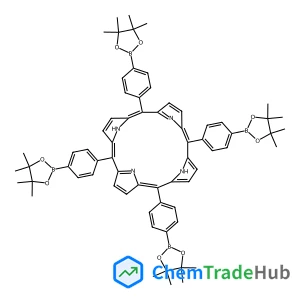
5,10,15,20-tetrakis(4-boronic acid pinacol ester phenyl) porphyrin
CAS号:
1332748-00-1
分子式:
C68H74B4N4O8
![6-Bromo-3-ethyl-3H-imidazo[4,5-b]pyridine structure](https://cnstatic.chemtradehub.com/structs/103/1033202-59-3-2a8f.webp "6-Bromo-3-ethyl-3H-imidazo[4,5-b]pyridine structure")
推荐供应商


免责声明
本页面提供的学术期刊信息仅供参考和研究使用。我们与任何期刊出版商均无关联,也不处理投稿事宜。如有投稿相关咨询,请直接联系相关期刊出版商。
如发现页面信息有误,请发送邮件至 support@chemtradehub.com 联系我们。我们将及时核实并处理您的问题。