
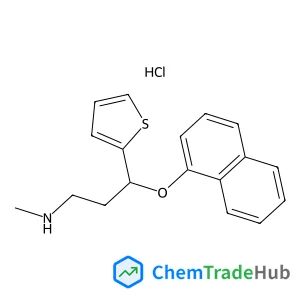
N-Methyl-3-(1-naphthyloxy)-3-(2-thienyl)-1-propanamine hydrochloride (1:1)
CAS号:
1188266-11-6
分子式:
C18H20ClNOS
Junwei Lucas Bao, Prasenjit Seal, Donald G. Truhlar
The growth of nanodusty particles, which is critical in plasma chemistry, physics, and engineering. The aim of the present work is to understand the detailed reaction mechanisms of early steps in this growth. The polymerization of neutral silane with the silylene or silyl anion, which eliminates molecular hydrogen with the formation of their higher homologues, governs the silicon hydride clustering in nanodusty plasma chemistry. The detailed mechanisms of these important polymerization reactions in terms of elementary reactions have not been proposed yet. In the present work, we investigated the initial steps of these polymerization reactions, i.e., the SiH4 + Si2H4−/Si2H5− reactions, and we propose a three-step mechanism, which is also applicable to the following polymerization steps. CM5 charges of all the silicon-containing species were computed in order to analyze the character of the species in the proposed reaction mechanisms. We also calculated thermal rate constant of each step using multi-structural canonical variational transition state theory (MS-CVT) with the small-curvature tunneling (SCT) approximation, based on the minimum energy path computed using M08-HX/MG3S electronic structure method.
DOI: 10.1039/D3CS00194F
Alexey A. Festa, Olga A. Storozhenko, Leonid G. Voskressensky
DOI: 10.1039/D3CS00366C
Hao-Yang Liu, Xiao Li, Zhi-Gang Wang
DOI: 10.1039/D3CS90101G
Conor J. Crawford
DOI: 10.1039/D3CS00321C
Rahul Dev Mukhopadhyay
DOI: 10.1039/D3CS00692A
Xinlu Zheng, Ziwei Ye, Zeeshan Akmal, Chun He, Jinlong Zhang, Lingzhi Wang
DOI: 10.1039/D3CS00462G
Xiuwen Xu
DOI: 10.1039/D3CS00611E
Quanpu Wang, Chao Fang
DOI: 10.1039/D3CS00489A
2-氨基戊烷,又名pentan-2-amine,是一种有机化合物,分子式为C5H11NH2。它是一种无色透明液体,有氨味。该化合物在工业和研究中有一定的应用。
该化合物为白色固体,分子量为552.31 g/mol。它在水中溶解度较低,在有机溶剂如乙腈、乙酸乙酯中有较好的溶解性。该化合物具有较高的化学稳定性,对酸和碱具有...
处理含有Pyrotinib dimaleate 的废料时,应遵循当地的法规要求。首先,收集废料并进行分类,确保没有与其他化学品混合。然后,采取适当的物理和化学处...
在合成过程中,可以考虑使用其他结构类似的化合物作为替代品,例如苯甲酸酯类化合物,如2-乙基-5-甲基噁二唑基苯甲酸乙酯等。这些替代品可能具有相似的化学性质,但在...
处理含有该化合物的废液时,应先确保其完全反应并转化为无害物质。对于未反应的化合物,建议采用中和处理后进行蒸馏回收,剩余物可使用化学氧化法或焚烧法进行无害化处理。...
目前该化合物主要应用于药物合成领域,尤其在开发新型抗癌药物方面具有潜在应用。随着制药行业的持续发展,对于高效、低毒的合成中间体需求增加,预计该化合物的研究和应用...
N,N-乙烯双(碘乙酰胺)是一种白色或类白色固体,易溶于乙醇、丙酮等有机溶剂,但在水中溶解度较低。该化合物具有较高的反应活性,可以与其他含有活性氢的化合物发生酰...
该化合物可以通过环合反应合成,首先合成吡啶和哌啶的衍生物,然后在合适的条件下进行环合反应得到目标化合物。常用的催化剂包括某些金属盐类,产率一般在70%-90%之...
在处理3-乙酰滇乌碱时,应穿戴适当的个人防护装备(PPE),如实验服、手套(丁腈手套或PVC手套)、护目镜和口罩。实验应在通风橱中进行,以减少吸入或皮肤接触的风...
2-溴-5-硝基-4-羧酸应存放在阴凉、干燥、通风良好的地方,远离火源和热源。避免与还原剂、碱性物质接触。储存容器应密封,防止吸湿。

Physical Chemistry Chemical Physics (PCCP) is an international journal co-owned by 19 physical chemistry and physics societies from around the world. This journal publishes original, cutting-edge research in physical chemistry, chemical physics and biophysical chemistry. To be suitable for publication in PCCP, articles must include significant innovation and/or insight into physical chemistry; this is the most important criterion that reviewers and Editors will judge against when evaluating submissions. The journal has a broad scope and welcomes contributions spanning experiment, theory, computation and data science. Topical coverage includes spectroscopy, dynamics, kinetics, statistical mechanics, thermodynamics, electrochemistry, catalysis, surface science, quantum mechanics, quantum computing and machine learning. Interdisciplinary research areas such as polymers and soft matter, materials, nanoscience, energy, surfaces/interfaces, and biophysical chemistry are welcomed if they demonstrate significant innovation and/or insight into physical chemistry. Joined experimental/theoretical studies are particularly appreciated when complementary and based on up-to-date approaches.
![1-[6-(1H-Imidazol-1-yl)-3-pyridinyl]methanamine structure](https://cnstatic.chemtradehub.com/structs/914/914637-08-4-8825.webp "1-[6-(1H-Imidazol-1-yl)-3-pyridinyl]methanamine structure")