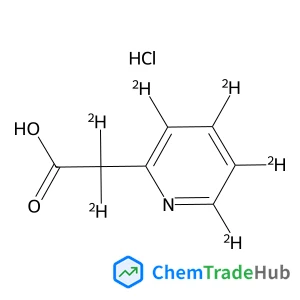
2,2-dideuterio-2-(3,4,5,6-tetradeuterio-2-pyridyl)acetic acid;hydrochloride
CAS号:
1329799-67-8
分子式:
C7H2ClD6NO2
Francesca Peccati, Marta Wiśniewska, Xavier Solans-Monfort, Mariona Sodupe
According to the amyloid cascade hypothesis, amyloid-β (Aβ) deposition is a central event in the Alzheimer's disease and thus, detection of Aβ deposits is crucial to monitor the progression of the pathology. Despite its low tissue penetration, fluorescence imaging may become an alternative technique for identifying these deposits because it is less toxic and less costly than positron emission tomography. Suitable dyes, however, should emit in the near infrared (NIR) region, cross the blood–brain barrier and target Aβ aggregates. In this work, we use TD-DFT, AIMD simulations and protein energy landscape exploration (PELE) to analyze the photophysical properties of a family of donor–acceptor markers and their binding to amyloid fibrils. These markers are formed by N,N-dimethylaniline donor and propanedinitrile acceptor groups separated by a spacer consisting of one, two or three conjugated double bonds. The smallest compound has a low emission wavelength, can deactivate through a non-radiative process involving a conical intersection and binds weakly to Aβ fibrils. In contrast, the largest dye is a suitable compound as it shows an emission wavelength in the NIR region, does not seem to relax through conical intersection processes and binds to Aβ fibrils strongly entering hydrophobic voids. Analysis of electronic excitations shows that the transition has an important charge transfer character that increases with the length of the spacer, the π bridge being an active participant in the transition. Therefore, adding double bonds to the dye skeleton has two beneficial effects: (i) it increases the emission wavelength as it enlarges the π system and (ii) it increases the charge transfer character of the transition, which increases the red-shifting of the emission wavelength in polar solvents.

New Journal of Chemistry
Russian Journal of General Chemistry

Chemical Communications

Journal of Natural Medicines

Chemistry Education Research and Practice
Current Opinion in Colloid & Interface Science
Crystallography Reports

Saudi Pharmaceutical Journal

Russian Journal of Organic Chemistry

Current Opinion in Solid State & Materials Science
DOI: 10.1039/A809794A
Thomas Ruchti, Berton E. Callicoatt, Kenneth C. Janda
DOI: 10.1039/B002051F
Christopher Breen, Jeffrey Forsyth, Jack Yarwood, Trevor Hughes
DOI: 10.1039/B003587O
DOI: 10.1039/A809348B
DOI: 10.1039/A809238I
L. A. Poveda, J. M. García de la Vega, R. H. González-Jonte
DOI: 10.1039/B003132L
1,2-环己二酮环乙缩醛应储存在阴凉、干燥、通风良好的地方,避免阳光直射。建议使用密封容器保存,并保持环境温度在室温范围内,远离火源和热源。
Ecopladib作为一种新型的药物,主要应用于治疗高胆固醇等疾病。目前,市场和研究趋势显示,Ecopladib因其独特的药理作用而受到关注。随着对心血管疾病治...
2,3-二甲基-3H-咪唑[4,5-c]吡啶通常通过咪唑和2,3-二甲基吡啶的缩合反应合成。具体来说,将咪唑和2,3-二甲基吡啶在适当的溶剂中进行加热或加压反应...
该化合物在药物化学和有机合成中有一定的应用。近年来,随着对新型药物化合物的需求增加,该化合物的研究趋势主要集中在探索其生物活性,尤其是其在神经系统疾病治疗中的潜...
盐酸甘氨酸丁酯应储存在阴凉、干燥、通风良好的地方,避免阳光直射和高温环境,温度应控制在25℃以下。储存容器应密封,避免与空气中的水分和酸性物质接触,以防发生水解...
2-碘-N,N-二甲基苯胺是一种有机化合物,化学名为2-Iodo-N,N-dimethylbenzamide。其分子式为C<sub>9</sub>H<sub>1...
随着医药、农药和新材料领域的发展,该化合物作为关键中间体的应用日益增多。特别是在药物合成中,由于其独特的化学性质,可以用于合成多种药物分子。未来的研究趋势可能集...
2,4-二溴-6-三氟甲基嘧啶通常通过溴化反应合成。首先,将6-三氟甲基嘧啶与溴化剂(如液溴)在适当的溶剂(如二氯甲烷、四氢呋喃)中反应,加入适当的催化剂(如四...

Physical Chemistry Chemical Physics (PCCP) is an international journal co-owned by 19 physical chemistry and physics societies from around the world. This journal publishes original, cutting-edge research in physical chemistry, chemical physics and biophysical chemistry. To be suitable for publication in PCCP, articles must include significant innovation and/or insight into physical chemistry; this is the most important criterion that reviewers and Editors will judge against when evaluating submissions. The journal has a broad scope and welcomes contributions spanning experiment, theory, computation and data science. Topical coverage includes spectroscopy, dynamics, kinetics, statistical mechanics, thermodynamics, electrochemistry, catalysis, surface science, quantum mechanics, quantum computing and machine learning. Interdisciplinary research areas such as polymers and soft matter, materials, nanoscience, energy, surfaces/interfaces, and biophysical chemistry are welcomed if they demonstrate significant innovation and/or insight into physical chemistry. Joined experimental/theoretical studies are particularly appreciated when complementary and based on up-to-date approaches.
![N-[2-(4-Hydroxyphenoxy)-4-nitrophenyl]methanesulfonamide structure](https://cnstatic.chemtradehub.com/structs/109/109032-22-6-7c88.webp "N-[2-(4-Hydroxyphenoxy)-4-nitrophenyl]methanesulfonamide structure")
![1-[(4-Methylphenyl)sulfonyl]-3-(4,4,5,5-tetramethyl-1,3,2-dioxaborolan-2-yl)-1H-pyrrolo[2,3-b]pyridine-5-carbonitrile structure](https://cnstatic.chemtradehub.com/structs/143/1434747-57-5-fc0d.webp "1-[(4-Methylphenyl)sulfonyl]-3-(4,4,5,5-tetramethyl-1,3,2-dioxaborolan-2-yl)-1H-pyrrolo[2,3-b]pyridine-5-carbonitrile structure")