






Development of polycarbonate-containing block copolymers for thin film self-assembly applications
文献信息
发布日期
2015-12-10
DOI
10.1039/C5PY01846C
影响因子
5.582
作者
Ankit Vora, Rudy J. Wojtecki, Kristin Schmidt, Anindarupa Chunder, Joy Y. Cheng, Alshakim Nelson, Daniel P. Sanders
查看原文
摘要
Access to well-defined materials is one of the key requirements for successful implementation of block copolymer-based lithography for advanced semiconductor nodes. We report on the development of polystyrene-b-polytrimethylene carbonate (PS-b-PTMC) block copolymer (BCP) using organocatalytic ring opening polymerization of trimethylene carbonate (TMC) from hydroxyl-functional polystyrene macroinitiator as a materials candidate for directed self-assembly applications. The impact of organocatalyst choice and the extent of TMC conversion on the quality of PS-b-PTMC BCP were studied using gel permeation chromatography and nuclear magnetic resonance (NMR) spectroscopy techniques. As a direct method to identify PTMC homopolymer content in the resulting BCPs, a new NMR-based technique was developed. Finally, the influence of BCP purity on the thin film morphology was studied using atomic force microscopy and grazing incidence small angle X-ray scattering techniques. Our results indicate that the PTMC homopolymer impurity negatively impacts the thin film morphology, which is extremely important for lithographic applications.
相关文献
Understanding the differences between iron and palladium in cross-coupling reactions
Xiaobo Sun, Trevor A. Hamlin
2019-02-25
Paper
DOI: 10.1039/C8CP07671E
Computer simulations of the adsorption of an N-terminal peptide of statherin, SN15, and its mutants on hydroxyapatite surfaces
Muzhong Luo, Shengjiang Yang, Xuebo Quan, Delin Sun, Jian Zhou
2019-04-09
Paper
DOI: 10.1039/C9CP01638D
Ion speciation of lithium hexafluorophosphate in dimethyl carbonate solutions: an infrared spectroscopy study
Kristen D. Fulfer, Daniel G. Kuroda
2018-08-13
Paper
DOI: 10.1039/C8CP03315C
Uptake and accommodation of water clusters by adamantane clusters in helium droplets: interplay between magic number clusters
Lorenz Kranabetter, Paul Martini, Norbert Gitzl, Martin Kuhn, Fatima Saleem, Bilal Rasul, Masoomeh Mahmoodi Darian, Elias Jabbour Al Maalouf, Ivan Sukuba, Alexander Kaiser, Marcelo Goulart, Diethard K. Böhme, Paul Scheier
2018-08-10
Paper
DOI: 10.1039/C8CP02207K
Excited state dynamics study of the self-trapped exciton formation in silicon nanosheets
Naeem Ullah, Shunwei Chen
2018-10-29
Paper
DOI: 10.1039/C8CP04806A
Interband transitions in closed-shell vacancy containing graphene quantum dots complexed with heavy metals
Rositsa Yakimova
2018-08-01
Paper
DOI: 10.1039/C8CP03306D
How does the electric current propagate through fully-hydrogenated borophene?
Jutao Jiao, Yusheng Hou, Hui Wang, Dapeng Wu, Tianxing Wang, Zhaoming Fu, Guoliang Xu, Ruqian Wu
2018-07-30
Paper
DOI: 10.1039/C8CP04272A
Excited interatomic potential energy surfaces of Rb + He that correlate with Rb terms 52S through 72S
Amit R. Sharma, David E. Weeks
2018-11-09
Paper
DOI: 10.1039/C8CP05550E
Ionized water confined in graphene nanochannels
Belisa R. H. de Aquino, H. Ghorbanfekr-Kalashami, M. Neek-Amal, F. M. Peeters
2019-03-22
Paper
DOI: 10.1039/C9CP00075E
您可能还喜欢
化合物问答
如何储存1,2-环己二酮环乙缩醛(CAS号:4746-96-7)?
1,2-环己二酮环乙缩醛应储存在阴凉、干燥、通风良好的地方,避免阳光直射。建议使用密封容器保存,并保持环境温度在室温范围内,远离火源和热源。
4746-96-71,4-Dioxaspiro[4.5]d...
化合物问答
Ecopladib(CAS号:381683-92-7)的市场或研究趋势如何?
Ecopladib作为一种新型的药物,主要应用于治疗高胆固醇等疾病。目前,市场和研究趋势显示,Ecopladib因其独特的药理作用而受到关注。随着对心血管疾病治...
381683-92-7Ecopladib
化合物问答
2,3-Dimethyl-3H-imidazo[4,5-c]pyridine(CAS号:52538-09-7)通常如何合成?
2,3-二甲基-3H-咪唑[4,5-c]吡啶通常通过咪唑和2,3-二甲基吡啶的缩合反应合成。具体来说,将咪唑和2,3-二甲基吡啶在适当的溶剂中进行加热或加压反应...
52538-09-72,3-Dimethyl-3H-imid...
化合物问答
2,3,4,5-tetrahydro-1H-3-苯并氮杂环;盐酸盐(CAS号:17379-01-0)的市场或研究趋势如何?
该化合物在药物化学和有机合成中有一定的应用。近年来,随着对新型药物化合物的需求增加,该化合物的研究趋势主要集中在探索其生物活性,尤其是其在神经系统疾病治疗中的潜...
17379-01-02,3,4,5-Tetrahydro-1...
68-90-6(2-Ethyl-1-benzofura...
化合物问答
如何储存盐酸甘氨酸丁酯(CAS号:13048-99-2)?
盐酸甘氨酸丁酯应储存在阴凉、干燥、通风良好的地方,避免阳光直射和高温环境,温度应控制在25℃以下。储存容器应密封,避免与空气中的水分和酸性物质接触,以防发生水解...
13048-99-2Butyl glycinate hydr...
化合物问答
什么是2-Iodo-N,N-dimethylbenzamide(CAS号:54616-46-5)?
2-碘-N,N-二甲基苯胺是一种有机化合物,化学名为2-Iodo-N,N-dimethylbenzamide。其分子式为C<sub>9</sub>H<sub>1...
54616-46-52-Iodo-N,N-dimethylb...
16817-90-6N-Cyclohexylglycinam...
化合物问答
5-溴-2-(4H-1,2,4-三唑-4-基)吡啶(CAS号:959240-99-4)的市场或研究趋势如何?
随着医药、农药和新材料领域的发展,该化合物作为关键中间体的应用日益增多。特别是在药物合成中,由于其独特的化学性质,可以用于合成多种药物分子。未来的研究趋势可能集...
959240-99-45-Bromo-2-(4H-1,2,4-...
化合物问答
2,4-二溴-6-三氟甲基嘧啶(CAS号:785778-00-9)通常如何合成?
2,4-二溴-6-三氟甲基嘧啶通常通过溴化反应合成。首先,将6-三氟甲基嘧啶与溴化剂(如液溴)在适当的溶剂(如二氯甲烷、四氢呋喃)中反应,加入适当的催化剂(如四...
785778-00-92,4-Dibromo-6-(trifl...
来源期刊
Polymer Chemistry

CiteScore:
8.6
自引率:
7.3%
年发文量:
457
Polymer Chemistry welcomes submissions in all areas of polymer science that have a strong focus on macromolecular chemistry. Manuscripts may cover a broad range of fields, yet no direct application focus is required.
推荐化合物
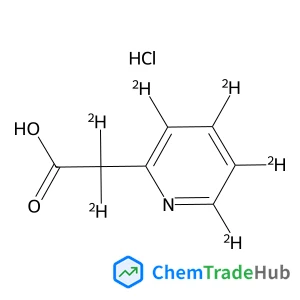
2,2-dideuterio-2-(3,4,5,6-tetradeuterio-2-pyridyl)acetic acid;hydrochloride
CAS号:
1329799-67-8
分子式:
C7H2ClD6NO2
推荐供应商





免责声明
本页面提供的学术期刊信息仅供参考和研究使用。我们与任何期刊出版商均无关联,也不处理投稿事宜。如有投稿相关咨询,请直接联系相关期刊出版商。
如发现页面信息有误,请发送邮件至 support@chemtradehub.com 联系我们。我们将及时核实并处理您的问题。