






Correcting the fundamental ion mobility equation for field effects
文献信息
发布日期
2016-09-26
DOI
10.1039/C6AN01353H
影响因子
4.616
作者
William F. Siems, Larry A. Viehland, Herbert H. Hill, Jr
查看原文
摘要
The fundamental ion mobility equation computes the energy-averaged collision cross section as a function of measured drift velocity, electric field strength, ion and neutral masses, and drift gas state parameters. As field strength approaches zero, in particular when the drift velocity drops below about 4% of the average ion-neutral thermal speed, the fundamental equation takes on an especially simple form because the collision frequency and average momentum transfer become indistinguishable from their thermal values. However, in modern high-performance IMS-MS instruments, ion drift velocities may be 10–50% or more of thermal speed, and analysis using the zero-field equation gives rise to erroneously large cross sections. We address this problem by developing correction factors for the zero-field equation from an improved momentum-transfer (MT) theory for ion mobility, corrected and completed herein, and from the well-known two-temperature (2T) theory. The corrected and uncorrected equations are compared by their ability to recover known hard-sphere cross sections from accurately-computed mobility data. Both MT and 2T expressions adjust for the field-driven increase in collision frequency and are noticeably superior to zero-field expression whenever the ion drift velocity is greater than ∼4% of thermal speed. The MT expression also adjusts for the mass and field dependent change in average momentum transfer, and is more accurate than the 2T first approximation whenever the mass of the ionic species is greater than about four times that of drift gas molecules, as is the case in most analytical applications of IMS coupled to MS.
期刊推荐
相关文献
The Fermi level as an energy reference in liquid jet X-ray photoelectron spectroscopy studies of aqueous solutions
Lucía Pérez Ramírez, Anthony Boucly, Florent Saudrais, Emmanuel Maisonhaute, Aleksandar R. Milosavljević, Christophe Nicolas, François Rochet
2021-07-05
Paper
DOI: 10.1039/D1CP01511G
Formation of dimethyl carbonate via direct esterification of CO2 with methanol on reduced or stoichiometric CeO2(111) and (110) surfaces
Jian Jiang, Chris M. Marin, Avinash Kumar Both, Chin Li Cheung, Lei Li, Xiao Cheng Zeng
2021-07-19
Paper
DOI: 10.1039/D1CP02152D
An evaluation of solvent effects and ethanol oxidation
Yuhan Mei, N. Aaron Deskins
2021-07-19
Paper
DOI: 10.1039/D1CP00630D
Assessing nickel oxide electrocatalysts incorporating diamines and having improved oxygen evolution activity using operando UV/visible and X-ray absorption spectroscopy
Takafumi Miura, Shun Tsunekawa, Sho Onishi, Toshiaki Ina, Kehsuan Wang, Genta Watanabe, Chechia Hu, Hiroshi Kondoh, Takeshi Kawai
2021-10-11
Paper
DOI: 10.1039/D1CP03323A
Improving the surface hydrophobicity by the solvent effect to reduce the water erosion of the CL-20/TNT cocrystal explosive
Yu Sha, Xiaobing Zhang
2021-09-22
Paper
DOI: 10.1039/D1CP03317D
Core-softened water–alcohol mixtures: the solute-size effects
Murilo S. Marques, Vinicius F. Hernandes, José Rafael Bordin
2021-07-05
Paper
DOI: 10.1039/D1CP00751C
Mechanical properties and thermal conductivity of newly introduced graphene-like borophanes: a reactive molecular dynamics study
2021-08-02
Paper
DOI: 10.1039/D1CP01831K
Unravelling the nature of a toluene–fumaronitrile complex
Andrzej J. Kałka, Mateusz Z. Brela, Andrzej M. Turek
2021-07-03
Paper
DOI: 10.1039/D1CP01895G
Active Brownian particle in homogeneous media of different viscosities: numerical simulations
E. A. Lisin, O. S. Vaulina, I. I. Lisina, O. F. Petrov
2021-07-26
Paper
DOI: 10.1039/D1CP02511B
The growth of a large GdPO4 crystal guided by theoretical simulation and the study of its phonon properties
Xinghong Gong, Yujin Chen, Jianhua Huang, Yanfu Lin, Zundu Luo, Shuiquan Deng, Yidong Huang
2021-09-16
Paper
DOI: 10.1039/D1CP02977K
您可能还喜欢
化合物问答
如何储存8-溴-4-羟基-6-(三氟甲氧基)喹啉-3-羧酸乙酯(CAS号:1072944-81-0)?
8-溴-4-羟基-6-(三氟甲氧基)喹啉-3-羧酸乙酯应储存在阴凉、干燥的地方,避免光照和高温。建议使用密封容器进行储存,以防止水分和空气的影响。
1072944-81-0Ethyl 8-bromo-4-hydr...
化合物问答
2,2-二(2-呋喃基)丙烷(CAS号:17920-88-6)的市场或研究趋势如何?
2,2-二(2-呋喃基)丙烷的研究趋势主要集中在新型材料的开发和应用,如高分子材料、有机光电材料等。市场趋势方面,随着环保要求的提高和新材料的应用,该化合物的需...
17920-88-62,2'-(2,2-Propanediy...
化合物问答
如何处理含有螺[呋喃并[3,4-b]吡啶-5(7H),4'-哌啶]-7-酮盐酸盐(CAS号:475152-31-9)的废料?
对于含有螺[呋喃并[3,4-b]吡啶-5(7H),4'-哌啶]-7-酮盐酸盐的废料,应首先进行分类和分离,以减少危险物质的数量。随后,可以考虑通过化学氧化、生物...
475152-31-97H-Spiro[furo[3,4-b]...
化合物问答
Cinnamyl 3-aminobut-2-enoate(CAS号:113898-97-8)安全吗?
Cinnamyl 3-氨基丁-2-烯酸在接触皮肤和眼睛时可能会引起刺激。应避免吸入其粉尘和烟雾。操作时应穿戴适当的个人防护装备,如手套、护目镜和实验室外套。
113898-97-8Cinnamyl 3-aminobut-...
化合物问答
反式-2-十二碳烯二酸(CAS号:6402-36-4)的市场或研究趋势如何?
反式-2-十二碳烯二酸在医药、材料科学等领域有一定的应用,但其市场相对较小。近年来,由于环保意识的提升,对环境友好型化学品的需求增加,研究倾向于开发更绿色的合成...
6402-36-4Traumatic Acid
化合物问答
什么是(9ci)-1H-苯并咪唑-5-乙酸(CAS号:473895-86-2)?
(9ci)-1H-苯并咪唑-5-乙酸是一种含氮杂环化合物,其化学结构为1H-苯并咪唑-5-乙酸。该化合物具有特定的分子式C8H7NO2,属于有机酸类化合物。
473895-86-21H-Benzimidazol-5-yl...
化合物问答
酞菁蓝(CAS号:147-14-8)的主要用途是什么?
酞菁蓝主要用作颜料和染料,广泛应用于塑料、油墨、涂料、纺织品及橡胶工业中。它也用于光敏材料,如太阳能电池和光刻胶。在医疗领域,酞菁蓝因其光敏特性被用于某些光动力...
147-14-8Copper(2+) phthalocy...
化合物问答
5-甲基-1,2,3,4-四氢异喹啉(CAS号:123593-99-7)安全吗?
5-甲基-1,2,3,4-四氢异喹啉在使用和储存时需要谨慎处理。它具有一定的毒性,应避免吸入其蒸气或直接接触皮肤和眼睛。操作此化合物时,建议佩戴防护眼镜、实验服...
123593-99-75-Methyl-1,2,3,4-tet...
化合物问答
如何处理含有3',4',5'-三甲氧基苯乙酮(CAS号:1136-86-3)的废料?
含有3',4',5'-三甲氧基苯乙酮的废液应首先确保其是否为危险废物,根据当地法规确定处理方法。通常,这类有机废液可以采用中和反应降低其pH值,然后通过蒸馏或萃...
1136-86-31-(3,4,5-Trimethoxyp...
化合物问答
如何储存KI-7(CAS号:1489263-00-4)?
KI-7应储存在通风良好的干燥环境中,避免光照和高温。建议使用密封容器储存,并保持在阴凉处。储存温度应控制在室温范围内,一般建议不超过25°C。避免与氧化剂接触...
1489263-00-42-(1-Benzyl-1H-indol...
来源期刊
Analyst

CiteScore:
7.8
自引率:
5.6%
年发文量:
653
Analyst publishes analytical and bioanalytical research that reports premier fundamental discoveries and inventions, and the applications of those discoveries, unconfined by traditional discipline barriers.
推荐化合物

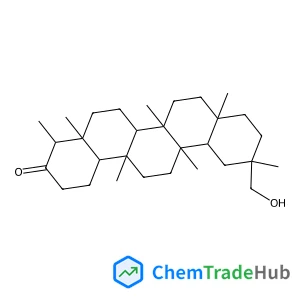
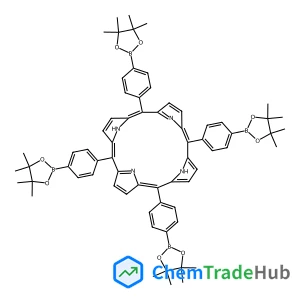
5,10,15,20-tetrakis(4-boronic acid pinacol ester phenyl) porphyrin
CAS号:
1332748-00-1
分子式:
C68H74B4N4O8
推荐供应商




免责声明
本页面提供的学术期刊信息仅供参考和研究使用。我们与任何期刊出版商均无关联,也不处理投稿事宜。如有投稿相关咨询,请直接联系相关期刊出版商。
如发现页面信息有误,请发送邮件至 support@chemtradehub.com 联系我们。我们将及时核实并处理您的问题。