




DNA biosensing with 3D printing technology
文献信息
发布日期
2016-12-21
DOI
10.1039/C6AN02038K
影响因子
4.616
作者
Adeline Huiling Loo, Chun Kiang Chua, Martin Pumera
查看原文
摘要
3D printing, an upcoming technology, has vast potential to transform conventional fabrication processes due to the numerous improvements it can offer to the current methods. To date, the employment of 3D printing technology has been examined for applications in the fields of engineering, manufacturing and biological sciences. In this study, we examined the potential of adopting 3D printing technology for a novel application, electrochemical DNA biosensing. Metal 3D printing was utilized to construct helical-shaped stainless steel electrodes which functioned as a transducing platform for the detection of DNA hybridization. The ability of electroactive methylene blue to intercalate into the double helix structure of double-stranded DNA was then exploited to monitor the DNA hybridization process, with its inherent reduction peak serving as an analytical signal. The designed biosensing approach was found to demonstrate superior selectivity against a non-complementary DNA target, with a detection range of 1–1000 nM.
相关文献
Improving the surface hydrophobicity by the solvent effect to reduce the water erosion of the CL-20/TNT cocrystal explosive
Yu Sha, Xiaobing Zhang
2021-09-22
Paper
DOI: 10.1039/D1CP03317D
Single sheets of graphene for fabrication of fibers with enhanced mechanical properties
Muhammad G. Salim, Luke A. Thimons, Min A. Kim, Brennan Carr, Michelle Montgomery, Nathan Tolman, Tevis D. B. Jacobs, Haitao Liu
2021-09-20
Paper
DOI: 10.1039/D1CP03238K
Decomposition of nitrous oxide in hydrated cobalt(i) clusters: a theoretical insight into the mechanistic roles of ligand-binding modes
Ephrem G. Demissie, Wing Ka Lam, Wai Kit Tang, Chi-Kit Siu
2021-07-06
Paper
DOI: 10.1039/D1CP01820E
Robustness and accuracy improvement of data processing with 2D neural networks for transient absorption dynamics
Ruixuan Zhao, Daxin Wu, Jiao Wen, Qi Zhang, Guanglei Zhang, Jiebo Li
2021-07-16
Paper
DOI: 10.1039/D1CP02521J
Superconducting properties of BaBi3 at ambient and high pressures
Yanan Wang, Tomoya Taguchi, Huan Li, Ai Suzuki, Yanting Zhang, Akari Miura, Mitsuki Ikeda, Hidenori Goto, Ritsuko Eguchi, Takafumi Miyazaki, Yen-Fa Liao, Hirofumi Ishii, Yoshihiro Kubozono
2021-09-20
Paper
DOI: 10.1039/D1CP00042J
Sequence-dependent aggregation-prone conformations of islet amyloid polypeptide
Bumjoon Choi, Nam Hyeong Kim, Geun Young Jin, Yung Sam Kim, Kilho Eom
2021-09-04
Paper
DOI: 10.1039/D1CP01061A
From water-rich to oil-rich gelled non-toxic microemulsions
Ke Peng, Natalie Preisig, Thomas Sottmann, Cosima Stubenrauch
2021-07-30
Paper
DOI: 10.1039/D1CP02522H
Local Kondo scattering in 4d-electron RuOx nanoclusters on atomically-resolved ultrathin SrRuO3 films
Xin Liu
2021-09-13
Paper
DOI: 10.1039/D1CP02738G
Polariton induced conical intersection and berry phase
Marwa H. Farag, Arkajit Mandal
2021-07-19
Paper
DOI: 10.1039/D1CP00943E
Dissolution kinetics of a sodium borosilicate glass in Tris buffer solutions: impact of Tris concentration and acid (HCl/HNO3) identity
Nicholas Stone-Weiss, Nicholas J. Smith, Randall E. Youngman, Eric M. Pierce, Ashutosh Goel
2021-07-08
Paper
DOI: 10.1039/D0CP06425D
您可能还喜欢
化合物问答
如何储存8-溴-4-羟基-6-(三氟甲氧基)喹啉-3-羧酸乙酯(CAS号:1072944-81-0)?
8-溴-4-羟基-6-(三氟甲氧基)喹啉-3-羧酸乙酯应储存在阴凉、干燥的地方,避免光照和高温。建议使用密封容器进行储存,以防止水分和空气的影响。
1072944-81-0Ethyl 8-bromo-4-hydr...
化合物问答
2,2-二(2-呋喃基)丙烷(CAS号:17920-88-6)的市场或研究趋势如何?
2,2-二(2-呋喃基)丙烷的研究趋势主要集中在新型材料的开发和应用,如高分子材料、有机光电材料等。市场趋势方面,随着环保要求的提高和新材料的应用,该化合物的需...
17920-88-62,2'-(2,2-Propanediy...
化合物问答
如何处理含有螺[呋喃并[3,4-b]吡啶-5(7H),4'-哌啶]-7-酮盐酸盐(CAS号:475152-31-9)的废料?
对于含有螺[呋喃并[3,4-b]吡啶-5(7H),4'-哌啶]-7-酮盐酸盐的废料,应首先进行分类和分离,以减少危险物质的数量。随后,可以考虑通过化学氧化、生物...
475152-31-97H-Spiro[furo[3,4-b]...
化合物问答
Cinnamyl 3-aminobut-2-enoate(CAS号:113898-97-8)安全吗?
Cinnamyl 3-氨基丁-2-烯酸在接触皮肤和眼睛时可能会引起刺激。应避免吸入其粉尘和烟雾。操作时应穿戴适当的个人防护装备,如手套、护目镜和实验室外套。
113898-97-8Cinnamyl 3-aminobut-...
化合物问答
反式-2-十二碳烯二酸(CAS号:6402-36-4)的市场或研究趋势如何?
反式-2-十二碳烯二酸在医药、材料科学等领域有一定的应用,但其市场相对较小。近年来,由于环保意识的提升,对环境友好型化学品的需求增加,研究倾向于开发更绿色的合成...
6402-36-4Traumatic Acid
化合物问答
什么是(9ci)-1H-苯并咪唑-5-乙酸(CAS号:473895-86-2)?
(9ci)-1H-苯并咪唑-5-乙酸是一种含氮杂环化合物,其化学结构为1H-苯并咪唑-5-乙酸。该化合物具有特定的分子式C8H7NO2,属于有机酸类化合物。
473895-86-21H-Benzimidazol-5-yl...
化合物问答
酞菁蓝(CAS号:147-14-8)的主要用途是什么?
酞菁蓝主要用作颜料和染料,广泛应用于塑料、油墨、涂料、纺织品及橡胶工业中。它也用于光敏材料,如太阳能电池和光刻胶。在医疗领域,酞菁蓝因其光敏特性被用于某些光动力...
147-14-8Copper(2+) phthalocy...
化合物问答
5-甲基-1,2,3,4-四氢异喹啉(CAS号:123593-99-7)安全吗?
5-甲基-1,2,3,4-四氢异喹啉在使用和储存时需要谨慎处理。它具有一定的毒性,应避免吸入其蒸气或直接接触皮肤和眼睛。操作此化合物时,建议佩戴防护眼镜、实验服...
123593-99-75-Methyl-1,2,3,4-tet...
化合物问答
如何处理含有3',4',5'-三甲氧基苯乙酮(CAS号:1136-86-3)的废料?
含有3',4',5'-三甲氧基苯乙酮的废液应首先确保其是否为危险废物,根据当地法规确定处理方法。通常,这类有机废液可以采用中和反应降低其pH值,然后通过蒸馏或萃...
1136-86-31-(3,4,5-Trimethoxyp...
化合物问答
如何储存KI-7(CAS号:1489263-00-4)?
KI-7应储存在通风良好的干燥环境中,避免光照和高温。建议使用密封容器储存,并保持在阴凉处。储存温度应控制在室温范围内,一般建议不超过25°C。避免与氧化剂接触...
1489263-00-42-(1-Benzyl-1H-indol...
来源期刊
Analyst

CiteScore:
7.8
自引率:
5.6%
年发文量:
653
Analyst publishes analytical and bioanalytical research that reports premier fundamental discoveries and inventions, and the applications of those discoveries, unconfined by traditional discipline barriers.
推荐化合物
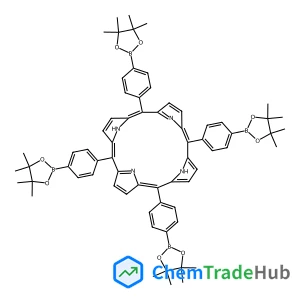
5,10,15,20-tetrakis(4-boronic acid pinacol ester phenyl) porphyrin
CAS号:
1332748-00-1
分子式:
C68H74B4N4O8
推荐供应商




免责声明
本页面提供的学术期刊信息仅供参考和研究使用。我们与任何期刊出版商均无关联,也不处理投稿事宜。如有投稿相关咨询,请直接联系相关期刊出版商。
如发现页面信息有误,请发送邮件至 support@chemtradehub.com 联系我们。我们将及时核实并处理您的问题。