







A NASBA on microgel-tethered molecular-beacon microarray for real-time microbial molecular diagnostics
文献信息
发布日期
2016-11-24
DOI
10.1039/C6AN02192A
影响因子
4.616
作者
Y. Ma, T. Hong, G. B. Munk, M. Libera
查看原文
摘要
Despite their many advantages and successes, molecular beacon (MB) hybridization probes have not been extensively used in microarray formats because of the complicating probe–substrate interactions that increase the background intensity. We have previously shown that tethering to surface-patterned microgels is an effective means for localizing MB probes to specific surface locations in a microarray format while simultaneously maintaining them in as water-like an environment as possible and minimizing probe–surface interactions. Here we extend this approach to include both real-time detection together with integrated NASBA amplification. We fabricate small (∼250 μm × 250 μm) simplex, duplex, and five-plex assays with microarray spots of controllable size (∼20 μm diameter), position, and shape to detect bacteria and fungi in a bloodstream-infection model. The targets, primers, and microgel-tethered probes can be combined in a single isothermal reaction chamber with no post-amplification labelling. We extract total RNA from clinical blood samples and differentiate between Gram-positive and Gram-negative bloodstream infection in a duplex assay to detect RNA- amplicons. The sensitivity based on our current protocols in a simplex assay to detect specific ribosomal RNA sequences within total RNA extracted from S. aureus and E. coli cultures corresponds to tens of bacteria per ml. We furthermore show that the platform can detect RNA- amplicons from synthetic target DNA with 1 fM sensitivity in sample volumes that contain about 12 000 DNA molecules. These experiments demonstrate an alternative approach that can enable rapid and real-time microarray-based molecular diagnostics.
相关文献
Bishop's hat silicene: a planar square silicon bilayer decorated with adatoms
Pedro Borlido, Miguel A. L. Marques, Silvana Botti
2021-08-02
Paper
DOI: 10.1039/D1CP01316E
Understanding charge storage in Nb2CTx MXene as an anode material for lithium ion batteries
Tao Hu, Zuohua Wang, Weizhen Wang, Yan Liang, Chao Zhang, Cuiyu Li, Hailong Wang, Hongxia Lu, Zhiqing Yang, Hongwang Zhang, Xiaohui Wang
2021-09-16
Paper
DOI: 10.1039/D1CP03070A
Extinction, absorption, and scattering of light by plasmonic spheres embedded in an absorbing host medium
2021-09-15
Paper
DOI: 10.1039/D1CP03057D
Cation enrichment in the ion atmosphere is promoted by local hydration of DNA
Chun Yu Ma, Simone Pezzotti, Gerhard Schwaab, Magdalena Gebala, Daniel Herschlag, Martina Havenith
2021-09-15
Paper
DOI: 10.1039/D1CP01963E
Enhanced strain-induced magnetoelectric coupling in polarization-free Fe/BaTiO3 heterostructures
Carlos O. Amorim, João S. Amaral, Vítor S. Amaral
2021-07-01
Paper
DOI: 10.1039/D1CP00885D
Revisiting the glass transition temperature of water–glycerol mixtures in the bulk and confined in mesoporous silica
Ivette Angarita, Ma. Florencia Mazzobre
2021-07-10
Paper
DOI: 10.1039/D1CP02153B
Noncentrosymmetric Weyl phase and topological phase transition in bulk MoTe
Jia-Fang Wu, Sha-Sha Ke, Yong Guo, Huai-Wu Zhang
2021-09-25
Paper
DOI: 10.1039/D1CP02793J
A graphene–Mo2C heterostructure for a highly responsive broadband photodetector
Xiaozhi Bao, Tian Sun, Yan Liu, Chuan Xu, Weiliang Ma, Junpo Guo, Yun Zheng, Shivananju Bannur Nanjunda, Huating Liu, Zongyu Huang, Shenghuang Lin, Guichuan Xing, Wencai Ren, Qiaoliang Bao, Huaiyu Shao
2021-09-15
Paper
DOI: 10.1039/D1CP03536C
Single sheets of graphene for fabrication of fibers with enhanced mechanical properties
Muhammad G. Salim, Luke A. Thimons, Min A. Kim, Brennan Carr, Michelle Montgomery, Nathan Tolman, Tevis D. B. Jacobs, Haitao Liu
2021-09-20
Paper
DOI: 10.1039/D1CP03238K
Oscillatory dynamics during the methanol electrooxidation reaction on Pt(111)
Kaline Nascimento da Silva
2021-08-02
Paper
DOI: 10.1039/D1CP02490F
您可能还喜欢
化合物问答
如何储存8-溴-4-羟基-6-(三氟甲氧基)喹啉-3-羧酸乙酯(CAS号:1072944-81-0)?
8-溴-4-羟基-6-(三氟甲氧基)喹啉-3-羧酸乙酯应储存在阴凉、干燥的地方,避免光照和高温。建议使用密封容器进行储存,以防止水分和空气的影响。
1072944-81-0Ethyl 8-bromo-4-hydr...
化合物问答
2,2-二(2-呋喃基)丙烷(CAS号:17920-88-6)的市场或研究趋势如何?
2,2-二(2-呋喃基)丙烷的研究趋势主要集中在新型材料的开发和应用,如高分子材料、有机光电材料等。市场趋势方面,随着环保要求的提高和新材料的应用,该化合物的需...
17920-88-62,2'-(2,2-Propanediy...
化合物问答
如何处理含有螺[呋喃并[3,4-b]吡啶-5(7H),4'-哌啶]-7-酮盐酸盐(CAS号:475152-31-9)的废料?
对于含有螺[呋喃并[3,4-b]吡啶-5(7H),4'-哌啶]-7-酮盐酸盐的废料,应首先进行分类和分离,以减少危险物质的数量。随后,可以考虑通过化学氧化、生物...
475152-31-97H-Spiro[furo[3,4-b]...
化合物问答
Cinnamyl 3-aminobut-2-enoate(CAS号:113898-97-8)安全吗?
Cinnamyl 3-氨基丁-2-烯酸在接触皮肤和眼睛时可能会引起刺激。应避免吸入其粉尘和烟雾。操作时应穿戴适当的个人防护装备,如手套、护目镜和实验室外套。
113898-97-8Cinnamyl 3-aminobut-...
化合物问答
反式-2-十二碳烯二酸(CAS号:6402-36-4)的市场或研究趋势如何?
反式-2-十二碳烯二酸在医药、材料科学等领域有一定的应用,但其市场相对较小。近年来,由于环保意识的提升,对环境友好型化学品的需求增加,研究倾向于开发更绿色的合成...
6402-36-4Traumatic Acid
化合物问答
什么是(9ci)-1H-苯并咪唑-5-乙酸(CAS号:473895-86-2)?
(9ci)-1H-苯并咪唑-5-乙酸是一种含氮杂环化合物,其化学结构为1H-苯并咪唑-5-乙酸。该化合物具有特定的分子式C8H7NO2,属于有机酸类化合物。
473895-86-21H-Benzimidazol-5-yl...
化合物问答
酞菁蓝(CAS号:147-14-8)的主要用途是什么?
酞菁蓝主要用作颜料和染料,广泛应用于塑料、油墨、涂料、纺织品及橡胶工业中。它也用于光敏材料,如太阳能电池和光刻胶。在医疗领域,酞菁蓝因其光敏特性被用于某些光动力...
147-14-8Copper(2+) phthalocy...
化合物问答
5-甲基-1,2,3,4-四氢异喹啉(CAS号:123593-99-7)安全吗?
5-甲基-1,2,3,4-四氢异喹啉在使用和储存时需要谨慎处理。它具有一定的毒性,应避免吸入其蒸气或直接接触皮肤和眼睛。操作此化合物时,建议佩戴防护眼镜、实验服...
123593-99-75-Methyl-1,2,3,4-tet...
化合物问答
如何处理含有3',4',5'-三甲氧基苯乙酮(CAS号:1136-86-3)的废料?
含有3',4',5'-三甲氧基苯乙酮的废液应首先确保其是否为危险废物,根据当地法规确定处理方法。通常,这类有机废液可以采用中和反应降低其pH值,然后通过蒸馏或萃...
1136-86-31-(3,4,5-Trimethoxyp...
化合物问答
如何储存KI-7(CAS号:1489263-00-4)?
KI-7应储存在通风良好的干燥环境中,避免光照和高温。建议使用密封容器储存,并保持在阴凉处。储存温度应控制在室温范围内,一般建议不超过25°C。避免与氧化剂接触...
1489263-00-42-(1-Benzyl-1H-indol...
来源期刊
Analyst

CiteScore:
7.8
自引率:
5.6%
年发文量:
653
Analyst publishes analytical and bioanalytical research that reports premier fundamental discoveries and inventions, and the applications of those discoveries, unconfined by traditional discipline barriers.
推荐化合物
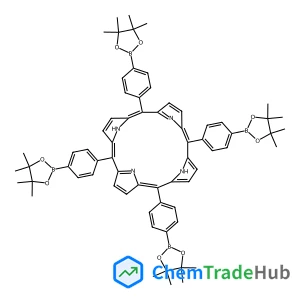
5,10,15,20-tetrakis(4-boronic acid pinacol ester phenyl) porphyrin
CAS号:
1332748-00-1
分子式:
C68H74B4N4O8
![2-[(5Z,8Z,11Z,14Z)-5,8,11,14-Icosatetraen-1-yloxy]-1,3-propanediol structure](https://cnstatic.chemtradehub.com/structs/222/222723-55-9-0348.webp "2-[(5Z,8Z,11Z,14Z)-5,8,11,14-Icosatetraen-1-yloxy]-1,3-propanediol structure")
推荐供应商







免责声明
本页面提供的学术期刊信息仅供参考和研究使用。我们与任何期刊出版商均无关联,也不处理投稿事宜。如有投稿相关咨询,请直接联系相关期刊出版商。
如发现页面信息有误,请发送邮件至 support@chemtradehub.com 联系我们。我们将及时核实并处理您的问题。