









A lab-on-a-chip for monolith-based preconcentration and electrophoresis separation of phosphopeptides
文献信息
发布日期
2017-01-18
DOI
10.1039/C6AN02324J
影响因子
4.616
作者
Monica Araya-Farias, Benjamin Carbonnier, Mohamed Guerrouache, Ichraf Ayed, Nacera Aboud, Myriam Taverna, N. Thuy Tran
查看原文
摘要
A microdevice combining online preconcentration and separation of phosphopeptides was developed in a glass microchip. An ethylene glycol methacrylate phosphate (EGMP), acrylamide (AM) and bisacrylamide (BAA) based monolith was synthesized within microchannels through a photo-driven process. Morphological investigations revealed a homogeneous monolithic structure composed of uniform nodules (∼0.8 μm), with a large pore volume (0.62 cm3 g−1) and sufficiently high specific surface area (34.1 m2 g−1). These features make the monolith particularly interesting for preconcentration purposes. Immobilization of Zr4+ ions on the phosphate groups present at the poly(EGMP-co-AM-co-BAA) monolith surface leads to immobilized metal affinity chromatography support. This monolith-Zr4+ showed a great capacity to capture phosphopeptides. Successful preconcentration and separation of a mixture of ERK2 derived peptides differing only by their phosphorylation degree and sites could be achieved with signal enhancement factors between 340 and 910 after only 7 min of preconcentration. This integrated microdevice represents a novel approach for phosphoproteomic applications.
相关文献
Effect of water nanoconfinement on the dynamic properties of paramagnetic colloidal complexes
Luca Bergamasco, Matteo Morciano, Matteo Fasano
2021-08-02
Paper
DOI: 10.1039/D1CP00708D
Strain engineering of polar optical phonon scattering mechanism – an effective way to optimize the power-factor and lattice thermal conductivity of ScN
Man Hea Kim, Carlos Baldo, III, Yan Wang, Mahalakshmi Sahasranaman
2021-09-27
Paper
DOI: 10.1039/D1CP02971A
Aggregation-induced negative differential resistance in graphene oxide quantum dots
Sonia Sharma, Chieh-An Cheng, Svette Reina Merden Santiago, Denice N. Feria, Chi-Tsu Yuan, Sheng-Hsiung Chang, Tai-Yuan Lin, Ji-Lin Shen
2021-08-01
Paper
DOI: 10.1039/D1CP01529J
Theoretical study of the dissociative photodetachment dynamics of the hydrated superoxide anion cluster
Yu Hashimoto, Kohei Saito, Toshiyuki Takayanagi, Hiroto Tachikawa
2021-07-27
Paper
DOI: 10.1039/D1CP02379A
Identification of intermediates of a molecular ruthenium catalyst for water oxidation using in situ electrochemical X-ray absorption spectroscopy
Huacai Yan, Fusheng Li, Qingyu Kong
2021-10-12
Paper
DOI: 10.1039/D1CP03837K
Electrically tunable band gap in strained h-BN/silicene van der Waals heterostructures
Douglas D. de Vargas, Rogério J. Baierle
2021-08-03
Paper
DOI: 10.1039/D1CP02012A
A graphene–Mo2C heterostructure for a highly responsive broadband photodetector
Xiaozhi Bao, Tian Sun, Yan Liu, Chuan Xu, Weiliang Ma, Junpo Guo, Yun Zheng, Shivananju Bannur Nanjunda, Huating Liu, Zongyu Huang, Shenghuang Lin, Guichuan Xing, Wencai Ren, Qiaoliang Bao, Huaiyu Shao
2021-09-15
Paper
DOI: 10.1039/D1CP03536C
Insights on peptide topology in the computational design of protein ligands: the example of lysozyme binding peptides
Cristina Cantarutti, M. Cristina Vargas, Mireille Dumoulin, Sara La Manna, Daniela Marasco, Carlo Santambrogio, Rita Grandori, Giacinto Scoles, Alessandra Corazza
2021-09-16
Paper
DOI: 10.1039/D1CP02536H
Local Kondo scattering in 4d-electron RuOx nanoclusters on atomically-resolved ultrathin SrRuO3 films
Xin Liu
2021-09-13
Paper
DOI: 10.1039/D1CP02738G
您可能还喜欢
化合物问答
如何储存8-溴-4-羟基-6-(三氟甲氧基)喹啉-3-羧酸乙酯(CAS号:1072944-81-0)?
8-溴-4-羟基-6-(三氟甲氧基)喹啉-3-羧酸乙酯应储存在阴凉、干燥的地方,避免光照和高温。建议使用密封容器进行储存,以防止水分和空气的影响。
1072944-81-0Ethyl 8-bromo-4-hydr...
化合物问答
2,2-二(2-呋喃基)丙烷(CAS号:17920-88-6)的市场或研究趋势如何?
2,2-二(2-呋喃基)丙烷的研究趋势主要集中在新型材料的开发和应用,如高分子材料、有机光电材料等。市场趋势方面,随着环保要求的提高和新材料的应用,该化合物的需...
17920-88-62,2'-(2,2-Propanediy...
化合物问答
如何处理含有螺[呋喃并[3,4-b]吡啶-5(7H),4'-哌啶]-7-酮盐酸盐(CAS号:475152-31-9)的废料?
对于含有螺[呋喃并[3,4-b]吡啶-5(7H),4'-哌啶]-7-酮盐酸盐的废料,应首先进行分类和分离,以减少危险物质的数量。随后,可以考虑通过化学氧化、生物...
475152-31-97H-Spiro[furo[3,4-b]...
化合物问答
Cinnamyl 3-aminobut-2-enoate(CAS号:113898-97-8)安全吗?
Cinnamyl 3-氨基丁-2-烯酸在接触皮肤和眼睛时可能会引起刺激。应避免吸入其粉尘和烟雾。操作时应穿戴适当的个人防护装备,如手套、护目镜和实验室外套。
113898-97-8Cinnamyl 3-aminobut-...
化合物问答
反式-2-十二碳烯二酸(CAS号:6402-36-4)的市场或研究趋势如何?
反式-2-十二碳烯二酸在医药、材料科学等领域有一定的应用,但其市场相对较小。近年来,由于环保意识的提升,对环境友好型化学品的需求增加,研究倾向于开发更绿色的合成...
6402-36-4Traumatic Acid
化合物问答
什么是(9ci)-1H-苯并咪唑-5-乙酸(CAS号:473895-86-2)?
(9ci)-1H-苯并咪唑-5-乙酸是一种含氮杂环化合物,其化学结构为1H-苯并咪唑-5-乙酸。该化合物具有特定的分子式C8H7NO2,属于有机酸类化合物。
473895-86-21H-Benzimidazol-5-yl...
化合物问答
酞菁蓝(CAS号:147-14-8)的主要用途是什么?
酞菁蓝主要用作颜料和染料,广泛应用于塑料、油墨、涂料、纺织品及橡胶工业中。它也用于光敏材料,如太阳能电池和光刻胶。在医疗领域,酞菁蓝因其光敏特性被用于某些光动力...
147-14-8Copper(2+) phthalocy...
化合物问答
5-甲基-1,2,3,4-四氢异喹啉(CAS号:123593-99-7)安全吗?
5-甲基-1,2,3,4-四氢异喹啉在使用和储存时需要谨慎处理。它具有一定的毒性,应避免吸入其蒸气或直接接触皮肤和眼睛。操作此化合物时,建议佩戴防护眼镜、实验服...
123593-99-75-Methyl-1,2,3,4-tet...
化合物问答
如何处理含有3',4',5'-三甲氧基苯乙酮(CAS号:1136-86-3)的废料?
含有3',4',5'-三甲氧基苯乙酮的废液应首先确保其是否为危险废物,根据当地法规确定处理方法。通常,这类有机废液可以采用中和反应降低其pH值,然后通过蒸馏或萃...
1136-86-31-(3,4,5-Trimethoxyp...
化合物问答
如何储存KI-7(CAS号:1489263-00-4)?
KI-7应储存在通风良好的干燥环境中,避免光照和高温。建议使用密封容器储存,并保持在阴凉处。储存温度应控制在室温范围内,一般建议不超过25°C。避免与氧化剂接触...
1489263-00-42-(1-Benzyl-1H-indol...
来源期刊
Analyst

CiteScore:
7.8
自引率:
5.6%
年发文量:
653
Analyst publishes analytical and bioanalytical research that reports premier fundamental discoveries and inventions, and the applications of those discoveries, unconfined by traditional discipline barriers.
推荐化合物
![N-{3-[Benzyl(methyl)amino]propyl}-9-chloro-5,6,7,8-tetrahydro-2-acridinecarboxamide structure](https://cnstatic.chemtradehub.com/structs/142/1426944-49-1-1e4c.webp "N-{3-[Benzyl(methyl)amino]propyl}-9-chloro-5,6,7,8-tetrahydro-2-acridinecarboxamide structure")
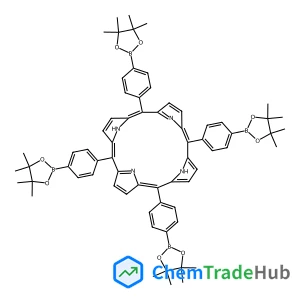
5,10,15,20-tetrakis(4-boronic acid pinacol ester phenyl) porphyrin
CAS号:
1332748-00-1
分子式:
C68H74B4N4O8
推荐供应商




免责声明
本页面提供的学术期刊信息仅供参考和研究使用。我们与任何期刊出版商均无关联,也不处理投稿事宜。如有投稿相关咨询,请直接联系相关期刊出版商。
如发现页面信息有误,请发送邮件至 support@chemtradehub.com 联系我们。我们将及时核实并处理您的问题。