






![1-[(4-Methylphenyl)sulfonyl]-3-(4,4,5,5-tetramethyl-1,3,2-dioxaborolan-2-yl)-1H-pyrrolo[2,3-b]pyridine-5-carbonitrile structure](https://cnstatic.chemtradehub.com/structs/143/1434747-57-5-fc0d.webp "1-[(4-Methylphenyl)sulfonyl]-3-(4,4,5,5-tetramethyl-1,3,2-dioxaborolan-2-yl)-1H-pyrrolo[2,3-b]pyridine-5-carbonitrile structure")
Energy-resolved collision-induced dissociation of non-covalent ions: charge- and guest-dependence of decomplexation reaction efficiencies
文献信息
发布日期
2016-03-31
DOI
10.1039/C6CP01026A
影响因子
3.676
作者
Vincent Lemaur, Julien De Winter, Lyle Isaacs, Edwin De Pauw, Jérôme Cornil, Pascal Gerbaux
查看原文
摘要
Supramolecular chemistry, and especially host–guest chemistry, has been the subject of great interest in the past few decades leading to the synthesis of host cage molecules such as calixarenes, cyclodextrins and more recently cucurbiturils. Mass spectrometry methods are increasingly used to decipher at the molecular level the non-covalent interactions between the different associated molecules. The present article illustrates that the association between mass spectrometry and computational chemistry techniques proves very complementary to depict the gas-phase dissociation processes of ionic non-covalent complexes when subjected to collisional activation. The selected system associates a nor-seco-cucurbit[10]uril bitopic receptor with different amino compounds (adamantylamine, para-xylylenediamine, and para-phenylenediamine). When subjected to CID experiments, the ternary complexes undergo fragmentation via dissociation of non-covalently bound partners. Interestingly, depending on their charge state, the collisionally excited complexes can selectively expel either a neutral guest molecule or a protonated guest molecule. Moreover, based on energy-resolved CID experiments, it is possible to evaluate the guest molecule dependence on the gas phase dissociation efficiency. We observed that the relative order of gas phase dissociation is charge state dependent, with the adamantylamine-containing complexes being the weakest when triply charged and the strongest when doubly charged. The energetics of the gas-phase dissociation reactions have been estimated by density functional theory (DFT) calculations. We succeeded in theoretically rationalizing the experimental collision-induced dissociation results with a special emphasis on: (i) the charge state of the expelled guest molecule and (ii) the nature of the guest molecule.
相关文献
Tunable electronic properties of an Sb/InSe van der Waals heterostructure by electric field effects
Zhihui Zhang, Yan Zhang, Zifeng Xie, Xing Wei, Tingting Guo, Jibin Fan, Lei Ni, Ye Tian, Jian Liu, Li Duan
2019-02-12
Paper
DOI: 10.1039/C8CP07407K
Fast Nosé–Hoover thermostat: molecular dynamics in quasi-thermodynamic equilibrium
Dominik Sidler, Sereina Riniker
2019-02-18
Paper
DOI: 10.1039/C8CP06800C
The influence of nanoparticles on the excitation energies of the photochromic dihydroazulene/vinylheptafulvene system
Andreas Erbs Hillers-Bendtsen, Mia Harring Hansen, Kurt V. Mikkelsen
2019-02-22
Paper
DOI: 10.1039/C8CP06539J
Temperature dependence of the cooperative out-of-equilibrium elastic switching in a spin-crossover material
Roman Bertoni, Eric Collet, Hervé Cailleau, Marie-Laure Boillot, Antoine Tissot, Jérôme Laisney, Cristian Enachescu, Maciej Lorenc
2019-02-27
Paper
DOI: 10.1039/C8CP07074A
Controllable design of double metal oxide (NiCo2O4)-modified CdS for efficient photocatalytic hydrogen production
2019-01-23
Paper
DOI: 10.1039/C8CP07275B
Photoinduced electron transfer in 5-bromouracil labeled DNA. A contrathermodynamic mechanism revisited by electron transfer theories
Lorenzo Cupellini, Benedetta Mennucci, Janusz Rak
2019-01-21
Paper
DOI: 10.1039/C8CP07700B
A study on the comprehension of differences in specific kinetic energy of TKX-50 and HMX from the perspective of gas products
Chuande Zhao, Yu Chi, Qiang Peng, Fang Yang, Jianhua Zhou, Xinfeng Wang, Kun Yu, Guijuan Fan, Jie Sun
2019-02-25
Paper
DOI: 10.1039/C8CP07487A
Reaction of chloride anion with atomic oxygen in aqueous solutions: can cold plasma help in chemistry research?
Yury Gorbanev, Jonas Van der Paal, Wilma Van Boxem, Sylvia Dewilde, Annemie Bogaerts
2019-01-30
Communication
DOI: 10.1039/C8CP07550F
Stabilizing amorphous Sb by adding alien seeds for durable memory materials
Meng Xu, Bowen Li, Kailang Xu, Hao Tong, Xiaomin Cheng, Ming Xu, Xiangshui Miao
2019-01-29
Paper
DOI: 10.1039/C8CP07446A
Dithiafulvene derivatized donor–acceptor norbornadienes with redshifted absorption
Martin Drøhse Kilde, Sandeep Kumar Singh, Paul Erhart, Kasper Moth-Poulsen, Mogens Brøndsted Nielsen
2019-01-10
Paper
DOI: 10.1039/C8CP07744D
您可能还喜欢
化合物问答
如何储存1,2-环己二酮环乙缩醛(CAS号:4746-96-7)?
1,2-环己二酮环乙缩醛应储存在阴凉、干燥、通风良好的地方,避免阳光直射。建议使用密封容器保存,并保持环境温度在室温范围内,远离火源和热源。
4746-96-71,4-Dioxaspiro[4.5]d...
化合物问答
Ecopladib(CAS号:381683-92-7)的市场或研究趋势如何?
Ecopladib作为一种新型的药物,主要应用于治疗高胆固醇等疾病。目前,市场和研究趋势显示,Ecopladib因其独特的药理作用而受到关注。随着对心血管疾病治...
381683-92-7Ecopladib
化合物问答
2,3-Dimethyl-3H-imidazo[4,5-c]pyridine(CAS号:52538-09-7)通常如何合成?
2,3-二甲基-3H-咪唑[4,5-c]吡啶通常通过咪唑和2,3-二甲基吡啶的缩合反应合成。具体来说,将咪唑和2,3-二甲基吡啶在适当的溶剂中进行加热或加压反应...
52538-09-72,3-Dimethyl-3H-imid...
化合物问答
2,3,4,5-tetrahydro-1H-3-苯并氮杂环;盐酸盐(CAS号:17379-01-0)的市场或研究趋势如何?
该化合物在药物化学和有机合成中有一定的应用。近年来,随着对新型药物化合物的需求增加,该化合物的研究趋势主要集中在探索其生物活性,尤其是其在神经系统疾病治疗中的潜...
17379-01-02,3,4,5-Tetrahydro-1...
68-90-6(2-Ethyl-1-benzofura...
化合物问答
如何储存盐酸甘氨酸丁酯(CAS号:13048-99-2)?
盐酸甘氨酸丁酯应储存在阴凉、干燥、通风良好的地方,避免阳光直射和高温环境,温度应控制在25℃以下。储存容器应密封,避免与空气中的水分和酸性物质接触,以防发生水解...
13048-99-2Butyl glycinate hydr...
化合物问答
什么是2-Iodo-N,N-dimethylbenzamide(CAS号:54616-46-5)?
2-碘-N,N-二甲基苯胺是一种有机化合物,化学名为2-Iodo-N,N-dimethylbenzamide。其分子式为C<sub>9</sub>H<sub>1...
54616-46-52-Iodo-N,N-dimethylb...
16817-90-6N-Cyclohexylglycinam...
化合物问答
5-溴-2-(4H-1,2,4-三唑-4-基)吡啶(CAS号:959240-99-4)的市场或研究趋势如何?
随着医药、农药和新材料领域的发展,该化合物作为关键中间体的应用日益增多。特别是在药物合成中,由于其独特的化学性质,可以用于合成多种药物分子。未来的研究趋势可能集...
959240-99-45-Bromo-2-(4H-1,2,4-...
化合物问答
2,4-二溴-6-三氟甲基嘧啶(CAS号:785778-00-9)通常如何合成?
2,4-二溴-6-三氟甲基嘧啶通常通过溴化反应合成。首先,将6-三氟甲基嘧啶与溴化剂(如液溴)在适当的溶剂(如二氯甲烷、四氢呋喃)中反应,加入适当的催化剂(如四...
785778-00-92,4-Dibromo-6-(trifl...
来源期刊
Physical Chemistry Chemical Physics

CiteScore:
5.5
自引率:
10.3%
年发文量:
3036
Physical Chemistry Chemical Physics (PCCP) is an international journal co-owned by 19 physical chemistry and physics societies from around the world. This journal publishes original, cutting-edge research in physical chemistry, chemical physics and biophysical chemistry. To be suitable for publication in PCCP, articles must include significant innovation and/or insight into physical chemistry; this is the most important criterion that reviewers and Editors will judge against when evaluating submissions. The journal has a broad scope and welcomes contributions spanning experiment, theory, computation and data science. Topical coverage includes spectroscopy, dynamics, kinetics, statistical mechanics, thermodynamics, electrochemistry, catalysis, surface science, quantum mechanics, quantum computing and machine learning. Interdisciplinary research areas such as polymers and soft matter, materials, nanoscience, energy, surfaces/interfaces, and biophysical chemistry are welcomed if they demonstrate significant innovation and/or insight into physical chemistry. Joined experimental/theoretical studies are particularly appreciated when complementary and based on up-to-date approaches.
推荐化合物
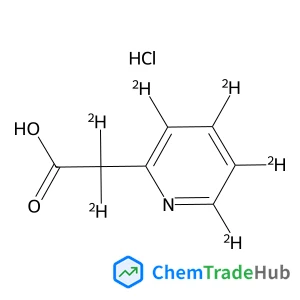
2,2-dideuterio-2-(3,4,5,6-tetradeuterio-2-pyridyl)acetic acid;hydrochloride
CAS号:
1329799-67-8
分子式:
C7H2ClD6NO2
推荐供应商




免责声明
本页面提供的学术期刊信息仅供参考和研究使用。我们与任何期刊出版商均无关联,也不处理投稿事宜。如有投稿相关咨询,请直接联系相关期刊出版商。
如发现页面信息有误,请发送邮件至 support@chemtradehub.com 联系我们。我们将及时核实并处理您的问题。