






![(1R,5R)-3-{[(2-Methyl-2-propanyl)oxy]carbonyl}-3-azabicyclo[3.1.0]hexane-1-carboxylic acid structure](https://cnstatic.chemtradehub.com/structs/116/1165450-63-4-bfe1.webp "(1R,5R)-3-{[(2-Methyl-2-propanyl)oxy]carbonyl}-3-azabicyclo[3.1.0]hexane-1-carboxylic acid structure")
The growth and thermal properties of Au deposited on Rh(111): formation of an ordered surface alloy
文献信息
发布日期
2016-08-17
DOI
10.1039/C6CP02128J
影响因子
3.676
作者
László Óvári, András Berkó, Gábor Vári, Richárd Gubó, Arnold Péter Farkas
查看原文
摘要
Scanning tunnelling microscopy (STM), low energy ion scattering spectroscopy (LEIS), X-ray photoelectron spectroscopy (XPS) and high resolution electron energy loss spectroscopy (HREELS) were applied for studying Au deposited on the Rh(111) surface. Both the deposition of Au at different substrate temperatures (400–800 K) and the effect of annealing Au deposited at 500 K were investigated. Gold deposition at 500 K, investigated by STM and LEIS methods, revealed that up to half monolayer Au the system exhibits clearly layer-by layer growth; however, above this coverage a slight deviation was identified, mainly due to kinetic and morphological effects. A continuous cover layer of Au was formed only above ∼2.5 monolayers (ML). Below this coverage, the pseudomorphic character of the Au overlayer was clearly proven by STM, but this feature disappears at 4 ML coverage. A moderate (5–10%) surface mixing of the two metals was observed only above 600 K, for both annealing the Au layer formed at lower temperatures and performing the deposition at elevated temperatures. Above 600 K a clear step-flow growth mechanism was verified. Depending on the Au coverage, a more extended mixing of the top layer and the sublayer was observed at even higher temperatures. In this case, nano-range ordering of the alloyed layer was detected by STM, where the lateral extension of the uniform commensurate (2 × 1) domains was around 4 × 4 nm2. In this case, the local intralayer mixing of Rh and Au can locally reach a value of 50%. The proposed structural model for the (2 × 1) alloy phase was also corroborated by HREELS investigations on CO adsorption.
相关文献
Control and modulation of chirality for azobenzene-substituted polydiacetylene LB films with circularly polarized light
Gang Zou, Hao Jiang, Hideki Kohn, Takaaki Manaka, Mitsumasa Iwamoto
2009-08-03
Communication
DOI: 10.1039/B909085A
Light responsive protective coatings
Ekaterina V. Skorb, Dmitry V. Sviridov, Helmuth Möhwald, Dmitry G. Shchukin
2009-09-15
Communication
DOI: 10.1039/B914257F
Metal oxide-sensitized TiO2 and TiO2−xNx with efficient charge transport conduits
Xin Shu, Zhe An, Lianying Wang, Jing He
2009-08-17
Communication
DOI: 10.1039/B909301J
Pronounced effects of substituents on the iridium-catalyzed borylation of aryl C–H bonds‡
Carl W. Liskey, Carolyn S. Wei, Dale R. Pahls, John F. Hartwig
2009-08-20
Communication
DOI: 10.1039/B913949D
Probe for i-motif structure and G-rich strands using end-stacking ability
Il Joon Lee, Jeong Wu Yi, Byeang Hyean Kim
2009-08-05
Communication
DOI: 10.1039/B908624B
Electrocyclization of cis-dienals in organic synthesis: a new and versatile synthetic method for the preparation of aryl- and heteroaryl-fused coumarins
Yung-Son Hon, Tze-Wei Tseng, Chia-Yi Cheng
2009-08-14
Communication
DOI: 10.1039/B912887E
A highly efficient methodology of asymmetric epoxidation based on a novel chiral sulfur ylide‡
Francisco Sarabia, Samy Chammaa, Miguel García-Castro, Francisca Martín-Gálvez
2009-08-07
Communication
DOI: 10.1039/B912070J
Platinum-catalysed aerobic 1,2-aminooxygenation of alkenes‡
Kilian Muñiz, Alvaro Iglesias, Yewen Fang
2009-08-28
Communication
DOI: 10.1039/B912139K
您可能还喜欢
化合物问答
什么是2,6-二溴-4,8-双[(2-乙基己基)氧基]苯并[1,2-b:4,5-b']二噻吩(CAS号:1226782-13-3)?
2,6-二溴-4,8-双[(2-乙基己基)氧基]苯并[1,2-b:4,5-b']二噻吩是一种有机化合物,分子式为C23H32Br2O2S2。该化合物具有芳香性和...
1226782-13-32,6-Dibromo-4,8-bis[...
化合物问答
木聚硫钠(CAS号:37319-17-8)的物理化学性质是什么?
木聚硫钠通常为无色或白色结晶性粉末,具有吸湿性。其分子量约为121.11 g/mol。木聚硫钠易溶于水,不溶于醇类和其他非极性溶剂。在酸性或碱性溶液中,木聚硫钠...
37319-17-8Pentosan
化合物问答
2-甲氧基-4-(三氟甲基)苄溴, JRD(CAS号:886500-59-0)适用哪些法规指南?
该化合物在合成、储存和运输过程中需遵循《全球化学品统一分类和标签制度》(GHS)的健康、环境和物理危险分类。在欧洲还需符合《化学品注册、评估、授权和限制》(RE...
886500-59-02-Methoxy-4-(trifluo...
化合物问答
1,4-Diazoniabicyclo[2.2.2]octane-1,4-disulfinate(CAS号:119752-83-9)的主要用途是什么?
1,4-二氮杂双环[2.2.2]辛烷-1,4-二硫酸二酯主要用于有机合成中的保护基团,特别是在保护胺基和硫醇基方面具有广泛应用。此外,它还用于一些特殊化学反应的...
119752-83-91,4-Diazabicyclo[2.2...
化合物问答
如何处理含有4-(Bromomethyl)-2-fluorobenzenesulphonamide(CAS号:1645275-47-3)的废料?
含有4-(Bromomethyl)-2-fluorobenzenesulphonamide的废液应首先进行中和处理,以降低pH值,避免对环境造成腐蚀性影响。随后...
1645275-47-34-(Bromomethyl)-2-fl...
化合物问答
Loureiriol(CAS号:479195-44-3)的物理化学性质是什么?
Loureiriol是一种天然化合物,其分子式为C15H22O4。Loureiriol为无色结晶性粉末,具有较高的熔点和良好的热稳定性。其相对分子质量为262....
479195-44-3Loureiriol
化合物问答
在合成中是否有3-氨基苯甲酰苯胺(CAS号:14315-16-3)的替代品?
在合成过程中,可以考虑使用类似结构的化合物作为3-氨基苯甲酰苯胺的替代品,例如N-苯基-3-氰基苯胺或N-苯基-3-硝基苯胺等,这些化合物具有相似的化学性质,可...
14315-16-33-Amino-N-phenylbenz...
化合物问答
4-异氰酰苯基硼酸频哪醇酯(CAS号:380430-64-8)的市场或研究趋势如何?
4-异氰酰苯基硼酸频哪醇酯主要应用于有机合成、药物化学和材料科学领域。随着绿色化学的发展,该化合物因其高效的官能团转化能力和环境友好性而受到越来越多的关注。近年...
380430-64-82-(4-Isocyanatopheny...
化合物问答
如何储存3β-乙酰氧基-7,25-甘遂二烯-24(R)-醇(CAS号:1352001-09-2)?
3β-乙酰氧基-7,25-甘遂二烯-24(R)-醇应储存在阴凉、干燥、通风良好的地方,避免直接光照。储存容器应密封,防止空气中的水分和氧气影响化合物的稳定性。建...
1352001-09-23β-acetoxy-eupha- 7,...
化合物问答
如何储存4-氟-2-甲基-1H-吲哚(CAS号:1260383-51-4)?
应将4-氟-2-甲基-1H-吲哚存放在阴凉、干燥、通风良好的地方,避免直接暴露在光照下。容器应密封,避免与空气中的水蒸气接触。建议在避光、温度不超过25℃的环境...
1260383-51-44-Fluoro-2-methyl-1H...
来源期刊
Physical Chemistry Chemical Physics

CiteScore:
5.5
自引率:
10.3%
年发文量:
3036
Physical Chemistry Chemical Physics (PCCP) is an international journal co-owned by 19 physical chemistry and physics societies from around the world. This journal publishes original, cutting-edge research in physical chemistry, chemical physics and biophysical chemistry. To be suitable for publication in PCCP, articles must include significant innovation and/or insight into physical chemistry; this is the most important criterion that reviewers and Editors will judge against when evaluating submissions. The journal has a broad scope and welcomes contributions spanning experiment, theory, computation and data science. Topical coverage includes spectroscopy, dynamics, kinetics, statistical mechanics, thermodynamics, electrochemistry, catalysis, surface science, quantum mechanics, quantum computing and machine learning. Interdisciplinary research areas such as polymers and soft matter, materials, nanoscience, energy, surfaces/interfaces, and biophysical chemistry are welcomed if they demonstrate significant innovation and/or insight into physical chemistry. Joined experimental/theoretical studies are particularly appreciated when complementary and based on up-to-date approaches.
推荐化合物
![(R)-N-[(S)-1-[2-(Diphenylphosphino)phenyl]ethyl]-2-methylpropane-2-sulfinamide structure](https://cnstatic.chemtradehub.com/structs/159/1595319-98-4-33e7.webp "(R)-N-[(S)-1-[2-(Diphenylphosphino)phenyl]ethyl]-2-methylpropane-2-sulfinamide structure")
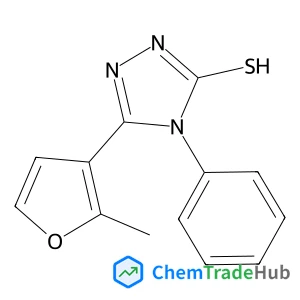
5-(2-Methyl-3-furyl)-4-phenyl-2,4-dihydro-3H-1,2,4-triazole-3-thione
CAS号:
346464-59-3
分子式:
C13H11N3OS
推荐供应商



免责声明
本页面提供的学术期刊信息仅供参考和研究使用。我们与任何期刊出版商均无关联,也不处理投稿事宜。如有投稿相关咨询,请直接联系相关期刊出版商。
如发现页面信息有误,请发送邮件至 support@chemtradehub.com 联系我们。我们将及时核实并处理您的问题。