


![(1R)-N-((1R)-1-Phenylethyl)-1-[4-(tert-butyldimethylsilyloxymethyl)cyclohexyl]ethan-1-amine structure](https://cnstatic.chemtradehub.com/structs/672/672314-45-3-47ef.webp "(1R)-N-((1R)-1-Phenylethyl)-1-[4-(tert-butyldimethylsilyloxymethyl)cyclohexyl]ethan-1-amine structure")
Doping the cage. Re@Au11Pt and Ta@Au11Hg, as novel 18-ve trimetallic superatoms displaying a doped icosahedral golden cage
文献信息
发布日期
2016-12-14
DOI
10.1039/C6CP07519C
影响因子
3.676
作者
查看原文
摘要
Expanding the versatility of well defined clusters is a major concern in the design of building blocks towards functional nanostructures. W@Au12 is a prototypical binary bare superatomic cluster involving an icosahedral symmetry, which has been discussed in the literature, precluding the proposal of several endohedral d-block and f-block element structures within a golden cage. Here we pursue the construction of related trimetallic clusters, which has been explored to a lesser extent. Our results expose the great advantages of involving heterocages in the superatom approach, unraveling Re@Au11Pt and Ta@Au11Hg as novel trimetallic candidates. Re@Au11Pt exhibits an electron-deficient element in the cage, and an endohedral atom with an extra electron. In contrast, Ta@Au11Hg is conceived as having an icosahedral cage with an extra electron, and an electron-deficient endohedral element. These new clusters follow the eighteen valence electron principle, with similar characteristics to their W@Au12 parent. This leads to stable clusters with an electronic structure formally described by the 1s21p61d10 closing shell order, showing an interesting approach to design ternary superatoms, where the variation of valence electrons occurs in both cage and endohedral sites. Moreover, the cage doping appears as a useful approach to further evaluate the formation of magnetic superatoms, and also the construction of larger clusters by fusing different icosahedral structures.
期刊推荐
Drug Discovery Today
Acta Materialia

Journal of Peptide Science
Nature Medicine
Russian Journal of Bioorganic Chemistry

Current Opinion in Solid State & Materials Science
Chemistry Education Research and Practice
Russian Journal of General Chemistry
Current Opinion in Colloid & Interface Science
Russian Journal of Organic Chemistry
相关文献
Microsolvation of 2-azetidinone: a model for the peptide group–water interactions
Juan C. López, Raquel Sánchez, Susana Blanco, José L. Alonso
2014-12-05
Paper
DOI: 10.1039/C4CP04577G
Silicon-pyrene/perylene hybrids as molecular rectifiers
Kavita Garg, Chiranjib Majumder, Sandip K. Nayak, Dinesh K. Aswal, Shiv K. Gupta, Subrata Chattopadhyay
2014-11-26
Paper
DOI: 10.1039/C4CP04044A
A theoretical study on photophysical properties of triphenylamine-cored molecules with naphthalimide arms and different π-conjugated bridges as organic solar cell materials
R. F. Jin, Y. F. Chang
2014-10-24
Paper
DOI: 10.1039/C4CP04394D
Demixing and crystallization of DODAB in DPPC–DODAB binary mixtures
Rui-Guang Wu, Hai-Yuan Sun, Yan-Zhen Zheng, Zhi-Wu Yu
2014-06-09
Paper
DOI: 10.1039/C4CP01707B
Theoretical studies on the effect of a bithiophene bridge with different substituent groups (R = H, CH3, OCH3 and CN) in donor–π–acceptor copolymers for organic solar cell applications
Zhiyong Fu, Wei Shen, Rongxing He, Xiaorui Liu, Huili Sun, Wanqiang Yin, Ming Li
2014-11-26
Paper
DOI: 10.1039/C4CP04103H
Adsorption and photocatalytic splitting of water on graphitic carbon nitride: a combined first principles and semiempirical study
Jonas Wirth, Rainer Neumann, Markus Antonietti, Peter Saalfrank
2014-06-25
Paper
DOI: 10.1039/C4CP02021A
Enhanced performance of polymer solar cells by employing a ternary cascade energy structure
Qiaoshi An, Fujun Zhang, Lingliang Li, Zuliang Zhuo, Jian Zhang, Weihua Tang, Feng Teng
2014-05-15
Paper
DOI: 10.1039/C4CP01411A
The acidity/basicity of metal-containing ionic liquids: insights from surface analysis and the Fukui function
Weihong Wu, Yunxiang Lu, Hairong Ding, Changjun Peng, Honglai Liu
2014-11-12
Paper
DOI: 10.1039/C4CP04603J
CdS nanorod arrays with TiO2 nano-coating for improved photostability and photocatalytic activity
Liangpeng Wu, Yulan Zhang, Xinjun Li, Chaoping Cen
2014-05-29
Paper
DOI: 10.1039/C4CP01347F
您可能还喜欢
化合物问答
什么是3-表南美楝属二醇(CAS号:19942-04-2)?
3-表南美楝属二醇是一种具有特定立体化学结构的化合物,其分子式为C31H52O2,属于甾醇类化合物。它具有光学活性,是一种复杂的有机分子,主要存在于一些植物中。
19942-04-2(3S,5R,8R,9R,10R,13R...
化合物问答
3-羧基-5-碘苯甲酸甲酯(CAS号:50765-22-5)应用于哪些行业?
3-羧基-5-碘苯甲酸甲酯主要应用于医药行业,作为合成某些药物中间体的重要原料。此外,它还可能用于聚合物的改性、传感器的制备以及半导体材料的制备等领域。
50765-22-5Methyl 3-hydroxy-5-i...
化合物问答
什么是3-Bromoindolin-2-one(CAS号:22942-87-6)?
3-Bromoindolin-2-one是一种含有溴代基团的吲哚酮衍生物,分子式为C9H7BrNO。它是一种无色固体,具有一定的挥发性,熔点为158-159°C...
22942-87-63-Bromoindolin-2-one
化合物问答
如何处理含有L-Lysyl-L-phenylalanyl-L-isoleucylglycyl-L-leucyl-L-methioninamide(CAS号:2990-43-4)的废料?
对于含有该化合物的废液,应先进行中和处理,然后根据其毒性和活性选择合适的处置方法。可以考虑焚烧处理或由专业的化学品废物处理公司进行无害化处理。处理过程中需注意环...
2990-43-4L-Lysyl-L-phenylalan...
化合物问答
ANGIOTENSIN 1/2 + A (2 - 8)(CAS号:51833-76-2)的物理化学性质是什么?
ANGIOTENSIN 1/2 + A (2 - 8)是一种蛋白质类化合物,具有典型的蛋白质性质。它的分子量约为5900 Da。该化合物在水中具有一定的溶解性,...
51833-76-2ANGIOTENSIN 1/2 + A ...
化合物问答
如何储存2-甲基硫代嘧啶-5-硼酸频那酯(CAS号:940284-18-4)?
应将该化合物存放在阴凉干燥、通风良好的地方,避免阳光直射。建议将化合物密封保存在避光的、干燥的容器中,远离火源和高温环境。
940284-18-42-(Methylthio)-5-(4,...
化合物问答
什么是苏丹红IV氘代物 标准品(CAS号:1014689-18-9)?
苏丹红IV氘代物 标准品是一种含有氘代标记的苏丹红IV化合物,是一种用于化合物分析、结构确证以及代谢研究的标准物质。
1014689-18-91-[(E)-{2-Methyl-4-[...
化合物问答
(+)-2-Amino-6-propionamido-d3-tetrahydrobenzothiazole(CAS号:1217680-69-7)适用哪些法规指南?
该化合物需要遵循《全球化学品统一分类和标签制度》(GHS)中的分类和标签要求,具体分类需依据其毒性和物理化学性质。此外,还需要符合《欧盟化学品注册、评估、授权和...
1217680-69-7(+)-2-Amino-6-propio...
化合物问答
如何储存2-氨基-2-(2-吡啶)乙酸乙酯(CAS号:55243-15-7)?
2-氨基-2-(2-吡啶)乙酸乙酯应储存于阴凉、干燥、通风良好的环境中,避免高温和光照。应使用密封容器储存,并远离易燃物、氧化剂和其他危险化学品。
55243-15-7Ethyl 2-amino-2-(pyr...
化合物问答
3-羟基-4-甲氧基吡啶-2-羧酸(CAS号:210300-09-7)的主要用途是什么?
3-羟基-4-甲氧基吡啶-2-羧酸主要用于合成其他有机化合物,如药物合成、农药合成和染料合成等。此外,它还可用作中间体和试剂,在化学研究领域也有一定的应用。
210300-09-73-Hydroxy-4-methoxy-...
来源期刊
Physical Chemistry Chemical Physics

CiteScore:
5.5
自引率:
10.3%
年发文量:
3036
Physical Chemistry Chemical Physics (PCCP) is an international journal co-owned by 19 physical chemistry and physics societies from around the world. This journal publishes original, cutting-edge research in physical chemistry, chemical physics and biophysical chemistry. To be suitable for publication in PCCP, articles must include significant innovation and/or insight into physical chemistry; this is the most important criterion that reviewers and Editors will judge against when evaluating submissions. The journal has a broad scope and welcomes contributions spanning experiment, theory, computation and data science. Topical coverage includes spectroscopy, dynamics, kinetics, statistical mechanics, thermodynamics, electrochemistry, catalysis, surface science, quantum mechanics, quantum computing and machine learning. Interdisciplinary research areas such as polymers and soft matter, materials, nanoscience, energy, surfaces/interfaces, and biophysical chemistry are welcomed if they demonstrate significant innovation and/or insight into physical chemistry. Joined experimental/theoretical studies are particularly appreciated when complementary and based on up-to-date approaches.
推荐化合物
![Heptadecanoic Acid 3-[2-[4-(6-Fluoro-1,2-benzisoxazol-3-yl)-1-piperidinyl]ethyl]-6,7,8,9-tetrahydro-2-methyl-4-oxo-4H-pyrido[1,2-a]pyrimidin-9-yl Ester structure](https://cnstatic.chemtradehub.com/structs/140/1404053-62-8-9da4.webp "Heptadecanoic Acid 3-[2-[4-(6-Fluoro-1,2-benzisoxazol-3-yl)-1-piperidinyl]ethyl]-6,7,8,9-tetrahydro-2-methyl-4-oxo-4H-pyrido[1,2-a]pyrimidin-9-yl Ester structure")
![2-[(E)-(2-Methoxyphenyl)diazenyl]-3-oxo-N-(2-oxo-2,3-dihydro-1H-benzimidazol-5-yl)butanamide structure](https://cnstatic.chemtradehub.com/structs/821/82199-12-0-f1d0.webp "2-[(E)-(2-Methoxyphenyl)diazenyl]-3-oxo-N-(2-oxo-2,3-dihydro-1H-benzimidazol-5-yl)butanamide structure")
![3,7-Di(1,1':3',1''-terphenyl-5'-yl)-10,11,12,13-tetrahydrodiindeno[7,1-de:1',7'-fg][1,3,2]dioxaphosphocin-5-ol 5-oxide structure](https://cnstatic.chemtradehub.com/structs/135/1352810-38-8-3f10.webp "3,7-Di(1,1':3',1''-terphenyl-5'-yl)-10,11,12,13-tetrahydrodiindeno[7,1-de:1',7'-fg][1,3,2]dioxaphosphocin-5-ol 5-oxide structure")
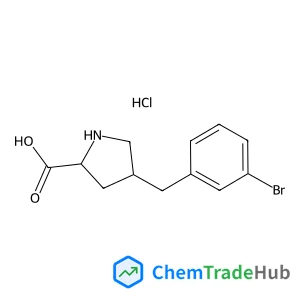
(2S,4R)-4-(3-Bromobenzyl)pyrrolidine-2-carboxylic acid hydrochloride
CAS号:
1049734-10-2
分子式:
C12H15BrClNO2
推荐供应商






免责声明
本页面提供的学术期刊信息仅供参考和研究使用。我们与任何期刊出版商均无关联,也不处理投稿事宜。如有投稿相关咨询,请直接联系相关期刊出版商。
如发现页面信息有误,请发送邮件至 support@chemtradehub.com 联系我们。我们将及时核实并处理您的问题。