


Synthesis, optoelectronic properties and photovoltaic performances of wide band-gap copolymers based on dibenzosilole and quinoxaline units, rivals to P3HT
文献信息
发布日期
2016-05-13
DOI
10.1039/C6PY00370B
影响因子
5.582
作者
P. Chávez, P. Lévêque, N. Leclerc
查看原文
摘要
Three π-conjugated alternating copolymers, based on dibenzosilole as an electron-rich unit and fluorinated or non-fluorinated quinoxaline as an electron-withdrawing unit, connected through thiazole or thiophene moieties, have been synthesized, fully characterized and applied as donors in polymer solar cells (PSCs). The three copolymers, namely PDBS-TQx, PDBS-TQxF and PDBS-TzQx, belong to the wide band-gap semiconductor materials family, and they show an absorption edge in the visible region close to 650 nm. In order to tune the position of the polymer energy levels, and in particular to decrease their HOMO energy level, we compare the use of a thiazole spacer sandwiching the electron-deficient moiety as an alternative way to the popular backbone fluorination. PSCs based on a blend of PDBS-TQx and [6,6]-phenyl-C71-butyric acid methylester (PC71BM) as an active layer have shown the best device performances with a maximum power conversion efficiency (PCE) of 5.14% for the active area of 0.28 cm2 (under standard illumination of AM 1.5G, 1000 W m−2). Interestingly this polymer outperforms P3HT:(PC61BM) solar cells used as a reference material in this work. In addition to the thorough characterization data, including among other spectroscopy techniques, XRD, OFET, AFM and nc-AFM, we discuss in detail the relationship between the chemical structures of the three polymers, their optoelectronic properties, the phase separation in blends with PC71BM and their photovoltaic performances.
期刊推荐
Russian Journal of General Chemistry
Russian Journal of Applied Chemistry
Organic Process Research & Development
Russian Journal of Coordination Chemistry
Journal of Natural Medicines
Chemistry Education Research and Practice
Journal of Saudi Chemical Society
New Journal of Chemistry
Saudi Pharmaceutical Journal
Current Opinion in Colloid & Interface Science
相关文献
Glassy dynamics of sorbitol solutions at terahertz frequencies
Juraj Sibik, Evgenyi Y. Shalaev, J. Axel Zeitler
2013-05-31
Paper
DOI: 10.1039/C3CP51936H
Marine natural products from the deep Pacific as potential non-linear optical chromophores
Bruce F. Milne, Patrick Norman, Fernando Nogueira, Cláudia Cardoso
2013-07-24
Paper
DOI: 10.1039/C3CP52528G
Layer-by-layer self-assembly and disassembly of single charged inorganic small molecules: towards surface patterning
Mengjiao Cheng, Chao Jiang, Zhiyi Ding, Yajun Zhang, Yu Fu, Feng Shi
2013-07-16
Paper
DOI: 10.1039/C3CP52217B
CH4combustion cycles at Pd/Al2O3 – important role of support and oxygen access
Izabela Czekaj, Katarzyna A. Kacprzak, John Mantzaras
2013-05-16
Paper
DOI: 10.1039/C3CP51085A
New perspectives on potential hydrogen storage materials using high pressure
Yang Song
2013-06-04
Perspective
DOI: 10.1039/C3CP52154K
Rapid self-healable poly(ethylene glycol) hydrogels formed by selective metal–phosphate interactions
Mitsuhiro Ebara, Shinji Tanaka, Taka-Aki Asoh, Akihiko Kikuchi
2013-04-03
Paper
DOI: 10.1039/C3CP50165E
Propagation of nanopores during anodic etching of n-InP in KOH
Robert P. Lynch, Nathan Quill, Shohei Nakahara, D. Noel Buckley
2013-07-31
Paper
DOI: 10.1039/C3CP52253A
Isoindigo-based small molecules for high-performance solution-processed organic photovoltaic devices: the electron donating effect of the donor group on photo-physical properties and device performance
Chang-Lyoul Lee, Shinuk Cho, Seung-Hwan Oh, Seung-Hyeon Moon, Ahmed Elbarbary
2013-07-17
Paper
DOI: 10.1039/C3CP52151F
Ionothermal synthesis of mesoporous SnO2 nanomaterials and their gas sensitivity depending on the reducing ability of toxic gases
Wei Guo, Xiaochuan Duan, Yan Shen, Kezhen Qi, Caiying Wei, Wenjun Zheng
2013-05-14
Communication
DOI: 10.1039/C3CP51663F
Studies of bimolecular reaction dynamics using pulsed high-intensity vacuum-ultraviolet lasers for photoionization detection
Daniel R. Albert, H. Floyd Davis
2013-07-12
Perspective
DOI: 10.1039/C3CP51930A
您可能还喜欢
化合物问答
4,5-二甲基-2-硝基苯甲酸(CAS号:4315-14-4)的市场或研究趋势如何?
4,5-二甲基-2-硝基苯甲酸主要应用于制药、染料和农药等行业。由于其潜在的毒性,其市场趋势可能受到法规限制和环保考量的影响,推动了替代产品的研发。在研究领域,...
4315-14-44,5-Dimethyl-2-nitro...
化合物问答
处理直接黑22(CAS号:6473-13-8)时应注意哪些实验室安全事项?
处理直接黑22时应穿戴适当的个人防护装备(PPE),包括实验服、手套、护目镜和口罩。操作应在通风橱内进行,以避免吸入有害气体。如果发生泄漏,应立即清理,并使用大...
6473-13-82-Naphthalenesulfoni...
化合物问答
处理2,1,3-苯并噻二唑-4-基异氰酸酯(CAS号:342411-14-7)时应注意哪些实验室安全事项?
处理2,1,3-苯并噻二唑-4-基异氰酸酯时应注意以下安全事项:穿戴个人防护装备,如实验室外套、防护眼镜和手套;在通风橱中操作,确保良好的通风;保持实验室环境干...
342411-14-74-Isocyanato-2,1,3-b...
化合物问答
如何处理含有Δ-8,9-脱氢雌酮(CAS号:204077-66-7)的废料?
含有Δ-8,9-脱氢雌酮的废料需要进行适当的处理以确保环境和人体安全。首先,收集废液并存放于密封容器中,避免泄漏。其次,可以考虑将其转化为无害物质或通过专业处理...
204077-66-7Thioquinapiperifil d...
化合物问答
如何储存5-溴戊酸(CAS号:2067-33-6)?
5-溴戊酸应储存在阴凉、干燥、通风良好的环境中,避免阳光直射。建议在室温(约15-25°C)下保存,保持相对湿度低于60%。应使用密封的玻璃或塑料容器,并远离热...
2067-33-65-Bromopentanoic aci...
化合物问答
4-(甲基亚磺酰基)苯胺(CAS号:22865-62-9)应用于哪些行业?
4-(甲基亚磺酰基)苯胺在医药、聚合物和传感器等领域有一定的应用。在医药方面,它可以用作合成药物的中间体;在聚合物领域,可以作为合成特殊性能高分子材料的单体;在...
22865-62-94-Methylsulfinylanil...
化合物问答
什么是1-(2-FLUOROPHENYL)-5-METHYL-1H-PYRAZOLE-4-CARBOHYDRAZIDE(CAS号:618092-58-3)?
1-(2-氟苯基)-5-甲基-1H-吡唑-4-亚甲基肼是一种有机化合物,其分子式为C9H9FN3O。该化合物具有特定的物理化学性质,如熔点、沸点等,但具体值需查...
618092-58-31-(2-Fluorophenyl)-5...
化合物问答
Dauricumine(CAS号:345641-00-1)通常如何合成?
Dauricumine通常通过复杂的合成路线制备,涉及多个步骤,包括环化、氧化、卤化等反应。合成过程中使用了多种催化剂和试剂,例如金属催化剂、氧化剂等。产率通常...
345641-00-1(1R,1'S,5R,6'S,8'S)-...
化合物问答
5-氰基苯酞(CAS号:82104-74-3)安全吗?
5-氰基苯酞在正常使用条件下相对安全,但其具有一定的毒性,需谨慎操作。在实验或工业应用中,应采取适当的防护措施,如佩戴防护手套、护目镜和实验服,确保通风良好。误...
82104-74-31-Oxo-1,3-dihydro-2-...
化合物问答
2-Methyl-1-(phenylsulfonyl)-1H-pyrrolo[2,3-b]pyridin-5-amine(CAS号:1186502-59-9)安全吗?
该化合物在使用时需要谨慎操作。虽然其毒性和健康风险尚未完全明确,但建议在通风良好的环境中操作,并穿戴适当的个人防护装备,如手套和防护眼镜。
1186502-59-92-Methyl-1-(phenylsu...
来源期刊
Polymer Chemistry

CiteScore:
8.6
自引率:
7.3%
年发文量:
457
Polymer Chemistry welcomes submissions in all areas of polymer science that have a strong focus on macromolecular chemistry. Manuscripts may cover a broad range of fields, yet no direct application focus is required.
推荐化合物
![[4-(Isobutyrylamino)phenyl]boronic acid structure](https://cnstatic.chemtradehub.com/structs/874/874219-50-8-6ab5.webp "[4-(Isobutyrylamino)phenyl]boronic acid structure")
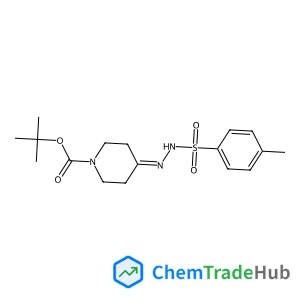
tert-Butyl 4-(2-(p-Tolylsulfonyl)hydrazono)piperidine-1-carboxylate
CAS号:
1046478-89-0
分子式:
C17H25N3O4S
推荐供应商





免责声明
本页面提供的学术期刊信息仅供参考和研究使用。我们与任何期刊出版商均无关联,也不处理投稿事宜。如有投稿相关咨询,请直接联系相关期刊出版商。
如发现页面信息有误,请发送邮件至 support@chemtradehub.com 联系我们。我们将及时核实并处理您的问题。