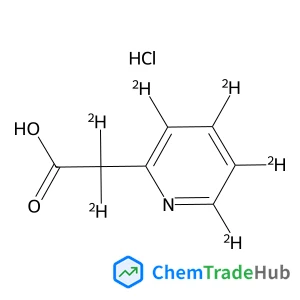
2,2-dideuterio-2-(3,4,5,6-tetradeuterio-2-pyridyl)acetic acid;hydrochloride
CAS号:
1329799-67-8
分子式:
C7H2ClD6NO2
Jaipal Gupta, Daniel J. Keddie, Chaoying Wan, David M. Haddleton, Tony McNally
Poly(lauryl acrylate) P[LA] of various molar masses were prepared via reversible addition–fragmentation chain transfer (RAFT) polymerisation and Cu(0)-mediated radical polymerisation, for the purpose of improving the dispersion and interfacial adhesion of MWCNTs with polymers such as isotactic poly(propylene) (iPP). Lauryl acrylate (LA) was polymerised via RAFT to high conversion (95%), furnished polymers in good agreement with theoretical Mn with dispersity increasing with increasing Mn. LA polymerised via the Cu(0)-mediated method to full conversion (>98%), gave polymers in good agreement with theoretical Mn and low dispersity (Đ ≈ 1.2) for lower molar mass polymers. Low molar mass tailing was also observed for P[LA] via Cu(0)-mediated polymerisation for higher molar mass polymers. Thermogravimetric analysis (TGA) of P[LA] via RAFT showed an onset of degradation occurred at ≈340–350 °C, however, this decreased to ≈250–260 °C for lower molar mass polymers. TGA of the RAFT agent revealed an onset of degradation of ≈200–250 °C. Free radicals generated from thermal degradation of end groups did not influence the thermal stability of the P[LA] backbone and ‘unzipping’ commonly seen with methacrylates was not observed. TGA analysis of P[LA] via the Cu(0)-mediated method revealed a similar degradation profile to that of P[LA] via RAFT. The thermal stability of P[LA] is sufficient to allow for melt processing with iPP. P[LA] via RAFT mixed with MWCNTs showed an adsorption of ≈10–25 wt% P[LA] on to the MWCNTs. The onset of thermal degradation of the P[LA] remained unchanged after adsorption on to the MWCNTs. P[LA] via the Cu(0)-mediated method adsorbed up to 85 wt% and an increase in thermal stability of ≈50 °C was recorded. Increasing P[LA] and MWCNT concentration independently also resulted in an increase in the level of adsorption, possibility due to increased CH–π interaction. The difference in thermal stability could possibly be due to heat transfer from the P[LA] to the MWCNTs, resulting in delayed pyrolysis of P[LA]. Size exclusion chromatography (SEC) and matrix-assisted laser desorption/ionization time of flight mass spectrometry (MALDI-TOF MS) of P[LA] after heating to 200 °C for 30 min in air showed loss of end groups but, the P[LA] backbone remained preserved for both polymer types. Evidence from transmission electron micrographs (TEM) shows the P[LA] adsorbing onto the MWCNT surface. Melt processing composites of P[LA] via Cu(0)-mediated with MWCNTs and iPP was possible as the P[LA] was thermally stable during the both extrusion and in the TGA when studied post melt mixing.
Current Opinion in Colloid & Interface Science
Crystallography Reports
Journal of Saudi Chemical Society
Russian Journal of Organic Chemistry
Organic Process Research & Development

Chemical Communications
Russian Chemical Bulletin
Journal of Peptide Science

Chemistry Education Research and Practice
Drug Discovery Today
Changjun Jiang
DOI: 10.1039/C9CP04169A
Evgeniy V. Gromov, Tatiana Domratcheva
DOI: 10.1039/D0CP00814A
Brian A. Rohr, Aayush R. Singh, Joseph A. Gauthier, Michael J. Statt, Jens K. Nørskov
DOI: 10.1039/C9CP05751J
DOI: 10.1039/C9CP06029D
Shivani Gupta
DOI: 10.1039/C9CP04162A
Huazhen Chang, Xuan Qin, Lei Ma, Tao Zhang, Junhua Li
DOI: 10.1039/C9CP04519H
Bohak Yoon, Haley M. Stowe
DOI: 10.1039/C9CP04518J
Mohammad Hasani, Lars Nordstierna, Anna Martinelli
DOI: 10.1039/C9CP03563J
Adam Payne, Guillermo Avedaño-Franco, Xu He, Eric Bousquet, Aldo H. Romero
DOI: 10.1039/C9CP03618K
Om Prakash, Hao Fan, Lisa H. M. de Groot, Valtýr Freyr Hlynsson, Simon Kaufhold, Olga Gordivska, Nicolás Velásquez, Pavel Chabera, Pieter Glatzel, Kenneth Wärnmark, Petter Persson, Jens Uhlig
DOI: 10.1039/C9CP06309A
1,2-环己二酮环乙缩醛应储存在阴凉、干燥、通风良好的地方,避免阳光直射。建议使用密封容器保存,并保持环境温度在室温范围内,远离火源和热源。
Ecopladib作为一种新型的药物,主要应用于治疗高胆固醇等疾病。目前,市场和研究趋势显示,Ecopladib因其独特的药理作用而受到关注。随着对心血管疾病治...
2,3-二甲基-3H-咪唑[4,5-c]吡啶通常通过咪唑和2,3-二甲基吡啶的缩合反应合成。具体来说,将咪唑和2,3-二甲基吡啶在适当的溶剂中进行加热或加压反应...
该化合物在药物化学和有机合成中有一定的应用。近年来,随着对新型药物化合物的需求增加,该化合物的研究趋势主要集中在探索其生物活性,尤其是其在神经系统疾病治疗中的潜...
盐酸甘氨酸丁酯应储存在阴凉、干燥、通风良好的地方,避免阳光直射和高温环境,温度应控制在25℃以下。储存容器应密封,避免与空气中的水分和酸性物质接触,以防发生水解...
2-碘-N,N-二甲基苯胺是一种有机化合物,化学名为2-Iodo-N,N-dimethylbenzamide。其分子式为C<sub>9</sub>H<sub>1...
随着医药、农药和新材料领域的发展,该化合物作为关键中间体的应用日益增多。特别是在药物合成中,由于其独特的化学性质,可以用于合成多种药物分子。未来的研究趋势可能集...
2,4-二溴-6-三氟甲基嘧啶通常通过溴化反应合成。首先,将6-三氟甲基嘧啶与溴化剂(如液溴)在适当的溶剂(如二氯甲烷、四氢呋喃)中反应,加入适当的催化剂(如四...

Polymer Chemistry welcomes submissions in all areas of polymer science that have a strong focus on macromolecular chemistry. Manuscripts may cover a broad range of fields, yet no direct application focus is required.