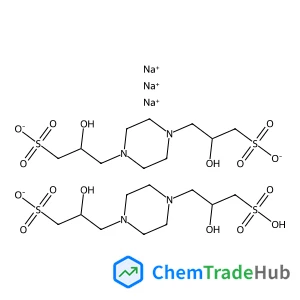
3,3'-(Piperazine-1,4-diyl)bis(2-hydroxypropane-1-sulfonic acid) Sodium Salt
CAS号:
108321-08-0
分子式:
C20H41N4Na3O16S4
Peifeng Su, Yong Xia, Zhijun Yang, Carl O. Trindle, Joseph L. Knee
Hydrogen (H) bonds are of fundamental importance in a wide range of molecular sciences. While the study of two-center H-bonding A⋯H is well advanced, much remains to be learned in a quantitative and definitive manner for complexes with multiple H-bonds. Exemplary cases are in the category of alpha hydroxy carboxylic acids, i.e., the complexes of glycolic acid with water and formic acid. In glycolic acid, an intramolecular H-bond forms between the carboxyl group and the alpha OH group. The alpha OH stretching frequency may be affected upon complexing with water or formic acid. Direct study of glycolic acid complexes is unfortunately very difficult. However, an aromatic analogue, 9-hydroxy-9-fluorene carboxylic acid (9HFCA), permits detailed and accurate gas phase spectroscopic studies. Since computational analysis establishes that H-bonding is very similar from glycolic acid complexes to 9HFCA complexes, direct studies on 9HFCA complexes by laser spectroscopy also deduce new and subtle information for glycolic acid complexes in terms of molecular structures, binding strength, and collective effects of multiple H-bonds associated with anti-cooperativity and cooperativity.
Current Opinion in Solid State & Materials Science
Russian Journal of General Chemistry
Journal of Saudi Chemical Society
Russian Journal of Coordination Chemistry
Russian Journal of Applied Chemistry
Drug Discovery Today
Journal of Peptide Science
Organic Process Research & Development

Chemical Communications
Russian Journal of Bioorganic Chemistry
Helmut Baltruschat
DOI: 10.1039/C7CP03914J
Keith G. Ray, Leonard E. Klebanoff, Jonathan R. I. Lee, Vitalie Stavila, Tae Wook Heo, Patrick Shea, Alexander A. Baker, Shinyoung Kang, Michael Bagge-Hansen, Yi-Sheng Liu, James L. White, Brandon C. Wood
DOI: 10.1039/C7CP03709K
Mihirsinh Chauhan, Vishal Bharti, Manoj Kumar, Suresh Chand, Brijesh Tripathi, J. P. Tiwari
DOI: 10.1039/C7CP05235A
Vanessa Riffet, Vanessa Labet, Julia Contreras-García
DOI: 10.1039/C7CP04349J
Jinbo Fei, Ganglong Cui, Xiangyang Liu, Weihai Fang
DOI: 10.1039/C7CP02543B
Wen-Fei Dong, James K. Ferri
DOI: 10.1039/C7CP02614E
Rômulo A. Ando, Samantha E. Brown-Xu, Lisa N. Q. Nguyen, Terry L. Gustafson
DOI: 10.1039/C7CP04961G
Moirangthem Kiran Singh, Mohammad Firoz Khan, Him Shweta, Sobhan Sen
DOI: 10.1039/C7CP03108D
K. Lambropoulos, C. Simserides
DOI: 10.1039/C7CP05134D
D. V. Andreeva, A. Kollath, D. V. Sviridov, B. J. Cafferty, H. Möhwald
DOI: 10.1039/C7CP02618H
该化合物适用的法规指南包括GHS(全球化学品统一分类和标签制度)分类为特定目标器官毒性-单次接触类别3;根据欧盟REACH法规,该化合物需要进行注册和评估;在美...
在合成中,可以考虑使用一些类似的化合物作为4-(4-氯苯基)-1H-咪唑的替代品,如4-(4-溴苯基)-1H-咪唑或4-(4-甲氧基苯基)-1H-咪唑。这些化合...
N~2~-甲基丙氨酸酰胺是一种有机化合物,其化学名为2-(Methylamino)propanamide。它是一种酰胺类化合物,分子式为C4H10N2O,相对分...
处理含有N-苄基-3-氨基氧杂环丁烷草酸盐(CAS号:1956341-96-0)的废料时,应首先确保遵循相关法规要求,如GHS和REACH等。通常,废液应先进行...
4-溴-2-氯-6-甲基苯甲酸是一种固体化合物,具有较高的熔点和较低的沸点。它的分子量为261.03 g/mol。该化合物在水中几乎不溶,在有机溶剂中溶解度适中...
该化合物通常通过缩合反应合成,典型的方法是将2,5-二氯嘧啶与N-甲基苯甲酰胺在碱性条件下进行偶联反应。常用的碱包括NaH、LDA等强碱。该合成路线具有较高的选...
3,5-二溴-4-甲基苯胺在某些合成路线中可能没有直接替代品。然而,在某些应用场景下,可以考虑使用其他类似结构的化合物如3,5-二溴-4-硝基苯胺或3,5-二碘...
2-氯喹啉-4-羧酸甲酯主要用于有机合成和药物合成领域,作为中间体或原料。它在合成某些药物和染料时具有重要作用。此外,该化合物还可能用于某些特定的化学研究中。
6-溴-8-氯咪唑[1,2-a]吡啶在操作过程中需要谨慎以确保安全。该化合物具有一定的毒性,吸入其蒸气或粉尘可能导致呼吸道刺激。处理时应佩戴适当的防护装备,如手...

Physical Chemistry Chemical Physics (PCCP) is an international journal co-owned by 19 physical chemistry and physics societies from around the world. This journal publishes original, cutting-edge research in physical chemistry, chemical physics and biophysical chemistry. To be suitable for publication in PCCP, articles must include significant innovation and/or insight into physical chemistry; this is the most important criterion that reviewers and Editors will judge against when evaluating submissions. The journal has a broad scope and welcomes contributions spanning experiment, theory, computation and data science. Topical coverage includes spectroscopy, dynamics, kinetics, statistical mechanics, thermodynamics, electrochemistry, catalysis, surface science, quantum mechanics, quantum computing and machine learning. Interdisciplinary research areas such as polymers and soft matter, materials, nanoscience, energy, surfaces/interfaces, and biophysical chemistry are welcomed if they demonstrate significant innovation and/or insight into physical chemistry. Joined experimental/theoretical studies are particularly appreciated when complementary and based on up-to-date approaches.