
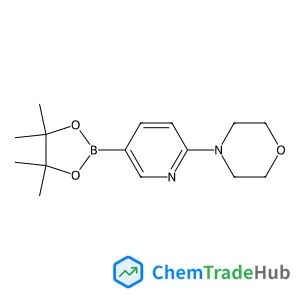
4-(5-(4,4,5,5-tetramethyl-1,3,2-dioxaborolan-2-yl)pyridin-2-yl)morpholine
CAS号:
485799-04-0
分子式:
C15H23BN2O3
Mikhail A. Grin, Marina A. Zakharko, Dmitriy A. Pritmov, Andrey F. Mironov, Antonina N. Arkhipova, Yuri V. Fedorov, Gediminas Jonusauskas, Raisa I. Yakubovskaya, Natalia B. Morozova
Propargyl-152,173-dimethoxy-131-amide of bacteriochlorin e (BChl) and a 4-(4-N,N-dimethylaminostyryl)-N-alkyl-1,8-naphthalimide bearing azide group in the N-alkyl fragment were conjugated by the copper(I)-catalyzed 1,3-dipolar cycloaddition to produce a novel dyad compound BChl–NI for anticancer photodynamic therapy (PDT) combining the modalities of a photosensitizer (PS) and a fluorescence imaging agent. A precise photophysical investigation of the conjugate in solution using steady-state and time-resolved optical spectroscopy revealed that the presence of the naphthalimide (NI) fragment does not decrease the photosensitizing ability of the bacteriochlorin (BChl) core as compared with BChl; however, the fluorescence of naphthalimide is completely quenched due to resonance energy transfer (RET) to BChl. It has been shown that the BChl–NI conjugate penetrates into human lung adenocarcinoma A549 cells, and accumulates in the cytoplasm where it has a mixed granular-diffuse distribution. Both NI and BChl fluorescence in vitro provides registration of bright images showing perfectly intracellular distribution of BChl–NI. The ability of NI to emit light upon excitation in imaging experiments has been found to be due to hampering of RET as a result of photodestruction of the energy acceptor BChl unit. Phototoxicity studies have shown that the BChl–NI conjugate is not toxic for A549 cells at tested concentrations (<8 μM) without light-induced activation. At the same time, the concentration-dependent killing of cells is observed upon the excitation of the bacteriochlorin moiety with red light that occurs due to reactive oxygen species formation. The presented data demonstrate that the BChl–NI conjugate is a promissing dual function agent for cancer diagnostics and therapy.
Adam Z. Weber
DOI: 10.1039/C8CP01319E
Emily Sahadeo, Jaehee Song, Karen Gaskell, Nam Kim, Sang Bok Lee
DOI: 10.1039/C7CP06312A
Ling Liu, Hao Li, Haijie Zhang, Jie Zhong, Yang Bai, Maofa Ge, Zesheng Li, Yu Chen, Xiuhui Zhang
DOI: 10.1039/C8CP02719F
Kohei Tada, Yasushi Maeda, Hiroyuki Ozaki, Shingo Tanaka, Shin-ichi Yamazaki
DOI: 10.1039/C8CP02923G
Kai Xu, Hajime Hirao
DOI: 10.1039/C8CP00858B
Alexander S. Lisitsyn, Olga A. Yakovina
DOI: 10.1039/C7CP06925A
Dominik Kosior, Jan Zawala
DOI: 10.1039/C7CP06099H
Nanjie Deng, Di Cui, Bin W. Zhang, Junchao Xia, Jeffrey Cruz, Ronald Levy
DOI: 10.1039/C8CP01524D
处理含有8-氯咪唑并[1,2-A]吡嗪的废料时,应首先将其收集并进行化学回收或降解。如果无法回收,需采用安全的化学处理方法,如中和、氧化还原或沉淀。处理过程中需...
Calhex 231 hydrochloride 需要遵循《全球化学品统一分类和标签制度》(GHS)的分类和标签要求,以及欧盟的《化学品注册、评估、授权和限制条...
11-Beta,17-alpha,21-三羟基-5-beta-孕烯-3,20-二酮是一种无色结晶性粉末,分子量为372.45 g/mol。该化合物在水中的溶解度...
处理5-异丙基-1,3,4-恶二唑-2-羧酸时应注意以下安全事项:穿戴适当的个人防护装备,包括实验室外套、手套和护目镜;操作应在通风橱中进行,以减少吸入或接触有...
Benzyl 3-bromopropanoate属于有毒物质,吸入、摄入或皮肤接触均可能对人体造成伤害。操作时应佩戴防护眼镜、口罩和手套,避免吸入蒸汽和直接接触...
(R)-N-苄氧羰基-3,4-二氢-1H-异喹啉羧酸是一种含有苄氧羰基和异喹啉环结构的化合物,分子式为C17H15NO3。它是一种有机化合物,具有一定的生物活性...
可以考虑使用1-苄基吡啶-3-羧酸盐作为1-苄基吡啶嗡-3-羧酸盐的替代品。此外,还可以探索其他类似物,如1-苄基吡啶-3-氨基甲酸酯等。具体的替代品选择需根据...
(2,6-二甲基吡啶-3-基)甲醇在使用时需注意安全,应避免吸入其蒸汽,接触皮肤和眼睛。操作应在通风良好的环境中进行,佩戴适当的个人防护装备。
5-溴-2-乙烯基吡啶是一种有机化合物,外观为白色固体,具有良好的结晶性。分子量约为190.03 g/mol。它的溶解性在水中较差,但在有机溶剂如二氯甲烷、甲醇...
2-羟基-3-硝基-5-甲基吡啶主要应用于医药、聚合物和半导体行业。在医药领域,它可以用作合成其他药物的中间体。在聚合物领域,它可以作为功能性单体参与聚合反应,...

Physical Chemistry Chemical Physics (PCCP) is an international journal co-owned by 19 physical chemistry and physics societies from around the world. This journal publishes original, cutting-edge research in physical chemistry, chemical physics and biophysical chemistry. To be suitable for publication in PCCP, articles must include significant innovation and/or insight into physical chemistry; this is the most important criterion that reviewers and Editors will judge against when evaluating submissions. The journal has a broad scope and welcomes contributions spanning experiment, theory, computation and data science. Topical coverage includes spectroscopy, dynamics, kinetics, statistical mechanics, thermodynamics, electrochemistry, catalysis, surface science, quantum mechanics, quantum computing and machine learning. Interdisciplinary research areas such as polymers and soft matter, materials, nanoscience, energy, surfaces/interfaces, and biophysical chemistry are welcomed if they demonstrate significant innovation and/or insight into physical chemistry. Joined experimental/theoretical studies are particularly appreciated when complementary and based on up-to-date approaches.