




Enhanced intersystem crossing in carbonylpyrenes
文献信息
发布日期
2017-10-03
DOI
10.1039/C7CP04834C
影响因子
3.676
作者
Shinaj K. Rajagopal, Ajith R. Mallia, Mahesh Hariharan
查看原文
摘要
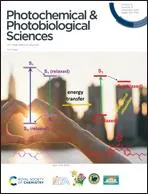
Ultrafast intersystem crossing of carbonylpyrenes in chloroform was investigated by femtosecond pump–probe spectroscopy. When compared to the dominant fluorescence decay pathway in pyrene, carbonyl functionalized pyrenes display near-unity triplet formation upon photoexcitation. The excited singlet state (Sp) undergoes rapid intersystem crossing (kISC) concomitantly with internal conversion (kIC) to lower excited singlet states (Sn) within a timescale of 5–11 ps (1/τ2 = kIC + kISC). Furthermore, intersystem crossing from lower excited singlet states (Sn) proceeds through coupling with receiver triplet states, eventually leading to high triplet quantum yields (ΦT = 97%; tetraacetylpyrene). Followed by internal conversion in the triplet manifolds, phosphorescence decay on a microsecond timescale is observed from the emitter triplet state.
相关文献
Switching the adsorption sites of PMS on SrCoO2.52 to enhance catalytic performance
Jiahong He, Qiang Xu, Bin Xiang
2023-11-21
Paper
DOI: 10.1039/D3TA06102G
The structural, energetic and dehydrogenation properties of pure and Ti-doped Mg(0001)/MgH2(110) interfaces
Bo Han, Yuxiao Jia, Jianchuan Wang, Xuezhang Xiao, Lixin Chen, Lixian Sun, Yong Du
2023-11-27
Paper
DOI: 10.1039/D3TA06177A
Synthesis of stretchable hybrid copper films via nanoconfinement
Zekun Wang, Qiao Gu, Yonghong Deng
2023-11-22
Paper
DOI: 10.1039/D3TA04958B
Mechanosynthesis of a bifunctional FeNi–N–C oxygen electrocatalyst via facile mixed-phase templating and preheating-pyrolysis
Akmal Kosimov, Gulnara Yusibova, Ivan Tito Wojsiat, Jaan Aruväli, Maike Käärik, Jaan Leis, Peeter Paaver, Sergei Vlassov, Arvo Kikas, Vambola Kisand, Helle-Mai Piirsoo, Kaupo Kukli, Ivo Heinmaa, Tiit Kaljuvee, Nadezda Kongi
2023-11-18
Paper
DOI: 10.1039/D3TA04580C
Fast redox conversion in lithium–sulfur batteries enabled by Cu-doped W18O49 with abundant oxygen defects
Guojun Dong, Yanfei Yang
2023-11-30
Paper
DOI: 10.1039/D3TA05773A
Looking back at the 10th anniversary year of Journal of Materials Chemistry A, B and C
Jeroen Cornelissen, Natalie Stingelin
2023-12-11
Editorial
DOI: 10.1039/D3TA90260A
Counterion chemistry of 5-halo (X: Cl, Br, I)-uracil derived carbon nitride: unlocking enhanced photocatalytic performance
Toshali Bhoyar, B. Moses Abraham, Akanksha Gupta, Dong Jin Kim, Nilesh R. Manwar, Kedhareswara Sairam Pasupuleti, Suresh S. Umare
2023-12-02
Paper
DOI: 10.1039/D3TA04938H
Two-dimensional metal–organic polymers as cathode hybrid materials for high-performance Al-batteries
Verónica Montes-García, Adam Gorczyński, Michał Bielejewski, Andrzej Musiał, Ignacio Pérez-Juste, Paolo Samorì
2023-11-13
Paper
DOI: 10.1039/D3TA05730E
您可能还喜欢
化合物问答
如何处理含有顺-二(2,2'-联吡啶)二氯化钌(II)二水合物(CAS号:67776-38-9)的废料?
处理含有该化合物的废料时,应先收集并分类,然后根据其危险特性选择合适的处理方法。推荐采用焚烧或由专业机构进行安全处理,以确保符合环保法规的要求。处理过程中应佩戴...
67776-38-93-{[(2R,3R,4S,5R,6R)...
化合物问答
4-amino-2-bromo-3-iodopyridine(CAS号:1300750-77-9)的市场或研究趋势如何?
4-氨基-2-溴-3-碘吡啶主要应用于药物合成和研究领域,尤其是在抗病毒和抗癌药物的研发中。随着新型药物的需求增加,该化合物的研究趋势较好。市场方面,由于其特殊...
1300750-77-92-bromo-3-iodopyridi...
化合物问答
4-乙酰基氨基-2-氨基-苯甲酸(CAS号:43134-76-5)的市场或研究趋势如何?
当前,4-乙酰基氨基-2-氨基-苯甲酸(CAS号:43134-76-5)在医药和化工领域有一定的应用。随着药物研发的进展,该化合物在新型药物设计中的应用可能增加...
43134-76-54-Acetamido-2-aminob...
化合物问答
庚a氟-1-(1-碘-1,2,2,2-四氟乙氧基)丙烷(CAS号:107432-46-2)的市场或研究趋势如何?
该化合物目前主要用于特定的工业应用,如氟聚合物的合成。市场趋势显示,由于其独特的结构和性能,未来可能在新型氟材料和特种化学品领域有更多的应用。研究趋势方面,主要...
107432-46-21,1,1,2,2,3,3-Heptaf...
化合物问答
在合成中是否有Propargyl-PEG13-bromide(CAS号:2055105-25-2)的替代品?
可以考虑使用1,3-丁二烯-1-炔-3-基-聚乙二醇-13-溴化物作为Propargyl-PEG13-bromide的替代品,因为两者在结构上相似,均可用于合成...
2055105-25-2Propargyl-peg13-brom...
化合物问答
2-氨基-6-甲氧基嘌呤(CAS号:20535-83-5)安全吗?
2-氨基-6-甲氧基嘌呤在正常使用条件下相对安全,但在操作时仍需注意防护措施,如佩戴手套和护目镜,避免吸入或接触皮肤和眼睛。
20535-83-56-Methoxy-7H-purin-2...
化合物问答
2-甲基-3-溴苯乙酸乙酯(CAS号:1261862-72-9)适用哪些法规指南?
该化合物根据其化学性质和潜在危害,可能适用于GHS(全球化学品统一分类和标签制度)的分类标准。具体分类需依据其毒性和燃烧危险性进行评估。此外,欧洲化学品管理局(...
1261862-72-9Ethyl (3-bromo-2-met...
化合物问答
4,4-二甲基吡咯烷-3-羧酸盐酸盐(CAS号:1351343-41-3)应用于哪些行业?
4,4-二甲基吡咯烷-3-羧酸盐酸盐在医药、聚合物和传感器领域有应用。在医药领域,它可以作为某些药物的中间体;在聚合物领域,它可用作某些聚合物的稳定剂;在传感器...
1351343-41-34,4-Dimethyl-3-pyrro...
化合物问答
处理5-Hydroxy-7-methoxy-2-(4-methoxyphenyl)-4-oxo-4H-chromen-6-yl 2-O-beta-D-xylopyranosyl-beta-D-glucopyranoside(CAS号:149998-39-0)时应注意哪些实验室安全事项?
处理该化合物时应注意使用个人防护装备(如手套、护目镜和实验服),在通风橱中操作。避免直接接触皮肤和吸入,泄漏时应立即清理并使用适当的吸收材料。参考安全数据表(S...
149998-39-05-Hydroxy-7-methoxy-...
化合物问答
7-甲基-1,2,3,4-四氢-吖啶-9-甲酸(CAS号:345621-27-4)的市场或研究趋势如何?
该化合物在医药研究中具有潜在应用价值,特别是在抗癌药物研发方面。随着研究的深入,对其合成方法的优化和生物活性的进一步探索将成为研究热点。
345621-27-47-Methyl-1,2,3,4-tet...
来源期刊
Physical Chemistry Chemical Physics

CiteScore:
5.5
自引率:
10.3%
年发文量:
3036
Physical Chemistry Chemical Physics (PCCP) is an international journal co-owned by 19 physical chemistry and physics societies from around the world. This journal publishes original, cutting-edge research in physical chemistry, chemical physics and biophysical chemistry. To be suitable for publication in PCCP, articles must include significant innovation and/or insight into physical chemistry; this is the most important criterion that reviewers and Editors will judge against when evaluating submissions. The journal has a broad scope and welcomes contributions spanning experiment, theory, computation and data science. Topical coverage includes spectroscopy, dynamics, kinetics, statistical mechanics, thermodynamics, electrochemistry, catalysis, surface science, quantum mechanics, quantum computing and machine learning. Interdisciplinary research areas such as polymers and soft matter, materials, nanoscience, energy, surfaces/interfaces, and biophysical chemistry are welcomed if they demonstrate significant innovation and/or insight into physical chemistry. Joined experimental/theoretical studies are particularly appreciated when complementary and based on up-to-date approaches.
推荐化合物
推荐供应商





免责声明
本页面提供的学术期刊信息仅供参考和研究使用。我们与任何期刊出版商均无关联,也不处理投稿事宜。如有投稿相关咨询,请直接联系相关期刊出版商。
如发现页面信息有误,请发送邮件至 support@chemtradehub.com 联系我们。我们将及时核实并处理您的问题。