







![(4aR,5S,6R,8aS)-5-[2-(3-Furyl)ethyl]-8a-(hydroxymethyl)-5,6-dimethyl-3,4,4a,5,6,7,8,8a-octahydro-1-naphthalenecarboxylic acid structure](https://cnstatic.chemtradehub.com/structs/184/18411-75-1-d4cd.webp "(4aR,5S,6R,8aS)-5-[2-(3-Furyl)ethyl]-8a-(hydroxymethyl)-5,6-dimethyl-3,4,4a,5,6,7,8,8a-octahydro-1-naphthalenecarboxylic acid structure")
Isomer-specific detection in the UV photodissociation of the propargyl radical by chirped-pulse mm-wave spectroscopy in a pulsed quasi-uniform flow
文献信息
发布日期
2017-11-13
DOI
10.1039/C7CP06211G
影响因子
3.676
作者
Bernadette M. Broderick, Nicolas Suas-David, Nureshan Dias, Arthur G. Suits
查看原文
摘要
Isomer-specific detection and product branching fractions in the UV photodissociation of the propargyl radical is achieved through the use of chirped-pulse Fourier-transform mm-wave spectroscopy in a pulsed quasi-uniform flow (CPUF). Propargyl radicals are produced in the 193 nm photodissociation of 1,2-butadiene. Absorption of a second photon leads to H atom elimination giving three possible C3H2 isomers: singlets cyclopropenylidene (c-C3H2) and propadienylidene (l-C3H2), and triplet propargylene (3HCCCH). The singlet products and their appearance kinetics in the flow are directly determined by rotational spectroscopy, but due to the negligible dipole moment of propargylene, it is not directly monitored. However, we exploit the time-dependent kinetics of H-atom catalyzed isomerization to infer the branching to propargylene as well. We obtain the overall branching among H loss channels to be 2.9% (+1.1/−0.5) l-C3H2 + H, 16.8% (+3.2/−1.3) c-C3H2 + H, and 80.2 (+1.8/−4.2) 3HCCCH + H. Our findings are qualitatively consistent with earlier RRKM calculations in that the major channel in the photodissociation of the propargyl radical at 193 nm is to 3HCCCH + H; however, a greater contribution to the energetically most favorable isomer, c-C3H2 + H is observed in this work. We do not detect the predicted HCCC + H2 channel, but place an upper bound on its yield of 1%.
相关文献
Recent advances in simulating gas permeation through MOF membranes
Hilal Daglar, Ilknur Erucar, Seda Keskin
2021-07-22
Review Article
DOI: 10.1039/D1MA00026H
Self-assembled, cogged hexameric nanotubes formed from pyrogallol[4]arenes with a unique branched side chain
Oleg V. Kulikov, Megan M. Daschbach, Carl R. Yamnitz, Nigam Rath
2009-11-12
Communication
DOI: 10.1039/B917431A
Retracted article: Hydrophilic hybrid materials with magnetism & NIR fluorescence via surface-initiated RAFT polymerization
Weiwei He, Lifen Zhang, Bing Han, Liang Cheng, Nianchen Zhou, Zhuang Liu, Zhenping Cheng
2013-05-24
Paper
DOI: 10.1039/C3TB20262C
Organolead halide perovskites beyond solar cells: self-powered devices and the associated progress and challenges
Avi Mathur, Hua Fan, Vivek Maheshwari
2021-06-30
Review Article
DOI: 10.1039/D1MA00377A
Sol–gel based structural designs of macropores and material shapes of metal–organic framework gels
Yosuke Hara, Kohei Manabe, Kazuyoshi Kanamori
2021-05-17
Communication
DOI: 10.1039/D0MA01009J
Synergistic effect of vanadium–phosphorus promoted oxidation of benzylic alcohols with molecular oxygen in water
Zhongtian Du, Hong Ma, Jin Gao, Jie Xu
2010-02-20
Communication
DOI: 10.1039/B924602A
The effect of storage cycle on improvement in the photovoltaic parameters of planar triple cation perovskite solar cells
Vera La Ferrara, Antonella De Maria, Gabriella Rametta, Paola Delli Veneri
2021-06-23
Paper
DOI: 10.1039/D1MA00345C
Gallium nanoparticles as novel inhibitors of Aβ40 aggregation
Kyabeth M. Torres, Ambar S. Delgado, Erika R. Serrano, Nitza V. Falcón-Cruz, Anamaris Meléndez, Idalia Ramos, Deguo Du, Rolando Oyola
2021-07-09
Paper
DOI: 10.1039/D1MA00461A
Non-matrix matched calibration of major and minor concentrations of Zn and Cu in brass, aluminium and silicate glass using NIR femtosecond laser ablation inductively coupled plasma mass spectrometry
Qunzhou Bian, Carmen C. Garcia, Joachim Koch, Kay Niemax
2005-12-20
Paper
DOI: 10.1039/B513690C
您可能还喜欢
化合物问答
如何储存8-溴-4-羟基-6-(三氟甲氧基)喹啉-3-羧酸乙酯(CAS号:1072944-81-0)?
8-溴-4-羟基-6-(三氟甲氧基)喹啉-3-羧酸乙酯应储存在阴凉、干燥的地方,避免光照和高温。建议使用密封容器进行储存,以防止水分和空气的影响。
1072944-81-0Ethyl 8-bromo-4-hydr...
化合物问答
2,2-二(2-呋喃基)丙烷(CAS号:17920-88-6)的市场或研究趋势如何?
2,2-二(2-呋喃基)丙烷的研究趋势主要集中在新型材料的开发和应用,如高分子材料、有机光电材料等。市场趋势方面,随着环保要求的提高和新材料的应用,该化合物的需...
17920-88-62,2'-(2,2-Propanediy...
化合物问答
如何处理含有螺[呋喃并[3,4-b]吡啶-5(7H),4'-哌啶]-7-酮盐酸盐(CAS号:475152-31-9)的废料?
对于含有螺[呋喃并[3,4-b]吡啶-5(7H),4'-哌啶]-7-酮盐酸盐的废料,应首先进行分类和分离,以减少危险物质的数量。随后,可以考虑通过化学氧化、生物...
475152-31-97H-Spiro[furo[3,4-b]...
化合物问答
Cinnamyl 3-aminobut-2-enoate(CAS号:113898-97-8)安全吗?
Cinnamyl 3-氨基丁-2-烯酸在接触皮肤和眼睛时可能会引起刺激。应避免吸入其粉尘和烟雾。操作时应穿戴适当的个人防护装备,如手套、护目镜和实验室外套。
113898-97-8Cinnamyl 3-aminobut-...
化合物问答
反式-2-十二碳烯二酸(CAS号:6402-36-4)的市场或研究趋势如何?
反式-2-十二碳烯二酸在医药、材料科学等领域有一定的应用,但其市场相对较小。近年来,由于环保意识的提升,对环境友好型化学品的需求增加,研究倾向于开发更绿色的合成...
6402-36-4Traumatic Acid
化合物问答
什么是(9ci)-1H-苯并咪唑-5-乙酸(CAS号:473895-86-2)?
(9ci)-1H-苯并咪唑-5-乙酸是一种含氮杂环化合物,其化学结构为1H-苯并咪唑-5-乙酸。该化合物具有特定的分子式C8H7NO2,属于有机酸类化合物。
473895-86-21H-Benzimidazol-5-yl...
化合物问答
酞菁蓝(CAS号:147-14-8)的主要用途是什么?
酞菁蓝主要用作颜料和染料,广泛应用于塑料、油墨、涂料、纺织品及橡胶工业中。它也用于光敏材料,如太阳能电池和光刻胶。在医疗领域,酞菁蓝因其光敏特性被用于某些光动力...
147-14-8Copper(2+) phthalocy...
化合物问答
5-甲基-1,2,3,4-四氢异喹啉(CAS号:123593-99-7)安全吗?
5-甲基-1,2,3,4-四氢异喹啉在使用和储存时需要谨慎处理。它具有一定的毒性,应避免吸入其蒸气或直接接触皮肤和眼睛。操作此化合物时,建议佩戴防护眼镜、实验服...
123593-99-75-Methyl-1,2,3,4-tet...
化合物问答
如何处理含有3',4',5'-三甲氧基苯乙酮(CAS号:1136-86-3)的废料?
含有3',4',5'-三甲氧基苯乙酮的废液应首先确保其是否为危险废物,根据当地法规确定处理方法。通常,这类有机废液可以采用中和反应降低其pH值,然后通过蒸馏或萃...
1136-86-31-(3,4,5-Trimethoxyp...
化合物问答
如何储存KI-7(CAS号:1489263-00-4)?
KI-7应储存在通风良好的干燥环境中,避免光照和高温。建议使用密封容器储存,并保持在阴凉处。储存温度应控制在室温范围内,一般建议不超过25°C。避免与氧化剂接触...
1489263-00-42-(1-Benzyl-1H-indol...
来源期刊
Physical Chemistry Chemical Physics

CiteScore:
5.5
自引率:
10.3%
年发文量:
3036
Physical Chemistry Chemical Physics (PCCP) is an international journal co-owned by 19 physical chemistry and physics societies from around the world. This journal publishes original, cutting-edge research in physical chemistry, chemical physics and biophysical chemistry. To be suitable for publication in PCCP, articles must include significant innovation and/or insight into physical chemistry; this is the most important criterion that reviewers and Editors will judge against when evaluating submissions. The journal has a broad scope and welcomes contributions spanning experiment, theory, computation and data science. Topical coverage includes spectroscopy, dynamics, kinetics, statistical mechanics, thermodynamics, electrochemistry, catalysis, surface science, quantum mechanics, quantum computing and machine learning. Interdisciplinary research areas such as polymers and soft matter, materials, nanoscience, energy, surfaces/interfaces, and biophysical chemistry are welcomed if they demonstrate significant innovation and/or insight into physical chemistry. Joined experimental/theoretical studies are particularly appreciated when complementary and based on up-to-date approaches.
推荐化合物
![N-{3-[Benzyl(methyl)amino]propyl}-9-chloro-5,6,7,8-tetrahydro-2-acridinecarboxamide structure](https://cnstatic.chemtradehub.com/structs/142/1426944-49-1-1e4c.webp "N-{3-[Benzyl(methyl)amino]propyl}-9-chloro-5,6,7,8-tetrahydro-2-acridinecarboxamide structure")
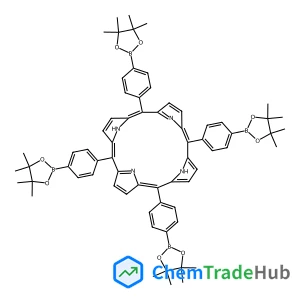
5,10,15,20-tetrakis(4-boronic acid pinacol ester phenyl) porphyrin
CAS号:
1332748-00-1
分子式:
C68H74B4N4O8
推荐供应商




免责声明
本页面提供的学术期刊信息仅供参考和研究使用。我们与任何期刊出版商均无关联,也不处理投稿事宜。如有投稿相关咨询,请直接联系相关期刊出版商。
如发现页面信息有误,请发送邮件至 support@chemtradehub.com 联系我们。我们将及时核实并处理您的问题。