



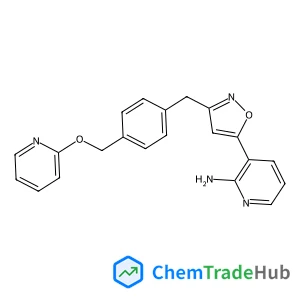
3-(3-(4-((Pyridin-2-yloxy)methyl)benzyl)isoxazol-5-yl)pyridin-2-amine
CAS号:
936339-60-5
分子式:
C21H18N4O2
Xiaochen Wang, Ailing Tang
To investigate the effect of conjugated π-bridge and fluorination on the properties of asymmetric-building-block-containing polymers (ABC polymers), hexylthiophene (HT) was inserted into D–A-type polymers based on asymmetric dithieno[3,2-b:2′,3′-d]pyran (DTPa) donor and benzothiadiazole (BT), mono-fluorinated benzothiadiazole (fBT) or di-fluorinated benzothiadiazole (ffBT) acceptors, respectively. In comparison with non-bridged analogs, introducing the HT π-bridge between DTPa and BTs significantly reduced the intramolecular charge transfer and consequently affected the absorption spectra, frontier energy levels, and electrochemical and charge transport properties of the resulting ABC polymers. Interestingly, HT π-bridge enlarged the fluorination effect on photovoltaic properties, and the power conversion efficiency (PCE) increased gradually from 1.56% (DTPa-HTBT) to 4.39% (DTPa-HTfBT) and 6.09% (DTPa-HTffBT), significantly different with non-bridged polymers. Most importantly, with the increase in the number of the fluorine atoms on the BT unit, all of the photovoltaic parameters, including PCE, Voc, Jsc, and FF, improved gradually, which provides a useful guide for the further design of ABC photovoltaic polymers.
Lujie Liu, Jiawei Zheng, Xuehong Zhang, Zhilong Wang
DOI: 10.1039/D0RE00355G
Tile Gieshoff, Holger Frey
DOI: 10.1039/C3PY00707C
Xinxin Tan, Liulin Yang, Yiliu Liu, Zehuan Huang, Hui Yang, Zhiqiang Wang, Xi Zhang
DOI: 10.1039/C3PY00888F
Zengchao Tang, Xiaoli Liu, Yafei Luan, Wei Liu, Zhaoqiang Wu, Dan Li, Hong Chen
DOI: 10.1039/C3PY00710C
Subhash Ghosh
DOI: 10.1039/D0RE00323A
Dmitry G. Shchukin
DOI: 10.1039/C3PY00082F
Benoît Louis, Wanlin Gao, Qiang Wang
DOI: 10.1039/D1RE00090J
John R. Pflug, Russell J. Varley
DOI: 10.1039/C3PY00095H
Meng-Dawn Cheng, Jason M. Richards, Michael A. Omana, Joshua A. Hubbard, Glenn A. Fugate
DOI: 10.1039/D0RE00207K
4-[4-三氟甲基苯基]恶唑通常通过将4-三氟甲基苯酚与异硫氰酸苯酯在有机溶剂中进行酯化反应合成。该反应可在无水条件下,使用适当的催化剂,如四丁基氢氧化铵,以提...
RockPhos Pd G3 通常通过钯催化偶联反应合成,使用配体 (2'-Amino-2-biphenylyl)(methanesulfonato-kappa...
1-哌啶甲酰胺作为有机合成中的重要中间体,其市场需求主要受医药、农药、染料等行业推动。近年来,随着新药开发和绿色化学的发展,该化合物的研究趋势集中在开发更高效、...
2-(二苯基膦基)乙胺适用于多种法规指南,包括但不限于《全球化学品统一分类和标签制度》(GHS),欧盟《化学品注册、评估、授权和限制》法规(REACH),以及美...
间苯二甲酸二烯丙酯应储存在阴凉、干燥、通风良好的地方,远离火源和热源。储存容器应密封,避免光照和高温。储存温度应控制在25℃以下,相对湿度应低于80%。避免与其...
间甲苯异硫代异氰酸酯是一种有机化合物,分子式为C7H7NO2S,具有刺激性气味。它是一种重要的有机合成中间体,在合成其他化合物时广泛应用。
在合成中,可以考虑使用N-Cbz-D-苯丙氨醇或N-Fmoc-D-苯丙氨醇作为替代品。这些化合物同样具有保护氨基的功能,且在合成过程中表现出良好的反应性能。
3-羟甲基-2-氧异丙基吡啶主要用于有机合成领域,可以作为合成其他药物、农药或精细化学品的中间体。此外,它还可能在实验室研究中作为特定反应的前体或溶剂。
6-氨基-9-甲基嘌呤目前主要应用于医药行业,作为某些药物的中间体。此外,它还可能用于聚合物、传感器和半导体的某些领域,作为功能性单体或掺杂剂。

Polymer Chemistry welcomes submissions in all areas of polymer science that have a strong focus on macromolecular chemistry. Manuscripts may cover a broad range of fields, yet no direct application focus is required.
![Ethyl (3aS,6aS)-1-benzylhexahydropyrrolo[3,4-b]pyrrole-5(1H)-carboxylate structure](https://cnstatic.chemtradehub.com/structs/894/894853-99-7-e175.webp "Ethyl (3aS,6aS)-1-benzylhexahydropyrrolo[3,4-b]pyrrole-5(1H)-carboxylate structure")