










![(2S)-2-({[(2-Methyl-2-propanyl)oxy]carbonyl}amino)-4-pentynoic acid structure](https://cnstatic.chemtradehub.com/structs/630/63039-48-5-b66d.webp "(2S)-2-({[(2-Methyl-2-propanyl)oxy]carbonyl}amino)-4-pentynoic acid structure")
Linking structural properties with functionality in solar cell materials – the effective mass and effective density of states
文献信息
发布日期
2018-05-08
DOI
10.1039/C7SE00622E
影响因子
6.367
作者
Uwe Rau
查看原文
摘要
Understanding crucial material properties making a certain material suitable for a specific application requires a clear methodology linking microscopic parameters with macroscopic functionality. This paper provides such a methodology for the relevant example of the effective mass or effective density of states in semiconductors used as photovoltaic absorber materials. This example is inspired by the recent suggestion that low effective masses are a crucial ingredient explaining the high efficiency and in particular the high open-circuit voltages in metal-halide perovskite solar cells. We critically examine this claim and discuss the conditions that affect the relation between basic properties of a band structure with photovoltaic or more generally optoelectronic functionality. While low effective masses may indeed have a beneficial effect on the open-circuit voltage in the non-radiative limit, using low effective masses as a generic criterion for high optoelectronic functionality would be an oversimplification. Instead the effective mass should always be considered in combination with other material or device specific properties such as the type of band gap (direct or indirect), the doping level and the dominant carrier scattering mechanism.
相关文献
Multifaceted properties of an engineered three-dimensional Zn(ii)–metal–organic coordination polymer: synthesis, crystal structure, efficient photocatalytic degradation of an organic dye and selective luminescent sensing
Rais Ahmad Khan, Amal AlFawaz, Imran Hasan, Nouf A. AlMuryyi, Afnan A. Alhamed, Sameen Laeeq, Sandeep Dey, Anup Paul, Ali Alsalme
2023-12-20
Paper
DOI: 10.1039/D3NJ04709A
Recent advances in fabricating injectable hydrogels via tunable molecular interactions for bio-applications
Jingsi Chen, Ziqian Zhao, Meng Wu, Lu Gong, Yimei Sun, Charley Huang, Bin Yan, Hongbo Zeng
2023-11-07
Review Article
DOI: 10.1039/D3TB02105J
Camptothecin-loaded supramolecular nanodelivery system based on amphiphilic calix[4]arene for targeted tumor therapy
2023-12-06
Paper
DOI: 10.1039/D3NJ03289B
A copper–platinum nanoplatform for synergistic photothermal and chemodynamic tumor therapy via ROS outburst and GSH exhaustion
Chao Li, Yan Kang, Chaohui Zhou, Nengqin Jia
2024-01-08
Paper
DOI: 10.1039/D3TB02288A
A novel magnetically guided, oxygen propelled CoPt/Au nanosheet motor in conjugation with a multilayer hollow microcapsule for effective drug delivery and light triggered drug release
Samira Kariminia, Mojtaba Shamsipur, Kamran Mansouri
2023-11-27
Paper
DOI: 10.1039/D3TB01888A
Activating black phosphorene's inert basal plane via nonprecious metal–nonmetal co-doping for visible-light-driven photocatalytic H2 evolution
Luteng Luo, Weiting Cui, Hang Xue, Sunzai Ke, Min-Quan Yang, Qingrong Qian
2023-11-24
Paper
DOI: 10.1039/D3NJ04778D
pH-dependent adsorption of the sulfamethoxazole antibiotic on HKUST-1@CNS nanocomposite corroborating efficiency, mechanistic, and kinetic studies
Geetika Jain, Puja Bhattacharyya, Mrinal Kanti Mandal, Rajib Ghosh Chaudhuri, Sandip Chakrabarti
2024-01-05
Paper
DOI: 10.1039/D3NJ04424F
The application of nanoparticles based on ferroptosis in cancer therapy
Yifei Li, Chen Wei, Jianqin Yan, Fashun Li, Bohan Chen, Yong Sun, Kui Luo, Bin He, Yan Liang
2023-12-08
Review Article
DOI: 10.1039/D3TB02308G
您可能还喜欢
化合物问答
什么是5-Fluoro-4-iodo-2-methylaniline(CAS号:307306-08-7)?
5-氟-4-碘-2-甲氨基苯属于芳香族化合物,其分子式为C8H7FN2I。该化合物具有一定的反应活性,在有机合成和药物化学领域有一定的应用。
307306-08-75-Fluoro-4-iodo-2-me...
化合物问答
4-氟-3-硝基三氟甲苯(CAS号:367-86-2)通常如何合成?
4-氟-3-硝基三氟甲苯通常通过将三氟甲基苯在酸性条件下催化氧化为三氟甲基硝基苯,然后进行氟化反应得到目标化合物。该过程需要使用催化剂,如三氟乙酸,反应产率较高...
367-86-21-Fluoro-2-nitro-4-(...
化合物问答
6-氯-9-(2,3,5-三苯甲酰氧基-2-C-甲基-beta-D-呋喃核糖基)-9H-嘌呤(CAS号:205171-05-7)的物理化学性质是什么?
该化合物为白色至类白色晶体,分子量约为1046.95。它在水中几乎不溶,在有机溶剂如乙腈和甲醇中具有一定的溶解性。该化合物具有良好的化学稳定性和生物活性。
205171-05-76-Chloro-9-(2-C-meth...
化合物问答
如何储存6-氟喹啉-4-羧酸(CAS号:220844-73-5)?
6-氟喹啉-4-羧酸应储存在阴凉、干燥、通风良好的地方,避免阳光直射。储存在密闭容器中,避免与空气中的水分接触。储存温度应控制在室温以下,避免高温。
220844-73-56-Fluoroquinoline-4-...
化合物问答
(2S,2'S,3S,3'S)-3,3'-di-tert-butyl-4,4'-bis(2,6-dimethoxyphenyl)-2,2',3,3'-tetrahydro-2,2'-bibenzo[d][1,3]oxaphosphole(CAS号:1435940-21-8)通常如何合成?
该化合物通常通过芳香族化合物的亲核取代反应合成,首先将2,6-二甲氧基苯基引入到双环结构中,然后通过特定条件下的还原或氧化反应引入二叔丁基。反应过程中使用了钯作...
1435940-21-8(2S,2'S,3S,3'S)-4,4'...
化合物问答
如何储存KY02111(CAS号:1118807-13-8)?
KY02111应储存于阴凉、干燥、通风良好的地方,避免阳光直射和高温环境。应使用合适的密闭容器储存,并确保容器密封良好,防止水分和潮气进入。在储存期间,应注意检...
1118807-13-8N-(6-chlorobenzo[d]t...
化合物问答
如何储存4-(4-氯苯氧基)丁酸乙酯(CAS号:59227-79-1)?
4-(4-氯苯氧基)丁酸乙酯应储存在阴凉、干燥、通风良好的地方,远离火源和热源。避免阳光直射,防止容器破裂导致泄漏。储存时应保持容器密封,避免与空气中的水蒸气接...
59227-79-1Ethyl 4-(4-chlorophe...
化合物问答
4-庚基苯乙酮(CAS号:37593-03-6)安全吗?
4-庚基苯乙酮相对安全,但在使用和储存时仍需注意。应避免吸入其蒸气,避免皮肤接触,使用时需佩戴防护眼镜和手套。储存时应远离火源和热源,保持容器密封,放置于阴凉、...
37593-03-61-(4-Heptylphenyl)et...
化合物问答
什么是乙基2-氨基-4-(3-溴苯基)噻吩-3-羧酸乙酯(CAS号:438218-48-5)?
乙基2-氨基-4-(3-溴苯基)噻吩-3-羧酸乙酯是一种有机化合物,分子式为C16H12BrN2O2S。它是一种含有噻吩环、氨基、溴苯基和羧酸酯结构的化合物。这...
438218-48-5ethyl 2-amino-4-(3-b...
化合物问答
什么是(9ci)-2-氨基-6-甲基-苯甲酰胺(CAS号:1885-31-0)?
(9ci)-2-氨基-6-甲基-苯甲酰胺是一种化学化合物,其英文名称为2-Amino-6-methylbenzamide,CAS号为1885-31-0。该化合物...
1885-31-02-Amino-6-methylbenz...
来源期刊
推荐化合物
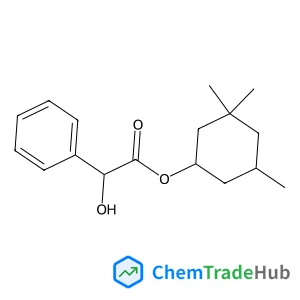
![5-Bromoimidazo[1,2-a]pyridine structure](https://cnstatic.chemtradehub.com/structs/692/69214-09-1-d8e2.webp "5-Bromoimidazo[1,2-a]pyridine structure")
推荐供应商





免责声明
本页面提供的学术期刊信息仅供参考和研究使用。我们与任何期刊出版商均无关联,也不处理投稿事宜。如有投稿相关咨询,请直接联系相关期刊出版商。
如发现页面信息有误,请发送邮件至 support@chemtradehub.com 联系我们。我们将及时核实并处理您的问题。