





Complex dielectric transformation of UV-vis diffuse reflectance spectra for estimating optical band-gap energies and materials classification
文献信息
发布日期
2019-03-05
DOI
10.1039/C8AN02257G
影响因子
4.616
作者
Prince George, Pradip Chowdhury
查看原文
摘要
In this work, a complex dielectric transformation of UV-vis diffuse reflectance spectra is proposed to estimate the optical band-gap energies of an array of materials classified as semi-conductors, conductors and insulators and the results are compared with the more common Kubelka–Munk (K–M) transformation. The results show a close match between the proposed method and the Tauc model based on the K–M transformation within ca. 0.16–7.07% variation. The proposed method based on the well-established dielectric transformation is unique in a way to estimate band-gap energy when there remain unresolved or multiple absorption peaks in the diffuse reflectance spectra. Importantly, the complex dielectric transformation method also distinguishes the class of the materials which is of paramount importance to validate and substantiate the band-gap energy values.
相关文献
Molecular BioSystems issue 5 contents pages - free access to ChemComm subscribers
Front/Back Matter
DOI: 10.1039/B705434N
A recipe for new organometallic polymers and oligomers? Synthesis and structure of an oligo- and a polymeric arrangement of P–S anions‡
Maryam Shafaei-Fallah, Weifeng Shi
2007-01-23
Communication
DOI: 10.1039/B617177J
Unusual carbon–sulfur bond cleavage in the reaction of a new type of bulky hexathioether with a zerovalent palladium complex
Daisuke Shimizu, Nobuhiro Takeda, Norihiro Tokitoh
2005-11-21
Communication
DOI: 10.1039/B513339D
Vacuum-ultraviolet ionization spectroscopy of the jet-cooled RNA-base uracil
Kyo-Won Choi, Joo-Hee Lee, Sang Kyu Kim
2005-11-17
Communication
DOI: 10.1039/B512465D
Complex PbTe hopper (skeletal) crystals with high hierarchy
Zhu-Bing He, Jun Jiang, Ke Chen, Xiao-Yuan Zhou
2005-10-20
Communication
DOI: 10.1039/B510930B
Creation of quaternary stereocenters in carbonyl allylation reactions
Ilan Marek, Genia Sklute
2006-12-06
Feature Article
DOI: 10.1039/B615042J
Direct visualisation, by aberration-corrected electron microscopy, of the crystallisation of bimetallic nanoparticlecatalysts
Edmund P. W. Ward, Ilke Arslan, Paul A. Midgley, Andrew Bleloch
2005-10-20
Communication
DOI: 10.1039/B511004A
Aryl bromide/triflate selectivities reveal mechanistic divergence in palladium-catalysed couplings; the Suzuki–Miyaura anomaly
Gustavo Espino, Almira Kurbangalieva, John M. Brown
2007-04-05
Communication
DOI: 10.1039/B701517H
A stable electrode for high-potential, electrocatalytic O2 reduction based on rational attachment of a blue copper oxidase to a graphite surface
Christopher F. Blanford, Rachel S. Heath, Fraser A. Armstrong
2007-04-03
Communication
DOI: 10.1039/B703114A
您可能还喜欢
化合物问答
什么是2,6-二溴-4,8-双[(2-乙基己基)氧基]苯并[1,2-b:4,5-b']二噻吩(CAS号:1226782-13-3)?
2,6-二溴-4,8-双[(2-乙基己基)氧基]苯并[1,2-b:4,5-b']二噻吩是一种有机化合物,分子式为C23H32Br2O2S2。该化合物具有芳香性和...
1226782-13-32,6-Dibromo-4,8-bis[...
化合物问答
木聚硫钠(CAS号:37319-17-8)的物理化学性质是什么?
木聚硫钠通常为无色或白色结晶性粉末,具有吸湿性。其分子量约为121.11 g/mol。木聚硫钠易溶于水,不溶于醇类和其他非极性溶剂。在酸性或碱性溶液中,木聚硫钠...
37319-17-8Pentosan
化合物问答
2-甲氧基-4-(三氟甲基)苄溴, JRD(CAS号:886500-59-0)适用哪些法规指南?
该化合物在合成、储存和运输过程中需遵循《全球化学品统一分类和标签制度》(GHS)的健康、环境和物理危险分类。在欧洲还需符合《化学品注册、评估、授权和限制》(RE...
886500-59-02-Methoxy-4-(trifluo...
化合物问答
1,4-Diazoniabicyclo[2.2.2]octane-1,4-disulfinate(CAS号:119752-83-9)的主要用途是什么?
1,4-二氮杂双环[2.2.2]辛烷-1,4-二硫酸二酯主要用于有机合成中的保护基团,特别是在保护胺基和硫醇基方面具有广泛应用。此外,它还用于一些特殊化学反应的...
119752-83-91,4-Diazabicyclo[2.2...
化合物问答
如何处理含有4-(Bromomethyl)-2-fluorobenzenesulphonamide(CAS号:1645275-47-3)的废料?
含有4-(Bromomethyl)-2-fluorobenzenesulphonamide的废液应首先进行中和处理,以降低pH值,避免对环境造成腐蚀性影响。随后...
1645275-47-34-(Bromomethyl)-2-fl...
化合物问答
Loureiriol(CAS号:479195-44-3)的物理化学性质是什么?
Loureiriol是一种天然化合物,其分子式为C15H22O4。Loureiriol为无色结晶性粉末,具有较高的熔点和良好的热稳定性。其相对分子质量为262....
479195-44-3Loureiriol
化合物问答
在合成中是否有3-氨基苯甲酰苯胺(CAS号:14315-16-3)的替代品?
在合成过程中,可以考虑使用类似结构的化合物作为3-氨基苯甲酰苯胺的替代品,例如N-苯基-3-氰基苯胺或N-苯基-3-硝基苯胺等,这些化合物具有相似的化学性质,可...
14315-16-33-Amino-N-phenylbenz...
化合物问答
4-异氰酰苯基硼酸频哪醇酯(CAS号:380430-64-8)的市场或研究趋势如何?
4-异氰酰苯基硼酸频哪醇酯主要应用于有机合成、药物化学和材料科学领域。随着绿色化学的发展,该化合物因其高效的官能团转化能力和环境友好性而受到越来越多的关注。近年...
380430-64-82-(4-Isocyanatopheny...
化合物问答
如何储存3β-乙酰氧基-7,25-甘遂二烯-24(R)-醇(CAS号:1352001-09-2)?
3β-乙酰氧基-7,25-甘遂二烯-24(R)-醇应储存在阴凉、干燥、通风良好的地方,避免直接光照。储存容器应密封,防止空气中的水分和氧气影响化合物的稳定性。建...
1352001-09-23β-acetoxy-eupha- 7,...
化合物问答
如何储存4-氟-2-甲基-1H-吲哚(CAS号:1260383-51-4)?
应将4-氟-2-甲基-1H-吲哚存放在阴凉、干燥、通风良好的地方,避免直接暴露在光照下。容器应密封,避免与空气中的水蒸气接触。建议在避光、温度不超过25℃的环境...
1260383-51-44-Fluoro-2-methyl-1H...
来源期刊
Analyst

CiteScore:
7.8
自引率:
5.6%
年发文量:
653
Analyst publishes analytical and bioanalytical research that reports premier fundamental discoveries and inventions, and the applications of those discoveries, unconfined by traditional discipline barriers.
推荐化合物
![[2',6'-bis(propan-2-yloxy)-[1,1'-biphenyl]-3-yl]dicyclohexylphosphane structure](https://cnstatic.chemtradehub.com/structs/787/787618-22-8-dda2.webp "[2',6'-bis(propan-2-yloxy)-[1,1'-biphenyl]-3-yl]dicyclohexylphosphane structure")
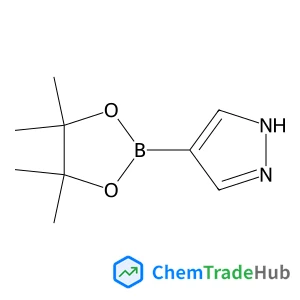
[2',6'-bis(propan-2-yloxy)-[1,1'-biphenyl]-3-yl]dicyclohexylphosphane
CAS号:
787618-22-8
分子式:
C30H43O2P
推荐供应商





免责声明
本页面提供的学术期刊信息仅供参考和研究使用。我们与任何期刊出版商均无关联,也不处理投稿事宜。如有投稿相关咨询,请直接联系相关期刊出版商。
如发现页面信息有误,请发送邮件至 support@chemtradehub.com 联系我们。我们将及时核实并处理您的问题。