


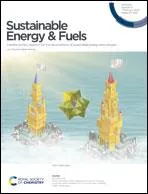
Boosting pseudocapacitive charge storage in in situ functionalized carbons with a high surface area for high-energy asymmetric supercapacitors
文献信息
发布日期
2018-08-08
DOI
10.1039/C8SE00348C
影响因子
6.367
作者
Hao Zhang, Mingjie Lu, Huanlei Wang, Yan Lyu, Dong Li, Shijiao Sun, Jing Shi, Wei Liu
查看原文
摘要
Achieving both a high surface area and high heteroatom doping in carbon materials is a major challenge for aqueous-based supercapacitors. Herein, we choose an efficient carbonization–activation pathway to tune the porosity and heteroatom doping level of carbon materials by using jellyfish as the precursor and KOH as the activating agent. Highly Functionalized Jellyfish-Derived Activated Carbons (HFJDACs) possess a high surface area of up to 3300 m2 g−1 with nitrogen and oxygen heteroatom doping. Carbon activated at 500 °C displays a capacitance as high as 743 F g−1 and 639 F cm−3, while carbons activated at a temperature higher than 500 °C exhibit a favorable capacitance retention of >48.1% at 100 A g−1. These values are among the highest reported in the literature, and therefore these carbon materials can be used as the ideal negative electrode in asymmetric supercapacitors to circumvent the capacitance mismatch between oxide-based positive electrodes and carbon-based negative electrodes. The assembled asymmetric capacitor employing HFJDACs can achieve a high energy density of 43.4 W h kg−1 and an amazing cycle life with capacitance retention of 110% after 20 000 cycles. These results demonstrate that adapting a scalable synthesis strategy for designing carbons with well-developed porosity and high level heteroatom doping is promising for advanced supercapacitors.
期刊推荐

Journal of Natural Medicines

Acta Materialia

Saudi Pharmaceutical Journal

Journal of Saudi Chemical Society

Current Opinion in Solid State & Materials Science
Russian Journal of Coordination Chemistry
Russian Journal of Applied Chemistry
Current Opinion in Colloid & Interface Science

Chemical Communications

Russian Journal of General Chemistry
相关文献
Facile synthesis and application of a carbon foam with large mesopores
Liling Fu, Genggeng Qi, Ritu Sahore, Rachid Sougrat, Francis J. DiSalvo, Emmanuel P. Giannelis
2013-10-02
Communication
DOI: 10.1039/C3CP53246A
Calculating and assigning rovibrational energy levels of (15N2O)2, (15N14NO)2, 14N2O–15N2O and 15N14NO–15N2O
2013-09-24
Paper
DOI: 10.1039/C3CP52548A
Electrochemistry at nanometer-sized electrodes
Shengli Chen, Yuwen Liu
2013-11-04
Perspective
DOI: 10.1039/C3CP53773K
268 nm photodissociation of ClN3: a femtosecond velocity-map imaging study
D. Staedter, E. Baynard, Peter C. Samartzis
2013-10-07
Paper
DOI: 10.1039/C3CP53507J
Synthesis of CdWO4 nanorods and investigation of the photocatalytic activity
Xiaojuan Bai, Jing Xu, Xinguo Ma, Yongfa Zhu
2013-10-17
Paper
DOI: 10.1039/C3CP53403K
The binding nature of light hydrocarbons on Fe/MOF-74 for gas separation
Heejin Kim, Joonho Park
2013-10-04
Paper
DOI: 10.1039/C3CP52980K
A roaming wavepacket in the dynamics of electronically excited 2-hydroxypyridine
Lionel Poisson, Benoît Soep, Majdi Hochlaf, Martial Boggio-Pasqua, Jean-Michel Mestdagh
2013-10-18
Paper
DOI: 10.1039/C3CP52923A
Vibrationally resolved absorption, emission and resonance Raman spectra of diamondoids: a study based on time-dependent correlation functions
Shiladitya Banerjee, Peter Saalfrank
2013-10-29
Paper
DOI: 10.1039/C3CP53535E
Photoresponse of the protonated Schiff-base retinal chromophore in the gas phase
Y. Toker, D. B. Rahbek, H. V. Kiefer, J. Rajput, R. Antoine, P. Dugourd, S. Brøndsted Nielsen, L. H. Andersen
2013-10-09
Communication
DOI: 10.1039/C3CP51759D
您可能还喜欢
化合物问答
什么是2-氨基戊烷(CAS号:63493-28-7)?
2-氨基戊烷,又名pentan-2-amine,是一种有机化合物,分子式为C5H11NH2。它是一种无色透明液体,有氨味。该化合物在工业和研究中有一定的应用。
63493-28-7pentan-2-amine
化合物问答
反式-4-[4-[[[5-[(3,4-二氟苯基)氨基]-1,3,4-恶二唑-2-基]羰基]氨基]苯基]环己烷乙酸(CAS号:892489-52-0)的物理化学性质是什么?
该化合物为白色固体,分子量为552.31 g/mol。它在水中溶解度较低,在有机溶剂如乙腈、乙酸乙酯中有较好的溶解性。该化合物具有较高的化学稳定性,对酸和碱具有...
892489-52-0Trans-4-[4-[[[5-[(3,...
化合物问答
如何处理含有Pyrotinib dimaleate(CAS号:1397922-61-0)的废料?
处理含有Pyrotinib dimaleate 的废料时,应遵循当地的法规要求。首先,收集废料并进行分类,确保没有与其他化学品混合。然后,采取适当的物理和化学处...
1397922-61-0(2E)-N-(4-{[3-Chloro...
化合物问答
在合成中是否有4-(5-5-乙基-1,2,4-噁二唑-3-基)苯甲酸乙酯(CAS号:1166756-79-1)的替代品?
在合成过程中,可以考虑使用其他结构类似的化合物作为替代品,例如苯甲酸酯类化合物,如2-乙基-5-甲基噁二唑基苯甲酸乙酯等。这些替代品可能具有相似的化学性质,但在...
1166756-79-1Ethyl 4-(5-ethyl-1,2...
化合物问答
如何处理含有1-((叔丁氧基羰基)氨基)环丁烷甲酸甲酯(CAS号:880166-10-9)的废料?
处理含有该化合物的废液时,应先确保其完全反应并转化为无害物质。对于未反应的化合物,建议采用中和处理后进行蒸馏回收,剩余物可使用化学氧化法或焚烧法进行无害化处理。...
880166-10-9Methyl 1-({[(2-methy...
化合物问答
2-({[3,5-二(三氟甲基)苯基]磺酰基}氨基)-4-(甲基硫代)丁酸甲酯(CAS号:175202-21-8)的市场或研究趋势如何?
目前该化合物主要应用于药物合成领域,尤其在开发新型抗癌药物方面具有潜在应用。随着制药行业的持续发展,对于高效、低毒的合成中间体需求增加,预计该化合物的研究和应用...
175202-21-8Methyl N-{[3,5-bis(t...
化合物问答
N,N-乙烯双(碘乙酰胺)(CAS号:7250-43-3)的物理化学性质是什么?
N,N-乙烯双(碘乙酰胺)是一种白色或类白色固体,易溶于乙醇、丙酮等有机溶剂,但在水中溶解度较低。该化合物具有较高的反应活性,可以与其他含有活性氢的化合物发生酰...
7250-43-3N,N'-1,2-Ethanediylb...
化合物问答
7-Fluoro-1H-spiro[furo[3,4-c]pyridine-3,4'-piperidine](CAS号:1283090-73-2)通常如何合成?
该化合物可以通过环合反应合成,首先合成吡啶和哌啶的衍生物,然后在合适的条件下进行环合反应得到目标化合物。常用的催化剂包括某些金属盐类,产率一般在70%-90%之...
1283090-73-27-Fluoro-1H-spiro[fu...
化合物问答
处理3-乙酰滇乌碱(CAS号:80787-51-5)时应注意哪些实验室安全事项?
在处理3-乙酰滇乌碱时,应穿戴适当的个人防护装备(PPE),如实验服、手套(丁腈手套或PVC手套)、护目镜和口罩。实验应在通风橱中进行,以减少吸入或皮肤接触的风...
80787-51-54-Methylaconitane-1,...
化合物问答
如何储存2-溴-5-硝基-4-羧酸(CAS号:1053655-82-5)?
2-溴-5-硝基-4-羧酸应存放在阴凉、干燥、通风良好的地方,远离火源和热源。避免与还原剂、碱性物质接触。储存容器应密封,防止吸湿。
1053655-82-52-Bromo-5-nitropyrid...
来源期刊
推荐化合物
![Benzo[b]naphtho[2,1-d]thiophene structure](https://cnstatic.chemtradehub.com/structs/239/239-35-0-ff90.webp "Benzo[b]naphtho[2,1-d]thiophene structure")
推荐供应商




免责声明
本页面提供的学术期刊信息仅供参考和研究使用。我们与任何期刊出版商均无关联,也不处理投稿事宜。如有投稿相关咨询,请直接联系相关期刊出版商。
如发现页面信息有误,请发送邮件至 support@chemtradehub.com 联系我们。我们将及时核实并处理您的问题。