



Molecular engineering of the bio/nano-interface for enzymatic electrocatalysis in fuel cells
文献信息
发布日期
2018-09-07
DOI
10.1039/C8SE00374B
影响因子
6.367
作者
Alan Le Goff, Michael Holzinger
查看原文
摘要
The fascinating topic of converting chemical energy into electric power using biological catalysts, called enzymes, and sustainable fuels motivates a large community of scientists to develop enzymatic fuel cells. Enzymes provide the advantage of catalytic oxidation and reduction processes under ecologically friendly conditions and even in complex media due to their unique specificity. However, this specificity represents a constant challenge since every enzyme has its own distinguished structure and catalytic behaviour. In this context, great efforts have been invested to understand the operational modes of promising enzymes for the bioconversion of energy. The aim is to provide chemical functions and functionalities to enable or to facilitate an electron transfer between the enzymes and the electrode material to reach the maximum efficiency of the electrocatalytic process. Original and high performance examples are summarized here in a non-exhaustive manner focusing on the wiring strategy for a series of enzymes described in the literature.
期刊推荐
Russian Journal of Coordination Chemistry

Acta Materialia

Chemistry Education Research and Practice
Russian Journal of Applied Chemistry
Nature Medicine
Drug Discovery Today
Crystallography Reports
Current Opinion in Colloid & Interface Science

Russian Journal of Organic Chemistry

Journal of Natural Medicines
相关文献
Electrochemistry at nanometer-sized electrodes
Shengli Chen, Yuwen Liu
2013-11-04
Perspective
DOI: 10.1039/C3CP53773K
Accelerated electron transport from photosystem I to redox partners by covalently linked ferredoxin
Gal Wittenberg, William Sheffler, Dana Darchi, David Baker
2013-10-01
Paper
DOI: 10.1039/C3CP53264J
Unravelling the quantum-entanglement effect of noble gas coordination on the spin ground state of CUO
Paweł Tecmer, Katharina Boguslawski, Örs Legeza, Markus Reiher
2013-11-04
Paper
DOI: 10.1039/C3CP53975J
Influence of La-doping on phase transformation and photocatalytic properties of ZnTiO3 nanoparticles synthesized via modified sol–gel method
T. Surendar, Santosh Kumar, Vishnu Shanker
2013-10-21
Paper
DOI: 10.1039/C3CP53855A
Metal-free, polyether-mediated H2-release from ammonia borane: roles of hydrogen bonding interactions in promoting dehydrogenation
Yongmin Kim, Hyunjae Baek, Jin Hee Lee, Shinyoung Yeo, Kibum Kim, Son-Jong Hwang, Bit Eun
2013-08-05
Paper
DOI: 10.1039/C3CP52591K
Experimental and theoretical investigation of correlated fine structure branching ratios arising from state-selected predissociation of BrO (A2Π3/2)
Michael P. Grubb, Kristin S. Dooley, C. Daniel Freeman, Kirk A. Peterson, Simon W. North
2013-10-29
Paper
DOI: 10.1039/C3CP53766H
High redox and performance stability of layered SmBa0.5Sr0.5Co1.5Cu0.5O5+δ perovskite cathodes for intermediate-temperature solid oxide fuel cells
Areum Jun, Jeeyoung Shin, Guntae Kim
2013-10-23
Paper
DOI: 10.1039/C3CP53883D
Study of underpotential deposited Cu layers on Pt(111) and their stability against CO and CO2 in perchloric acid
Christian Schlaup, Sebastian Horch
2013-10-04
Paper
DOI: 10.1039/C3CP52649F
A roaming wavepacket in the dynamics of electronically excited 2-hydroxypyridine
Lionel Poisson, Benoît Soep, Majdi Hochlaf, Martial Boggio-Pasqua, Jean-Michel Mestdagh
2013-10-18
Paper
DOI: 10.1039/C3CP52923A
Slice imaging of methyl bromide photofragmentation at 193 nm
M. Laura Lipciuc, Peter C. Samartzis, Xueming Yang
2013-11-25
Paper
DOI: 10.1039/C3CP53139B
您可能还喜欢
化合物问答
什么是2-氨基戊烷(CAS号:63493-28-7)?
2-氨基戊烷,又名pentan-2-amine,是一种有机化合物,分子式为C5H11NH2。它是一种无色透明液体,有氨味。该化合物在工业和研究中有一定的应用。
63493-28-7pentan-2-amine
化合物问答
反式-4-[4-[[[5-[(3,4-二氟苯基)氨基]-1,3,4-恶二唑-2-基]羰基]氨基]苯基]环己烷乙酸(CAS号:892489-52-0)的物理化学性质是什么?
该化合物为白色固体,分子量为552.31 g/mol。它在水中溶解度较低,在有机溶剂如乙腈、乙酸乙酯中有较好的溶解性。该化合物具有较高的化学稳定性,对酸和碱具有...
892489-52-0Trans-4-[4-[[[5-[(3,...
化合物问答
如何处理含有Pyrotinib dimaleate(CAS号:1397922-61-0)的废料?
处理含有Pyrotinib dimaleate 的废料时,应遵循当地的法规要求。首先,收集废料并进行分类,确保没有与其他化学品混合。然后,采取适当的物理和化学处...
1397922-61-0(2E)-N-(4-{[3-Chloro...
化合物问答
在合成中是否有4-(5-5-乙基-1,2,4-噁二唑-3-基)苯甲酸乙酯(CAS号:1166756-79-1)的替代品?
在合成过程中,可以考虑使用其他结构类似的化合物作为替代品,例如苯甲酸酯类化合物,如2-乙基-5-甲基噁二唑基苯甲酸乙酯等。这些替代品可能具有相似的化学性质,但在...
1166756-79-1Ethyl 4-(5-ethyl-1,2...
化合物问答
如何处理含有1-((叔丁氧基羰基)氨基)环丁烷甲酸甲酯(CAS号:880166-10-9)的废料?
处理含有该化合物的废液时,应先确保其完全反应并转化为无害物质。对于未反应的化合物,建议采用中和处理后进行蒸馏回收,剩余物可使用化学氧化法或焚烧法进行无害化处理。...
880166-10-9Methyl 1-({[(2-methy...
化合物问答
2-({[3,5-二(三氟甲基)苯基]磺酰基}氨基)-4-(甲基硫代)丁酸甲酯(CAS号:175202-21-8)的市场或研究趋势如何?
目前该化合物主要应用于药物合成领域,尤其在开发新型抗癌药物方面具有潜在应用。随着制药行业的持续发展,对于高效、低毒的合成中间体需求增加,预计该化合物的研究和应用...
175202-21-8Methyl N-{[3,5-bis(t...
化合物问答
N,N-乙烯双(碘乙酰胺)(CAS号:7250-43-3)的物理化学性质是什么?
N,N-乙烯双(碘乙酰胺)是一种白色或类白色固体,易溶于乙醇、丙酮等有机溶剂,但在水中溶解度较低。该化合物具有较高的反应活性,可以与其他含有活性氢的化合物发生酰...
7250-43-3N,N'-1,2-Ethanediylb...
化合物问答
7-Fluoro-1H-spiro[furo[3,4-c]pyridine-3,4'-piperidine](CAS号:1283090-73-2)通常如何合成?
该化合物可以通过环合反应合成,首先合成吡啶和哌啶的衍生物,然后在合适的条件下进行环合反应得到目标化合物。常用的催化剂包括某些金属盐类,产率一般在70%-90%之...
1283090-73-27-Fluoro-1H-spiro[fu...
化合物问答
处理3-乙酰滇乌碱(CAS号:80787-51-5)时应注意哪些实验室安全事项?
在处理3-乙酰滇乌碱时,应穿戴适当的个人防护装备(PPE),如实验服、手套(丁腈手套或PVC手套)、护目镜和口罩。实验应在通风橱中进行,以减少吸入或皮肤接触的风...
80787-51-54-Methylaconitane-1,...
化合物问答
如何储存2-溴-5-硝基-4-羧酸(CAS号:1053655-82-5)?
2-溴-5-硝基-4-羧酸应存放在阴凉、干燥、通风良好的地方,远离火源和热源。避免与还原剂、碱性物质接触。储存容器应密封,防止吸湿。
1053655-82-52-Bromo-5-nitropyrid...
来源期刊
推荐化合物
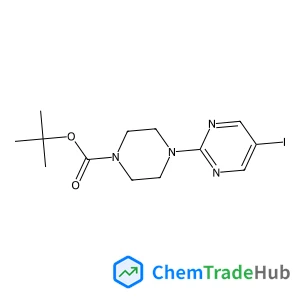
2-Methyl-2-propanyl 4-(5-iodo-2-pyrimidinyl)-1-piperazinecarboxylate
CAS号:
1027616-32-5
分子式:
C13H19IN4O2
![1-(2-Chlorophenyl)-6-[(2S)-3,3,3-trifluoro-2-methylpropyl]-1,7-dihydro-4H-pyrazolo[3,4-d]pyrimidin-4-one structure](https://cnstatic.chemtradehub.com/structs/794/794568-91-5-0c34.webp "1-(2-Chlorophenyl)-6-[(2S)-3,3,3-trifluoro-2-methylpropyl]-1,7-dihydro-4H-pyrazolo[3,4-d]pyrimidin-4-one structure")
推荐供应商





免责声明
本页面提供的学术期刊信息仅供参考和研究使用。我们与任何期刊出版商均无关联,也不处理投稿事宜。如有投稿相关咨询,请直接联系相关期刊出版商。
如发现页面信息有误,请发送邮件至 support@chemtradehub.com 联系我们。我们将及时核实并处理您的问题。