



Metabolomics for improved treatment monitoring of phenylketonuria: urinary biomarkers for non-invasive assessment of dietary adherence and nutritional deficiencies
文献信息
发布日期
2019-10-03
DOI
10.1039/C9AN01642B
影响因子
4.616
作者
Jennifer Wild, Meera Shanmuganathan, Mika Hayashi, Murray Potter
查看原文
摘要
Management of phenylketonuria (PKU) requires lifelong restriction of phenylalanine (Phe) intake using specialized medical foods to prevent neurocognitive impairment in affected patients. However, dietary adherence is challenging to maintain while ensuring adequate nutrition, which can lead to sub-optimal clinical outcomes. Metabolomics offers a systematic approach to identify new biomarkers of disease progression in PKU when using urine as a surrogate for blood specimens that is more accurate than self-reported diet records. Herein, the plasma and urine metabolome of a cohort of classic PKU patients (median age = 11 years; n = 22) mainly prescribed (78%) a Phe-restricted diet were characterized using multisegment injection-capillary electrophoresis-mass spectrometry (MSI-CE-MS). Overall, there was good mutual agreement between plasma Phe and tyrosine (Tyr) concentrations measured from PKU patients when using an amino acid analyzer based on UPLC-UV as compared to MSI-CE-MS with a mean bias of 12% (n = 82). Longitudinal measurements of recently diagnosed PKU infants (n = 3) revealed good long-term regulation of blood Phe with dietary management, and only occasional episodes exceeding the recommended therapeutic range (>360 μM) unlike older PKU patients. Plasma metabolomic studies demonstrated that non-adherent PKU patients had lower circulating concentrations of Tyr, arginine, 2-aminobutyric acid, and propionylcarnitine (q < 0.05, FDR) that were inversely correlated to Phe (r ≈ −0.600 to −0.830). Nontargeted metabolite profiling also revealed urinary biomarkers associated with poor dietary adherence among PKU patients, including elevated concentrations of catabolites indicative of Phe intoxication (e.g., phenylpyruvic acid, phenylacetylglutamine, hydroxyphenylacetic acid). Additionally, PKU patients with poor blood Phe control had lower excretion of urinary compounds derived from co-metabolism of Tyr due to microbiota activity (e.g., cresol sulfate, phenylsulfate), as well as several metabolites associated with inadequate nutrient intake, including low carnitine and B vitamin status (e.g., folic acid, vitamin B12). Interestingly, an unknown urinary metabolite was strongly correlated with Phe excretion in PKU patients (r = 0.861), which was subsequently identified as imidazole lactic acid when using high resolution MS/MS. Overall, urine profiling offers a non-invasive approach for better treatment monitoring of individual PKU patients, which can also guide the design of novel therapies that improve adherence to Phe-restricted diets without acquired nutritional deficiencies.
期刊推荐
Journal of Peptide Science

Current Opinion in Solid State & Materials Science
Russian Journal of Coordination Chemistry

Acta Materialia
Current Opinion in Colloid & Interface Science
Russian Journal of Organic Chemistry
Crystallography Reports
Saudi Pharmaceutical Journal

Chemical Communications
Journal of Natural Medicines
相关文献
Phenol–TiO2 complex photocatalysis: visible light-driven selective oxidation of amines into imines in air
Ji-Long Shi, Huimin Hao
2018-12-07
Paper
DOI: 10.1039/C8SE00527C
Preparation and photocatalytic activity of Au/TiO2 lyogels for hydrogen production
Lester Martínez, Mónica Benito, Lluís Soler, Elies Molins, Jordi Llorca
2018-08-03
Paper
DOI: 10.1039/C8SE00293B
Performance evaluation of a yeast biorefinery as a sustainable model for co-production of biomass, bioemulsifier, lipid, biodiesel and animal-feed components using inexpensive raw materials
RaviRanjan Kumar, Gunaseelan Dhanarajan, Moumita Bhaumik, Ramkrishna Sen
2017-04-24
Paper
DOI: 10.1039/C7SE00010C
High open circuit voltages in pin-type perovskite solar cells through strontium addition
Christian M. Wolff, José A. Márquez Prieto, Martin Stolterfoht, Pascal Becker, Thomas Unold, Bernd Rech, Dieter Neher
2019-01-09
Paper
DOI: 10.1039/C8SE00509E
Study of the enhancement on photogalvanics: solar energy conversion and storage in EDTA–safranine O–NaLS system
Prerna Gangotri, Pooran Koli
2017-03-28
Paper
DOI: 10.1039/C7SE00083A
A garnet structure-based all-solid-state Li battery without interface modification: resolving incompatibility issues on positive electrodes
Hao Zheng, Hans Peter Buchkremer
2018-11-08
Paper
DOI: 10.1039/C8SE00436F
Drastic improvement in the photocatalytic activity of Ga2O3 modified with Mg–Al layered double hydroxide for the conversion of CO2 in water
Shoji Iguchi, Yudai Hasegawa, Shotaro Kidera, Soichi Kikkawa
2017-06-28
Paper
DOI: 10.1039/C7SE00204A
您可能还喜欢
化合物问答
什么是2-氨基戊烷(CAS号:63493-28-7)?
2-氨基戊烷,又名pentan-2-amine,是一种有机化合物,分子式为C5H11NH2。它是一种无色透明液体,有氨味。该化合物在工业和研究中有一定的应用。
63493-28-7pentan-2-amine
化合物问答
反式-4-[4-[[[5-[(3,4-二氟苯基)氨基]-1,3,4-恶二唑-2-基]羰基]氨基]苯基]环己烷乙酸(CAS号:892489-52-0)的物理化学性质是什么?
该化合物为白色固体,分子量为552.31 g/mol。它在水中溶解度较低,在有机溶剂如乙腈、乙酸乙酯中有较好的溶解性。该化合物具有较高的化学稳定性,对酸和碱具有...
892489-52-0Trans-4-[4-[[[5-[(3,...
化合物问答
如何处理含有Pyrotinib dimaleate(CAS号:1397922-61-0)的废料?
处理含有Pyrotinib dimaleate 的废料时,应遵循当地的法规要求。首先,收集废料并进行分类,确保没有与其他化学品混合。然后,采取适当的物理和化学处...
1397922-61-0(2E)-N-(4-{[3-Chloro...
化合物问答
在合成中是否有4-(5-5-乙基-1,2,4-噁二唑-3-基)苯甲酸乙酯(CAS号:1166756-79-1)的替代品?
在合成过程中,可以考虑使用其他结构类似的化合物作为替代品,例如苯甲酸酯类化合物,如2-乙基-5-甲基噁二唑基苯甲酸乙酯等。这些替代品可能具有相似的化学性质,但在...
1166756-79-1Ethyl 4-(5-ethyl-1,2...
化合物问答
如何处理含有1-((叔丁氧基羰基)氨基)环丁烷甲酸甲酯(CAS号:880166-10-9)的废料?
处理含有该化合物的废液时,应先确保其完全反应并转化为无害物质。对于未反应的化合物,建议采用中和处理后进行蒸馏回收,剩余物可使用化学氧化法或焚烧法进行无害化处理。...
880166-10-9Methyl 1-({[(2-methy...
化合物问答
2-({[3,5-二(三氟甲基)苯基]磺酰基}氨基)-4-(甲基硫代)丁酸甲酯(CAS号:175202-21-8)的市场或研究趋势如何?
目前该化合物主要应用于药物合成领域,尤其在开发新型抗癌药物方面具有潜在应用。随着制药行业的持续发展,对于高效、低毒的合成中间体需求增加,预计该化合物的研究和应用...
175202-21-8Methyl N-{[3,5-bis(t...
化合物问答
N,N-乙烯双(碘乙酰胺)(CAS号:7250-43-3)的物理化学性质是什么?
N,N-乙烯双(碘乙酰胺)是一种白色或类白色固体,易溶于乙醇、丙酮等有机溶剂,但在水中溶解度较低。该化合物具有较高的反应活性,可以与其他含有活性氢的化合物发生酰...
7250-43-3N,N'-1,2-Ethanediylb...
化合物问答
7-Fluoro-1H-spiro[furo[3,4-c]pyridine-3,4'-piperidine](CAS号:1283090-73-2)通常如何合成?
该化合物可以通过环合反应合成,首先合成吡啶和哌啶的衍生物,然后在合适的条件下进行环合反应得到目标化合物。常用的催化剂包括某些金属盐类,产率一般在70%-90%之...
1283090-73-27-Fluoro-1H-spiro[fu...
化合物问答
处理3-乙酰滇乌碱(CAS号:80787-51-5)时应注意哪些实验室安全事项?
在处理3-乙酰滇乌碱时,应穿戴适当的个人防护装备(PPE),如实验服、手套(丁腈手套或PVC手套)、护目镜和口罩。实验应在通风橱中进行,以减少吸入或皮肤接触的风...
80787-51-54-Methylaconitane-1,...
化合物问答
如何储存2-溴-5-硝基-4-羧酸(CAS号:1053655-82-5)?
2-溴-5-硝基-4-羧酸应存放在阴凉、干燥、通风良好的地方,远离火源和热源。避免与还原剂、碱性物质接触。储存容器应密封,防止吸湿。
1053655-82-52-Bromo-5-nitropyrid...
来源期刊
Analyst

CiteScore:
7.8
自引率:
5.6%
年发文量:
653
Analyst publishes analytical and bioanalytical research that reports premier fundamental discoveries and inventions, and the applications of those discoveries, unconfined by traditional discipline barriers.
推荐化合物
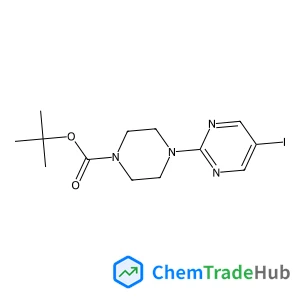
2-Methyl-2-propanyl 4-(5-iodo-2-pyrimidinyl)-1-piperazinecarboxylate
CAS号:
1027616-32-5
分子式:
C13H19IN4O2
推荐供应商






免责声明
本页面提供的学术期刊信息仅供参考和研究使用。我们与任何期刊出版商均无关联,也不处理投稿事宜。如有投稿相关咨询,请直接联系相关期刊出版商。
如发现页面信息有误,请发送邮件至 support@chemtradehub.com 联系我们。我们将及时核实并处理您的问题。