









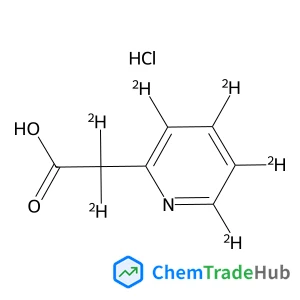
2,2-dideuterio-2-(3,4,5,6-tetradeuterio-2-pyridyl)acetic acid;hydrochloride
CAS号:
1329799-67-8
分子式:
C7H2ClD6NO2
Huazhen Chang, Xuan Qin, Lei Ma, Tao Zhang, Junhua Li
Cu/SAPO-34 catalysts were prepared by different solid-state ion exchange methods, i.e., mechanical mixing (Cu/SAPO-34-M) and ball milling (Cu/SAPO-34-B), and were used for selective catalytic reduction of NOx with NH3 (NH3-SCR) reaction. Compared with Cu/SAPO-34-M, Cu/SAPO-34-B exhibited more excellent NH3-SCR catalytic activity. Various characterization methods, including XRD, SEM, N2 adsorption–desorption, UV-vis, H2-TPR, EPR, NO + O2-TPD, NH3-TPD, and in situ DRIFTS, were used to elucidate their different catalytic performances. The characterization results suggested that ball milling could be beneficial for increasing the amount of isolated Cu2+ ions in the Cu/SAPO-34 catalyst. In comparison with Cu/SAPO-34-M, Cu/SAPO-34-B had more isolated Cu2+ ions, which mainly contributed to the NOx adsorption and Lewis acid sites. Furthermore, ball milling could improve the redox property of the Cu/SAPO-34 catalyst. The in situ DRIFTS results verified that NH3 adsorbed on Lewis acid sites were more active than those adsorbed on Brønsted acid sites. Therefore, it was believed that ball milling was a suitable method to prepare more efficient Cu/SAPO-34 catalysts for NOx removal from diesel exhaust.
Jaeeun Song, L. Palanikumar, Yeongkyu Choi, Inhye Kim, Tae-young Heo, Eungjin Ahn, Soo-Hyung Choi, Eunji Lee, Yuji Shibasaki, Ja-Hyoung Ryu
DOI: 10.1039/C7PY01613A
Hye Yun Lee, Seung Hun Park, Jae Ho Kim, Moon Suk Kim
DOI: 10.1039/C7PY01460K
Zhen Zhang, Yongcun Zhou, Zhuxian Zhou, Ying Piao, Nagendra Kalva, Xiangrui Liu, Jianbin Tang, Youqing Shen
DOI: 10.1039/C7PY01492A
Massimiliano Mauri, Leo Svenningsson, Thomas Hjertberg, Lars Nordstierna, Oscar Prieto, Christian Müller
DOI: 10.1039/C7PY01840A
R. W. M. Davidson, G. W. Simpson, J. Chiefari, M. J. Fuchter
DOI: 10.1039/C7PY01363A
Rashin Namivandi-Zangeneh, Rebecca J. Kwan, Thuy-Khanh Nguyen, Jonathan Yeow, Frances L. Byrne, Edgar H. H. Wong, Cyrille Boyer
DOI: 10.1039/C7PY01069A
Weiqiang Fu, Lichao Dong, Jianbing Shi, Bin Tong, Zhengxu Cai, Junge Zhi, Yuping Dong
DOI: 10.1039/C8PY00819A
1,2-环己二酮环乙缩醛应储存在阴凉、干燥、通风良好的地方,避免阳光直射。建议使用密封容器保存,并保持环境温度在室温范围内,远离火源和热源。
Ecopladib作为一种新型的药物,主要应用于治疗高胆固醇等疾病。目前,市场和研究趋势显示,Ecopladib因其独特的药理作用而受到关注。随着对心血管疾病治...
2,3-二甲基-3H-咪唑[4,5-c]吡啶通常通过咪唑和2,3-二甲基吡啶的缩合反应合成。具体来说,将咪唑和2,3-二甲基吡啶在适当的溶剂中进行加热或加压反应...
该化合物在药物化学和有机合成中有一定的应用。近年来,随着对新型药物化合物的需求增加,该化合物的研究趋势主要集中在探索其生物活性,尤其是其在神经系统疾病治疗中的潜...
盐酸甘氨酸丁酯应储存在阴凉、干燥、通风良好的地方,避免阳光直射和高温环境,温度应控制在25℃以下。储存容器应密封,避免与空气中的水分和酸性物质接触,以防发生水解...
2-碘-N,N-二甲基苯胺是一种有机化合物,化学名为2-Iodo-N,N-dimethylbenzamide。其分子式为C<sub>9</sub>H<sub>1...
随着医药、农药和新材料领域的发展,该化合物作为关键中间体的应用日益增多。特别是在药物合成中,由于其独特的化学性质,可以用于合成多种药物分子。未来的研究趋势可能集...
2,4-二溴-6-三氟甲基嘧啶通常通过溴化反应合成。首先,将6-三氟甲基嘧啶与溴化剂(如液溴)在适当的溶剂(如二氯甲烷、四氢呋喃)中反应,加入适当的催化剂(如四...

Physical Chemistry Chemical Physics (PCCP) is an international journal co-owned by 19 physical chemistry and physics societies from around the world. This journal publishes original, cutting-edge research in physical chemistry, chemical physics and biophysical chemistry. To be suitable for publication in PCCP, articles must include significant innovation and/or insight into physical chemistry; this is the most important criterion that reviewers and Editors will judge against when evaluating submissions. The journal has a broad scope and welcomes contributions spanning experiment, theory, computation and data science. Topical coverage includes spectroscopy, dynamics, kinetics, statistical mechanics, thermodynamics, electrochemistry, catalysis, surface science, quantum mechanics, quantum computing and machine learning. Interdisciplinary research areas such as polymers and soft matter, materials, nanoscience, energy, surfaces/interfaces, and biophysical chemistry are welcomed if they demonstrate significant innovation and/or insight into physical chemistry. Joined experimental/theoretical studies are particularly appreciated when complementary and based on up-to-date approaches.

![(2E)-3-(3-Chlorophenyl)-N-{2-[4-(methylsulfonyl)-1-piperazinyl]-2-oxoethyl}acrylamide structure](https://cnstatic.chemtradehub.com/structs/250/2505001-54-5-c1e9.webp "(2E)-3-(3-Chlorophenyl)-N-{2-[4-(methylsulfonyl)-1-piperazinyl]-2-oxoethyl}acrylamide structure")
phosphoryl}methyl 4-methylbenzenesulfonate structure](https://cnstatic.chemtradehub.com/structs/864/864068-45-1-ba7c.webp "{[3-(Hexadecyloxy)propoxy](hydroxy)phosphoryl}methyl 4-methylbenzenesulfonate structure")