










HIV detection from human serum with paper-based isotachophoretic RNA extraction and reverse transcription recombinase polymerase amplification
文献信息
发布日期
2021-04-06
DOI
10.1039/D0AN02483J
影响因子
4.616
作者
Andrew T. Bender, Benjamin P. Sullivan, Jane Y. Zhang, David C. Juergens, Lorraine Lillis, David S. Boyle
查看原文
摘要
The number of people living with HIV continues to increase with the current total near 38 million, of which about 26 million are receiving antiretroviral therapy (ART). These treatment regimens are highly effective when properly managed, requiring routine viral load monitoring to assess successful viral suppression. Efforts to expand access by decentralizing HIV nucleic acid testing in low- and middle-income countries (LMICs) has been hampered by the cost and complexity of current tests. Sample preparation of blood samples has traditionally relied on cumbersome RNA extraction methods, and it continues to be a key bottleneck for developing low-cost POC nucleic acid tests. We present a microfluidic paper-based analytical device (μPAD) for extracting RNA and detecting HIV in serum, leveraging low-cost materials, simple buffers, and an electric field. We detect HIV virions and MS2 bacteriophage internal control in human serum using a novel lysis and RNase inactivation method, paper-based isotachophoresis (ITP) for RNA extraction, and duplexed reverse transcription recombinase polymerase amplification (RT-RPA) for nucleic acid amplification. We design a specialized ITP system to extract and concentrate RNA, while excluding harsh reagents used for lysis and RNase inactivation. We found the ITP μPAD can extract and purify 5000 HIV RNA copies per mL of serum. We then demonstrate detection of HIV virions and MS2 bacteriophage in human serum within 45-minutes.
相关文献
The enhancement of photoswitching in a diarylethene derivative by the incorporation of cyanobiphenyl groups
Michel Frigoli, Georg H. Mehl
2004-02-23
Communication
DOI: 10.1039/B316146C
Rotavap simulation and the estimation of boiling points
Craig R. Stewart, Jonathan M. Goodman
2003-09-29
Communication
DOI: 10.1039/B309488J
Supramolecular assembly of a quaterthiophene surfactant
Lu Jiang, Robert C. Hughes, Darryl Y. Sasaki
2004-03-24
Communication
DOI: 10.1039/B316657K
First example of high loaded polymer-stabilized nanoclusters immobilized on hydrotalcite: effects in alkynehydrogenation
Jules C. A. A. Roelofs, Peter H. Berben
2004-03-16
Communication
DOI: 10.1039/B400737A
Synthesis of the stable UO2I2, the last of the uranyl dihalides. X-Ray crystal structure of [UO2I2(py)3]
Jean-Claude Berthet, Martine Nierlich, Michel Ephritikhine
2004-02-27
Communication
DOI: 10.1039/B400717D
Assembly of a polyoxometalate into an anisotropic gel
Sophie Favette, Bernold Hasenknopf, Jacqueline Vaissermann, Pierre Gouzerh, Cécile Roux
2003-09-25
Communication
DOI: 10.1039/B308889H
Molecular recognition. Self-assembly of molecular trigonal prisms and their host–guest adducts
James D. Crowley, Andrew J. Goshe, Brice Bosnich
2003-10-17
Communication
DOI: 10.1039/B307385H
The complexity of catalysis: origins of enantio- and diastereocontrol in sulfur ylide mediated epoxidation reactions
Varinder K. Aggarwal, Jeffery Richardson
2003-08-28
Feature Article
DOI: 10.1039/B304625G
Dynamic combinatorial libraries of metalloporphyrins: templated amplification of disulfide-linked oligomers
Amy L. Kieran, Andrew D. Bond, Ana M. Belenguer, Jeremy K. M. Sanders
2003-09-30
Communication
DOI: 10.1039/B310438A
On-chip separation of peptides prepared within a micro reactor
Vinod George, Paul Watts, Stephen J. Haswell, Esteban Pombo-Villar
2003-10-22
Communication
DOI: 10.1039/B310744B
您可能还喜欢
化合物问答
(5-氨基吡唑-3-基)乙酸(CAS号:174891-10-2)的物理化学性质是什么?
(5-氨基吡唑-3-基)乙酸是一种无色至白色固体,分子量为174.15 g/mol。它在水中具有较好的溶解性,在有机溶剂中的溶解度较低。该化合物具有较好的反应活...
174891-10-2(3-Amino-1H-pyrazol-...
化合物问答
3-氟-4,5-二氯苯胺(CAS号:35754-38-2)适用哪些法规指南?
3-氟-4,5-二氯苯胺受到多项法规指南的约束,包括但不限于GHS(全球化学品统一分类和标签制度)的危险分类标准、欧盟的REACH法规(注册、评估、授权和限制)...
35754-38-23,4-Dichloro-5-fluor...
化合物问答
什么是(R)-(+)-2,2',6,6'-四甲氧基-4,4'-联(二(3,5-二甲苯基基)膦基)-3,3'-二联吡啶(CAS号:442905-33-1)?
这是一种有机化合物,化学名为(R)-(+)-2,2',6,6'-四甲氧基-4,4'-联(二(3,5-二甲苯基基)膦基)-3,3'-二联吡啶,CAS号为44290...
442905-33-14,4'-Bis[bis(3,5-dim...
化合物问答
1-氨基-2-氰基萘(CAS号:3100-67-2)应用于哪些行业?
1-氨基-2-氰基萘在医药、聚合物、传感器和半导体等行业中有应用。在医药领域,它可用作中间体合成某些药物。在聚合物行业,它可以用于制备具有特定性能的聚合物。此外...
3100-67-21-Amino-2-naphthonit...
化合物问答
如何处理含有1-溴-4-(异丙氧基甲基)苯(CAS号:98446-84-5)的废料?
处理含1-溴-4-(异丙氧基甲基)苯的废料时,首先应确保废液收集在防渗漏的容器中,避免泄露。然后,可以考虑采用化学降解法或物理吸附法进行处理。在特定条件下,可通...
98446-84-51-Bromo-4-(isopropox...
化合物问答
6-Chloro-8-(trifluoromethyl)chroman-4-one(CAS号:1344889-75-3)的主要用途是什么?
6-氯-8-三氟甲基-2,3-二氢-4H-色喃-4-酮主要用于有机合成中的中间体,也可作为研究试剂使用。
1344889-75-36-Chloro-8-(trifluor...
化合物问答
7-乙氧基-2-萘酚(CAS号:57944-44-2)通常如何合成?
7-乙氧基-2-萘酚通常通过N-乙氧基化反应合成,首先将2-萘酚与乙醇钠在乙醇中反应生成7-乙氧基-2-萘酚钠盐,再通过酸化进一步得到7-乙氧基-2-萘酚。该合...
57944-44-27-Ethoxy-2-naphthol
化合物问答
4-(1,1-二氧硫代吗啉)丁醇(CAS号:59801-41-1)适用哪些法规指南?
该化合物需遵循一系列的法规指南,包括但不限于GHS全球统一分类和标签制度,其分类可能包括易燃液体和可能危害水生环境。在欧洲,还需遵循REACH法规,确保物质和混...
59801-41-14-(4-Hydroxybutyl)th...
化合物问答
4-甲氧基苄基叠氮甲酸酯(CAS号:25474-85-5)的物理化学性质是什么?
4-甲氧基苄基叠氮甲酸酯是一种无色液体,具有一定的挥发性。其分子量为198.16,熔点为-69°C,沸点为105°C。该化合物在水中溶解度较低,在有机溶剂如乙醇...
25474-85-54-Methoxybenzyl carb...
化合物问答
如何处理含有4-氯-2-氟嘧啶(CAS号:51422-00-5)的废料?
含有4-氯-2-氟嘧啶的废料应按照危险废物处理。首先,应收集并分类这些废料,避免与其他废物混合。然后,可以采用焚烧处理或者交由专业机构进行处置。在处理过程中,需...
51422-00-54-Chloro-2-fluoropyr...
来源期刊
Analyst

CiteScore:
7.8
自引率:
5.6%
年发文量:
653
Analyst publishes analytical and bioanalytical research that reports premier fundamental discoveries and inventions, and the applications of those discoveries, unconfined by traditional discipline barriers.
推荐化合物
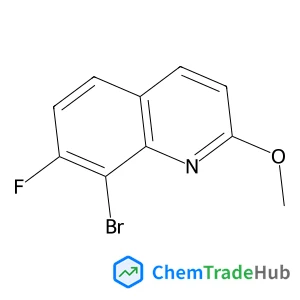
![1,10-bis(3,5-dimethylphenyl)-12-hydroxy-4,5,6,7-tetrahydroiindeno[7,1-de:1',7'-fg][1,3,2]dioxaphosphocine 12-oxide structure](https://cnstatic.chemtradehub.com/structs/141/1412439-82-7-b9a9.webp "1,10-bis(3,5-dimethylphenyl)-12-hydroxy-4,5,6,7-tetrahydroiindeno[7,1-de:1',7'-fg][1,3,2]dioxaphosphocine 12-oxide structure")
推荐供应商




免责声明
本页面提供的学术期刊信息仅供参考和研究使用。我们与任何期刊出版商均无关联,也不处理投稿事宜。如有投稿相关咨询,请直接联系相关期刊出版商。
如发现页面信息有误,请发送邮件至 support@chemtradehub.com 联系我们。我们将及时核实并处理您的问题。