




The co-reactant role during plasma enhanced atomic layer deposition of palladium
文献信息
发布日期
2020-04-07
DOI
10.1039/D0CP00786B
影响因子
3.676
作者
Ji-Yu Feng, Matthias M. Minjauw, Ranjith K. Ramachandran, Michiel Van Daele, Hilde Poelman, Timo Sajavaara, Jolien Dendooven, Christophe Detavernier
查看原文
摘要
Atomic layer deposition (ALD) of noble metals is an attractive technology potentially applied in nanoelectronics and catalysis. Unlike the combustion-like mechanism shown by other noble metal ALD processes, the main palladium (Pd) ALD process using palladium(II)hexafluoroacetylacetonate [Pd(hfac)2] as precursor is based on true reducing surface chemistry. In this work, a thorough investigation of plasma-enhanced Pd ALD is carried out by employing this precursor with different plasmas (H2*, NH3*, O2*) and plasma sequences (H2* + O2*, O2* + H2*) as co-reactants at varying temperatures, providing insights in the co-reactant and temperature dependence of the Pd growth per cycle (GPC). At all temperatures, films grown with only reducing co-reactants contain a large amount of carbon, while an additional O2* in the co-reactant sequence helps to obtain Pd films with much lower impurity concentrations. Remarkably, in situ XRD and SEM show an abrupt release of the carbon impurities during annealing at moderate temperatures in different atmospheres. In vacuo XPS measurements reveal the remaining species on the as-deposited surface after every exposure. Links are established between the particular surface termination prior to the precursor pulse and the observed differences in GPC, highlighting hydrogen as the key growth facilitator and carbon and oxygen as growth inhibitors. The increase in GPC with temperature for ALD sequences with H2* or NH3* prior to the precursor pulse is explained by an increase in the amount of hydrogen species that reside on the Pd surface which are available for reaction with the Pd(hfac)2 precursor.
相关文献
Swelling properties of thermoresponsive/hydrophilic co-networks with functional crosslinked domain structures
Shohei Ida, Hironobu Kitanaka, Tatsuya Ishikawa, Shokyoku Kanaoka, Yoshitsugu Hirokawa
2018-01-03
Paper
DOI: 10.1039/C7PY01793F
Hyperbranched polysiloxane with highly constrained rings and the effect of the attached arms on the assembly behavior
Chunyan Wu, Chunhua Hu, Yuzhou Liu
2017-10-06
Communication
DOI: 10.1039/C7PY01177F
Renewable polyols for advanced polyurethane foams from diverse biomass resources
Pierre Furtwengler, Luc Avérous
2018-07-24
Review Article
DOI: 10.1039/C8PY00827B
Squalene/polyethylenimine based non-viral vectors: synthesis and use in systems for sustained gene release
Geta David, Lilia Clima, Manuela Calin, Cristina Ana Constantinescu, Mihaela Balan-Porcarasu
2018-01-25
Paper
DOI: 10.1039/C7PY01720K
In situ synthesis of diblock copolymer nano-assemblies via dispersion RAFT polymerization induced self-assembly and Ag/copolymer composite nanoparticles thereof
Mengting Tan, Yan Shi, Zhifeng Fu, Wantai Yang
2018-02-05
Paper
DOI: 10.1039/C7PY01905J
Polyallene-based amphiphilic triblock copolymer via successive free radical polymerization and ATRP
Hao Guo, Xiaoyu Huang
2017-11-27
Paper
DOI: 10.1039/C7PY01407D
Visible light-induced iniferter polymerization of methacrylates enhanced by continuous flow
Maarten Rubens, Phanumat Latsrisaeng
2017-08-16
Paper
DOI: 10.1039/C7PY01157A
您可能还喜欢
化合物问答
如何储存1,2-环己二酮环乙缩醛(CAS号:4746-96-7)?
1,2-环己二酮环乙缩醛应储存在阴凉、干燥、通风良好的地方,避免阳光直射。建议使用密封容器保存,并保持环境温度在室温范围内,远离火源和热源。
4746-96-71,4-Dioxaspiro[4.5]d...
化合物问答
Ecopladib(CAS号:381683-92-7)的市场或研究趋势如何?
Ecopladib作为一种新型的药物,主要应用于治疗高胆固醇等疾病。目前,市场和研究趋势显示,Ecopladib因其独特的药理作用而受到关注。随着对心血管疾病治...
381683-92-7Ecopladib
化合物问答
2,3-Dimethyl-3H-imidazo[4,5-c]pyridine(CAS号:52538-09-7)通常如何合成?
2,3-二甲基-3H-咪唑[4,5-c]吡啶通常通过咪唑和2,3-二甲基吡啶的缩合反应合成。具体来说,将咪唑和2,3-二甲基吡啶在适当的溶剂中进行加热或加压反应...
52538-09-72,3-Dimethyl-3H-imid...
化合物问答
2,3,4,5-tetrahydro-1H-3-苯并氮杂环;盐酸盐(CAS号:17379-01-0)的市场或研究趋势如何?
该化合物在药物化学和有机合成中有一定的应用。近年来,随着对新型药物化合物的需求增加,该化合物的研究趋势主要集中在探索其生物活性,尤其是其在神经系统疾病治疗中的潜...
17379-01-02,3,4,5-Tetrahydro-1...
68-90-6(2-Ethyl-1-benzofura...
化合物问答
如何储存盐酸甘氨酸丁酯(CAS号:13048-99-2)?
盐酸甘氨酸丁酯应储存在阴凉、干燥、通风良好的地方,避免阳光直射和高温环境,温度应控制在25℃以下。储存容器应密封,避免与空气中的水分和酸性物质接触,以防发生水解...
13048-99-2Butyl glycinate hydr...
化合物问答
什么是2-Iodo-N,N-dimethylbenzamide(CAS号:54616-46-5)?
2-碘-N,N-二甲基苯胺是一种有机化合物,化学名为2-Iodo-N,N-dimethylbenzamide。其分子式为C<sub>9</sub>H<sub>1...
54616-46-52-Iodo-N,N-dimethylb...
16817-90-6N-Cyclohexylglycinam...
化合物问答
5-溴-2-(4H-1,2,4-三唑-4-基)吡啶(CAS号:959240-99-4)的市场或研究趋势如何?
随着医药、农药和新材料领域的发展,该化合物作为关键中间体的应用日益增多。特别是在药物合成中,由于其独特的化学性质,可以用于合成多种药物分子。未来的研究趋势可能集...
959240-99-45-Bromo-2-(4H-1,2,4-...
化合物问答
2,4-二溴-6-三氟甲基嘧啶(CAS号:785778-00-9)通常如何合成?
2,4-二溴-6-三氟甲基嘧啶通常通过溴化反应合成。首先,将6-三氟甲基嘧啶与溴化剂(如液溴)在适当的溶剂(如二氯甲烷、四氢呋喃)中反应,加入适当的催化剂(如四...
785778-00-92,4-Dibromo-6-(trifl...
来源期刊
Physical Chemistry Chemical Physics

CiteScore:
5.5
自引率:
10.3%
年发文量:
3036
Physical Chemistry Chemical Physics (PCCP) is an international journal co-owned by 19 physical chemistry and physics societies from around the world. This journal publishes original, cutting-edge research in physical chemistry, chemical physics and biophysical chemistry. To be suitable for publication in PCCP, articles must include significant innovation and/or insight into physical chemistry; this is the most important criterion that reviewers and Editors will judge against when evaluating submissions. The journal has a broad scope and welcomes contributions spanning experiment, theory, computation and data science. Topical coverage includes spectroscopy, dynamics, kinetics, statistical mechanics, thermodynamics, electrochemistry, catalysis, surface science, quantum mechanics, quantum computing and machine learning. Interdisciplinary research areas such as polymers and soft matter, materials, nanoscience, energy, surfaces/interfaces, and biophysical chemistry are welcomed if they demonstrate significant innovation and/or insight into physical chemistry. Joined experimental/theoretical studies are particularly appreciated when complementary and based on up-to-date approaches.
推荐化合物
![1-[(4-Methylphenyl)sulfonyl]-3-(4,4,5,5-tetramethyl-1,3,2-dioxaborolan-2-yl)-1H-pyrrolo[2,3-b]pyridine-5-carbonitrile structure](https://cnstatic.chemtradehub.com/structs/143/1434747-57-5-fc0d.webp "1-[(4-Methylphenyl)sulfonyl]-3-(4,4,5,5-tetramethyl-1,3,2-dioxaborolan-2-yl)-1H-pyrrolo[2,3-b]pyridine-5-carbonitrile structure")
![N-[2-(4-Hydroxyphenoxy)-4-nitrophenyl]methanesulfonamide structure](https://cnstatic.chemtradehub.com/structs/109/109032-22-6-7c88.webp "N-[2-(4-Hydroxyphenoxy)-4-nitrophenyl]methanesulfonamide structure")
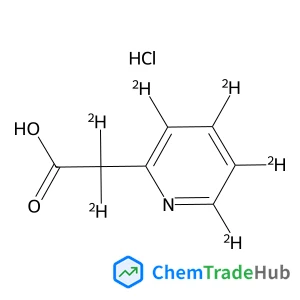
2,2-dideuterio-2-(3,4,5,6-tetradeuterio-2-pyridyl)acetic acid;hydrochloride
CAS号:
1329799-67-8
分子式:
C7H2ClD6NO2
推荐供应商





免责声明
本页面提供的学术期刊信息仅供参考和研究使用。我们与任何期刊出版商均无关联,也不处理投稿事宜。如有投稿相关咨询,请直接联系相关期刊出版商。
如发现页面信息有误,请发送邮件至 support@chemtradehub.com 联系我们。我们将及时核实并处理您的问题。