






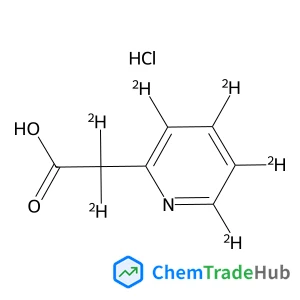
2,2-dideuterio-2-(3,4,5,6-tetradeuterio-2-pyridyl)acetic acid;hydrochloride
CAS号:
1329799-67-8
分子式:
C7H2ClD6NO2
Sourav Karmakar, Srihari Keshavamurthy
Intramolecular vibrational energy redistribution (IVR) impacts the dynamics of reactions in a profound way. Theoretical and experimental studies are increasingly indicating that accounting for the finite rate of energy flow is critical for uncovering the correct reaction mechanisms and calculating accurate rates. This requires an explicit understanding of the influence and interplay of the various anharmonic (Fermi) resonances that lead to the coupling of the vibrational modes. In this regard, the local random matrix theory (LRMT) and the related Bose-statistics triangle rule (BSTR) model have emerged as powerful and predictive quantum theories for IVR. In this Perspective we highlight the close correspondence between LRMT and the classical phase space perspective on IVR, primarily using model Hamiltonians with three degrees of freedom. Our purpose for this is threefold. First, this clearly brings out the extent to which IVR pathways are essentially classical, and hence crucial towards attempts to control IVR. Second, given that LRMT and BSTR are designed to be applicable for large molecules, the exquisite correspondence observed even for small molecules allows for insights into the quantum ergodicity transition. Third, we showcase the power of modern nonlinear dynamics methods in analysing high dimensional phase spaces, thereby extending the deep insights into IVR that were earlier gained for systems with effectively two degrees of freedom. We begin with a brief overview of recent examples where IVR plays an important role and conclude by mentioning the outstanding problems and the potential connections to issues of interest in other fields.
Stephen J. Cowling, John W. Goodby
DOI: 10.1039/B610154B
Alois Fürstner, Jacques-Alexis Funel, Martin Tremblay, Laure C. Bouchez, Cristina Nevado, Mario Waser, Jens Ackerstaff, Christopher C. Stimson
DOI: 10.1039/B805299A
Naoki Ousaka, Norihiko Tani, Ryo Sekiya
DOI: 10.1039/B803080D
Xia Meng, Guang-Rong Tang, Guo-Xin Jin
DOI: 10.1039/B803382J
Sang-Wook Woo, Keiji Sasajima, Takashi Takei
DOI: 10.1039/B607196A
Hidekazu Oyamada, Ryo Akiyama, Hiroyuki Hagio, Takeshi Naito, Shū Kobayashi
DOI: 10.1039/B610241G
Cédric R. Mayer, Eddy Dumas, Aude Michel, Francis Sécheresse
DOI: 10.1039/B610631E
Jiangying Qu, Zongbin Zhao, Jieshan Qiu, Yury Gogotsi
DOI: 10.1039/B805622F
Juta Kobayashi, Yuichiro Mori, Shū Kobayashi
DOI: 10.1039/B609335C
Dattatraya H. Dethe, David Y.-K. Chen
DOI: 10.1039/B805069B
1,2-环己二酮环乙缩醛应储存在阴凉、干燥、通风良好的地方,避免阳光直射。建议使用密封容器保存,并保持环境温度在室温范围内,远离火源和热源。
Ecopladib作为一种新型的药物,主要应用于治疗高胆固醇等疾病。目前,市场和研究趋势显示,Ecopladib因其独特的药理作用而受到关注。随着对心血管疾病治...
2,3-二甲基-3H-咪唑[4,5-c]吡啶通常通过咪唑和2,3-二甲基吡啶的缩合反应合成。具体来说,将咪唑和2,3-二甲基吡啶在适当的溶剂中进行加热或加压反应...
该化合物在药物化学和有机合成中有一定的应用。近年来,随着对新型药物化合物的需求增加,该化合物的研究趋势主要集中在探索其生物活性,尤其是其在神经系统疾病治疗中的潜...
盐酸甘氨酸丁酯应储存在阴凉、干燥、通风良好的地方,避免阳光直射和高温环境,温度应控制在25℃以下。储存容器应密封,避免与空气中的水分和酸性物质接触,以防发生水解...
2-碘-N,N-二甲基苯胺是一种有机化合物,化学名为2-Iodo-N,N-dimethylbenzamide。其分子式为C<sub>9</sub>H<sub>1...
随着医药、农药和新材料领域的发展,该化合物作为关键中间体的应用日益增多。特别是在药物合成中,由于其独特的化学性质,可以用于合成多种药物分子。未来的研究趋势可能集...
2,4-二溴-6-三氟甲基嘧啶通常通过溴化反应合成。首先,将6-三氟甲基嘧啶与溴化剂(如液溴)在适当的溶剂(如二氯甲烷、四氢呋喃)中反应,加入适当的催化剂(如四...

Physical Chemistry Chemical Physics (PCCP) is an international journal co-owned by 19 physical chemistry and physics societies from around the world. This journal publishes original, cutting-edge research in physical chemistry, chemical physics and biophysical chemistry. To be suitable for publication in PCCP, articles must include significant innovation and/or insight into physical chemistry; this is the most important criterion that reviewers and Editors will judge against when evaluating submissions. The journal has a broad scope and welcomes contributions spanning experiment, theory, computation and data science. Topical coverage includes spectroscopy, dynamics, kinetics, statistical mechanics, thermodynamics, electrochemistry, catalysis, surface science, quantum mechanics, quantum computing and machine learning. Interdisciplinary research areas such as polymers and soft matter, materials, nanoscience, energy, surfaces/interfaces, and biophysical chemistry are welcomed if they demonstrate significant innovation and/or insight into physical chemistry. Joined experimental/theoretical studies are particularly appreciated when complementary and based on up-to-date approaches.
![(3R,5R)-1-[(Benzyloxy)carbonyl]-5-methyl-3-piperidinecarboxylic acid structure](https://cnstatic.chemtradehub.com/structs/126/1269757-29-0-c552.webp "(3R,5R)-1-[(Benzyloxy)carbonyl]-5-methyl-3-piperidinecarboxylic acid structure")