







![1-(1-Benzyl-1,2,3,6-tetrahydropyridin-4-yl)-1H-benzo[d]imidazol-2(3H)-one structure](https://cnstatic.chemtradehub.com/structs/603/60373-71-9-7dfb.webp "1-(1-Benzyl-1,2,3,6-tetrahydropyridin-4-yl)-1H-benzo[d]imidazol-2(3H)-one structure")
Transition anionic complex in trihexyl(tetradecyl)phosphonium-bis(oxalato)borate ionic liquid – revisited
文献信息
发布日期
2021-02-09
DOI
10.1039/D0CP05845A
影响因子
3.676
作者
Manishkumar R. Shimpi, Patrick Rohlmann, Faiz Ullah Shah
查看原文
摘要
It was found that Li[BOB]·nH2O salts were not readily suitable for the synthesis of high-purity orthoborate-based tetraalkylphosphonium ionic liquids, as exemplified here for trihexyl(tetradecyl)phosphonium bis(oxalato)borate, [P6,6,6,14][BOB]; along with [BOB]−, a metastable transition anionic complex (TAC) of dihydroxy(oxalato)borate with oxalic acid, [B(C2O4)(OH)2·(HOOC–COOH)]−, was also formed and passed into the ionic liquid in the course of the metathesis reaction with trihexyl(tetradecyl)phosphonium chloride. On the contrary, Na[BOB] was found to be a more suitable reagent for the synthesis of this IL, because [BOB]− anions safely passed into the final IL without hydrolysis, when metathesis reactions were performed using aqueous-free media. Since ultra-pure Na[BOB] is not commercially available, in this work, a preparation protocol for ultra-pure (>99%) Na[BOB] was developed: (i) molar ratios of boric and oxalic acids were optimised to minimise boron-containing impurities, (ii) the Na[BOB] product was thoroughly purified by sequential washing of a fine powder product in hot acetonitrile and ethanol and (iii) characterised using powder X-ray diffraction and solid-state 11B MAS NMR spectroscopy. The physico-chemical properties of the prepared boron-impurity-free IL, i.e., its density, viscosity, electric conductivity, glass-transition temperature and thermal stability, were found to be significantly different from those of the previously reported [P6,6,6,14][BOB], containing ca. 45 mol% of TAC, [B(C2O4)(OH)2·(HOOC–COOH)]−. It was found that a high-purity [P6,6,6,14][BOB] prepared in this work has a considerably lower viscosity, a higher viscosity index and a wider electro-chemical window (ECW) compared to those of the sample of [P6,6,6,14][BOB] with ca. 45 mol% of TAC. Interestingly, [B(C2O4)(OH)2·(HOOC–COOH)]− in the latter sample almost completely transformed into [BOB]− anions upon heating of the IL sample at 413 K for 1 hour, as confirmed using both 11B and 13C NMR. Therefore, in this work, apart from a well-optimised synthetic protocol for boron-impurity-free [P6,6,6,14][BOB], implications of boron-containing transition anionic complexes in tetraalkylphosphonium-orthoborate ILs used in different applications were highlighted.
相关文献
Graphene oxide–Li+@C60 donor–acceptor composites for photoenergy conversion
Mustafa Supur, Yuki Kawashima, Kei Ohkubo, Hayato Sakai, Taku Hasobe
2015-05-13
Paper
DOI: 10.1039/C5CP01403D
Nanoscale crosslinking in thermoset polymers: a molecular dynamics study
Jingtian Kang, Changguo Wang, Defeng Li, Ge He, Huifeng Tan
2015-05-27
Paper
DOI: 10.1039/C5CP01984B
A new two-dimensional metal–organic framework with high spin-filtering efficiency
Bikash Mandal, Pranab Sarkar
2015-06-08
Paper
DOI: 10.1039/C5CP01359C
An electrochemical investigation of rutile TiO2 microspheres anchored by nanoneedle clusters for sodium storage
Yan Zhang, Xuli Pu, Yingchang Yang, Yirong Zhu, Hongshuai Hou, Mingjun Jing, Xuming Yang, Jun Chen, Xiaobo Ji
2015-05-08
Paper
DOI: 10.1039/C5CP01227A
Membrane adhesion and the formation of heterogeneities: biology, biophysics, and biotechnology
V. D. Gordon, T. J. O'Halloran, O. Shindell
2015-03-27
Perspective
DOI: 10.1039/C4CP05876C
Strong electronic polarization of the C60 fullerene by imidazolium-based ionic liquids: accurate insights from Born–Oppenheimer molecular dynamic simulations
Vitaly V. Chaban, Eudes Eterno Fileti
2015-05-13
Paper
DOI: 10.1039/C5CP00350D
Direct measurement of DNA-mediated adhesion between lipid bilayers
S. F. Shimobayashi, B. M. Mognetti, L. Parolini, D. Orsi, P. Cicuta, L. Di Michele
2015-05-12
Paper
DOI: 10.1039/C5CP01340B
Electrochemical growth of CoNi and Pt–CoNi soft magnetic composites on an alkanethiol monolayer-modified ITO substrate
D. Escalera-López, E. Gómez, E. Vallés
2015-05-27
Paper
DOI: 10.1039/C5CP02291F
Temperature-dependent energy levels and size-independent thermodynamics
2015-05-18
Communication
DOI: 10.1039/C5CP02332G
您可能还喜欢
化合物问答
什么是2-氨基戊烷(CAS号:63493-28-7)?
2-氨基戊烷,又名pentan-2-amine,是一种有机化合物,分子式为C5H11NH2。它是一种无色透明液体,有氨味。该化合物在工业和研究中有一定的应用。
63493-28-7pentan-2-amine
化合物问答
反式-4-[4-[[[5-[(3,4-二氟苯基)氨基]-1,3,4-恶二唑-2-基]羰基]氨基]苯基]环己烷乙酸(CAS号:892489-52-0)的物理化学性质是什么?
该化合物为白色固体,分子量为552.31 g/mol。它在水中溶解度较低,在有机溶剂如乙腈、乙酸乙酯中有较好的溶解性。该化合物具有较高的化学稳定性,对酸和碱具有...
892489-52-0Trans-4-[4-[[[5-[(3,...
化合物问答
如何处理含有Pyrotinib dimaleate(CAS号:1397922-61-0)的废料?
处理含有Pyrotinib dimaleate 的废料时,应遵循当地的法规要求。首先,收集废料并进行分类,确保没有与其他化学品混合。然后,采取适当的物理和化学处...
1397922-61-0(2E)-N-(4-{[3-Chloro...
化合物问答
在合成中是否有4-(5-5-乙基-1,2,4-噁二唑-3-基)苯甲酸乙酯(CAS号:1166756-79-1)的替代品?
在合成过程中,可以考虑使用其他结构类似的化合物作为替代品,例如苯甲酸酯类化合物,如2-乙基-5-甲基噁二唑基苯甲酸乙酯等。这些替代品可能具有相似的化学性质,但在...
1166756-79-1Ethyl 4-(5-ethyl-1,2...
化合物问答
如何处理含有1-((叔丁氧基羰基)氨基)环丁烷甲酸甲酯(CAS号:880166-10-9)的废料?
处理含有该化合物的废液时,应先确保其完全反应并转化为无害物质。对于未反应的化合物,建议采用中和处理后进行蒸馏回收,剩余物可使用化学氧化法或焚烧法进行无害化处理。...
880166-10-9Methyl 1-({[(2-methy...
化合物问答
2-({[3,5-二(三氟甲基)苯基]磺酰基}氨基)-4-(甲基硫代)丁酸甲酯(CAS号:175202-21-8)的市场或研究趋势如何?
目前该化合物主要应用于药物合成领域,尤其在开发新型抗癌药物方面具有潜在应用。随着制药行业的持续发展,对于高效、低毒的合成中间体需求增加,预计该化合物的研究和应用...
175202-21-8Methyl N-{[3,5-bis(t...
化合物问答
N,N-乙烯双(碘乙酰胺)(CAS号:7250-43-3)的物理化学性质是什么?
N,N-乙烯双(碘乙酰胺)是一种白色或类白色固体,易溶于乙醇、丙酮等有机溶剂,但在水中溶解度较低。该化合物具有较高的反应活性,可以与其他含有活性氢的化合物发生酰...
7250-43-3N,N'-1,2-Ethanediylb...
化合物问答
7-Fluoro-1H-spiro[furo[3,4-c]pyridine-3,4'-piperidine](CAS号:1283090-73-2)通常如何合成?
该化合物可以通过环合反应合成,首先合成吡啶和哌啶的衍生物,然后在合适的条件下进行环合反应得到目标化合物。常用的催化剂包括某些金属盐类,产率一般在70%-90%之...
1283090-73-27-Fluoro-1H-spiro[fu...
化合物问答
处理3-乙酰滇乌碱(CAS号:80787-51-5)时应注意哪些实验室安全事项?
在处理3-乙酰滇乌碱时,应穿戴适当的个人防护装备(PPE),如实验服、手套(丁腈手套或PVC手套)、护目镜和口罩。实验应在通风橱中进行,以减少吸入或皮肤接触的风...
80787-51-54-Methylaconitane-1,...
化合物问答
如何储存2-溴-5-硝基-4-羧酸(CAS号:1053655-82-5)?
2-溴-5-硝基-4-羧酸应存放在阴凉、干燥、通风良好的地方,远离火源和热源。避免与还原剂、碱性物质接触。储存容器应密封,防止吸湿。
1053655-82-52-Bromo-5-nitropyrid...
来源期刊
Physical Chemistry Chemical Physics

CiteScore:
5.5
自引率:
10.3%
年发文量:
3036
Physical Chemistry Chemical Physics (PCCP) is an international journal co-owned by 19 physical chemistry and physics societies from around the world. This journal publishes original, cutting-edge research in physical chemistry, chemical physics and biophysical chemistry. To be suitable for publication in PCCP, articles must include significant innovation and/or insight into physical chemistry; this is the most important criterion that reviewers and Editors will judge against when evaluating submissions. The journal has a broad scope and welcomes contributions spanning experiment, theory, computation and data science. Topical coverage includes spectroscopy, dynamics, kinetics, statistical mechanics, thermodynamics, electrochemistry, catalysis, surface science, quantum mechanics, quantum computing and machine learning. Interdisciplinary research areas such as polymers and soft matter, materials, nanoscience, energy, surfaces/interfaces, and biophysical chemistry are welcomed if they demonstrate significant innovation and/or insight into physical chemistry. Joined experimental/theoretical studies are particularly appreciated when complementary and based on up-to-date approaches.
推荐化合物
![N-{15-[(2,5-Dioxo-1-pyrrolidinyl)oxy]-15-oxo-3,6,9,12-tetraoxapentadec-1-yl}-2-(2-propyn-1-yloxy)acetamide structure](https://cnstatic.chemtradehub.com/structs/210/2101206-92-0-2eb5.webp "N-{15-[(2,5-Dioxo-1-pyrrolidinyl)oxy]-15-oxo-3,6,9,12-tetraoxapentadec-1-yl}-2-(2-propyn-1-yloxy)acetamide structure")
![1-[6-(1H-Imidazol-1-yl)-3-pyridinyl]methanamine structure](https://cnstatic.chemtradehub.com/structs/914/914637-08-4-8825.webp "1-[6-(1H-Imidazol-1-yl)-3-pyridinyl]methanamine structure")
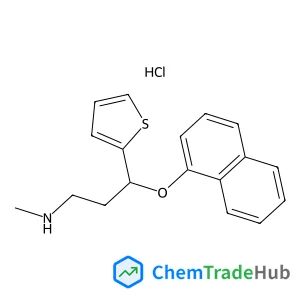
N-Methyl-3-(1-naphthyloxy)-3-(2-thienyl)-1-propanamine hydrochloride (1:1)
CAS号:
1188266-11-6
分子式:
C18H20ClNOS
推荐供应商


免责声明
本页面提供的学术期刊信息仅供参考和研究使用。我们与任何期刊出版商均无关联,也不处理投稿事宜。如有投稿相关咨询,请直接联系相关期刊出版商。
如发现页面信息有误,请发送邮件至 support@chemtradehub.com 联系我们。我们将及时核实并处理您的问题。